Polypodiaceae
Polypodiaceae is a family of ferns. In the Pteridophyte Phylogeny Group classification of 2016, the family includes around 65 genera and an estimated 1,650 species and is placed in the order Polypodiales, suborder Polypodiineae. A broader circumscription has also been used, in which the family includes other families kept separate in PPG I. Nearly all species are epiphytes, but some are terrestrial.

Uncredited · CC BY-SA 3.0 · via Wikipedia/Commons. May be a photograph of a specimen, or an artist’s reconstruction — an interpretation of a skeleton, since colour and soft tissue are almost never preserved.
On record
Recorded, not inferred- Sits inside
- PolypodiopsidaPBDB
- Diet
- "photoautotroph"PBDB, for Streptophyta
Time the record covers
At least 387 million years on record.
The record covers at least 387.95 Mya to 11.7 ka. No occurrence read is dated outside 393.47 Mya to 0 Mya.
2,013 occurrences of Polypodiaceae on record, most of them in the Eocene. The Paleobiology Database records this as a living group. Bar height is expected occurrences, not a count: each fossil is spread across the span it is dated to, so a tall narrow bar means tight dating and a low wide one means loose.
When
2,013 occurrences- Devonianunder 1%
- Carboniferous20%
- Permian3%
- Early Triassicunder 1%
- Middle Triassicunder 1%
- Late Triassic8%
- Early Jurassic5%
- Middle Jurassic2%
- Late Jurassic3%
- Early Cretaceous4%
- Late Cretaceous11%
- Paleocene10%
- Eocene22%
- Oligocene1%
- Miocene3%
- Plioceneunder 1%
- Pleistocene5%
- Holoceneunder 1%
These are dates about fossils, not the animal: the record can only begin after it arose and end before it died out, so either end may reach further. Shares are expected occurrences: a fossil dated to a span is counted partly in each period it straddles. More on what this infers.
Found in
347 formations
- Yaw Formation190
- Fort Union Formation118
- Carbondale Formation · Kewanee Group63
- Spoon Formation · Kewanee Group37
- Wasatch Formation28
- Lost Branch Formation26
Loading coastlines…
The named rock units Polypodiaceae has been recovered from, largest first. Drawn where the rock is now, not where it formed. 323 further formations hold fewer occurrences each and are not listed. 644 occurrences have no formation on record, which is common for older literature.
Polypodiaceae and its relatives
EoceneWhere Polypodiaceae and its relatives were recorded in the Eocene.
Found in the same rock
1,168 taxa- Laevigatosporites99 sites
- Lycospora74 sites
- Punctatisporites71 sites
- Florinites61 sites
- Calamospora60 sites
- Laevigatosporites vulgaris50 sites
- Punctatosporites49 sites
- Thymospora49 sites
- Triquitrites49 sites
- Granulatisporites47 sites
- Endosporites41 sites
- Cyclogranisporites36 sites
- Laevigatosporites tibuensis36 sites
- Wilsonites vesicatus36 sites
- Potonieisporites34 sites
- Mauritiidites franciscoi franciscoi33 sites
- Raistrickia33 sites
- Vesicaspora32 sites
- Clathropteris31 sites
- Granasporites medius31 sites
- Verrucosisporites31 sites
- Monocolpopollenites ovatus30 sites
- Cirratriradites29 sites
- Spinosporites29 sites
The Paleobiology Database records 1,253 sites for Polypodiaceae, and this reads 240 of them. The number is how many of those sites it was catalogued from too. The 24 sharing the most are listed.
This is not a list of everything alive at the time. It is only what has come out of the same ground as this animal and been written down.
Entered from
319 references- A proto-monsoonal climate in the late Eocene of Southeast Asia: evidence from a sedimentary record in central Myanmar190
- Distribution of pollen and spores in a subsurface marine Wilcox (Paleocene-Eocene) section in southwest Louisiana116
- Palynological Correlation of major Pennsylvanian (Middle and Upper Carboniferous) chronostratigraphic boundaries in the Illinois and other coal basins115
- A drowned lycopsid forest above the Mahoning Coal (Conemaugh Group, Upper Pennsylvanian) in eastern Ohio, U.S.A104
- Correlation and Palynology of Coals in the Carbondale and Spoon Formations (Pennsylvanian) of the Northeastern Part of the Illinois Basin100
- Palynological data from the Fort Union and Wasatch formations, Powder River basin, Wyoming and Montana83
- A Catalogue of Indian Fossil Plants60
- Biostratigraphy of selected K/T boundary sections in southwestern North Dakota, USA: toward a refinement of palynological identification criteria48
- Middle Paleogene palynology of Central Colombia, South America: A study of pollen and spores from tropical latitudes39
- Palynology of the Lost Branch Formation of Kansas--new insights on the major floral transition at the Middle-Upper Pennsylvanian boundary38
- Palinología del entorno cretácico/paleógeno del SO de la provincia de Santa Cruz: significado estratigráfico y paleoambiental35
- A complete pollen record of the last 230 ka from Lynch's Crater, north-eastern Australia30
Each of the 2,013 occurrences read was entered from one of these publications, ordered by how many each accounts for. This is not a search for papers mentioning the name. 307 further references are not listed. Entries link to doi.org where the Paleobiology Database holds an identifier, and to its own record where it does not. Relayed as the Paleobiology Database holds them, not checked against what they resolve to.
Media and terms
Media content1
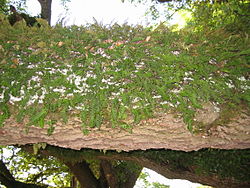
Picture of Polypodiaceae
- Source
- Wikipedia/Commons
- Credit
- nobody named on the record
- Licence
- CC BY-SA 3.0
- Commercial use
- the licence allows it
No 3D scan of Polypodiaceae was found in Sketchfab.
Smithsonian Open Access and MorphoSource were not reached for this taxon, so this list is what the others held rather than everything there is.
The description on this site
- Licence
- CC BY-SA 4.0
This is what the site found, which is not the same as what exists.
Keep going
What may have been alongside itPolypodiopsida through timeFormations of the EoceneThe world it lived on
Occurrence data from the Paleobiology Database, CC BY 4.0. (Presl and Presl 1822)