Polydolopimorphia
Polydolopimorphia is an extinct order of metatherians, closely related to extant marsupials. Known from the Paleocene-Pliocene of South America and the Eocene of Antarctica, they were a diverse group during the Paleogene, filling many niches, before declining and becoming extinct at the end of the Neogene. It is divided into two suborders, Bonapartheriiformes, and Polydolopiformes Most members are only known from jaw fragments, which have their characteristically generally bunodont teeth. The morphology of their teeth has led to proposals that polydolopimorphians may be crown group marsupials, nested within Australidelphia, though this proposal, has been questioned, with other analyses finding them outside of crown-group Marsupialia. The monophyly of the group has been questioned, due to the possibility of the characteristic bunodont teeth emerging convergently in unrelated groups, rather than reflecting a true phylogenetic relationship. The group contained omnivorous, frugivorous and herbivorous forms.

Nobu Tamura (nobu.tamura@yahoo.com) · CC BY-SA 4.0 · via Wikipedia/Commons. May be a photograph of a specimen, or an artist’s reconstruction — an interpretation of a skeleton, since colour and soft tissue are almost never preserved.
On record
Recorded, not inferred- Sits inside
- MarsupialiformesPBDB
- Diet
- omnivorePBDB, for Metatheria
- Life habit
- scansorialPBDB, for Theria
- Motility
- actively mobilePBDB, for Osteichthyes
- Environment
- terrestrialPBDB, for Mammalia
Time the record covers
At least 71 million years on record.
The record covers at least 72.2 Mya to 400 ka. No occurrence read is dated outside 83.6 Mya to 11.7 ka.
248 occurrences of Polydolopimorphia on record, most of them in the Eocene. Bar height is expected occurrences, not a count: each fossil is spread across the span it is dated to, so a tall narrow bar means tight dating and a low wide one means loose.
When
248 occurrences- Late Cretaceous13%
- Paleocene3%
- Eocene54%
- Oligocene15%
- Miocene7%
- Pliocene7%
- Pleistocene1%
These are dates about fossils, not the animal: the record can only begin after it arose and end before it died out, so either end may reach further. Shares are expected occurrences: a fossil dated to a span is counted partly in each period it straddles. More on what this infers.
Found in
44 formations
- Sarmiento Formation55
- Hell Creek Formation · Montana Group21
- Pozo Formation21
- La Meseta Formation17
- Andesitas Huancache Formation8
- Las Flores Formation · Río Chico Group7
Loading coastlines…
The named rock units Polydolopimorphia has been recovered from, largest first. Drawn where the rock is now, not where it formed. 20 further formations hold fewer occurrences each and are not listed. 40 occurrences have no formation on record, which is common for older literature.
Polydolopimorphia and its relatives
EoceneWhere Polydolopimorphia and its relatives were recorded in the Eocene.
Found in the same rock
1,482 taxa- Glasbius twitchelli19 sites
- Meniscoessus robustus18 sites
- Cimolodon nitidus17 sites
- Mammalia15 sites
- Didelphodon vorax14 sites
- Pediomys elegans14 sites
- Polydolops thomasi14 sites
- Testudines14 sites
- Ceratopsidae12 sites
- Mesodma thompsoni12 sites
- Protolambda hatcheri12 sites
- Trionychidae12 sites
- Archaeopithecus rogeri11 sites
- Aves11 sites
- Gypsonictops illuminatus11 sites
- Protolambda florencae11 sites
- Anura10 sites
- Gypsonictops hypoconus10 sites
- Lepisosteus occidentalis10 sites
- Leptalestes krejcii10 sites
- Lonchidion selachos10 sites
- Notoungulata10 sites
- Paronychodon10 sites
- Serrasalminae indet.10 sites
The Paleobiology Database records 126 sites for Polydolopimorphia, and this reads all of them. The number is how many of those sites it was catalogued from too. The 24 sharing the most are listed.
This is not a list of everything alive at the time. It is only what has come out of the same ground as this animal and been written down.
Entered from
90 references- Systematics of the extinct South American marsupial family Polydolopidae22
- Middle Tertiary marsupials from central Patagonia (early Oligocene of Gran Barranca): understanding South America's Grande Coupure17
- Interrelationships of Polydolopidae (Mammalia: Marsupialia) from South America and Antarctica14
- Biotic community and landscape changes around the Eocene–Oligocene transition at Shapaja, Peruvian Amazonia: Regional or global drivers?9
- A 60-million-year Cenozoic history of western Amazonian ecosystems in Contamana, eastern Peru9
- The beginning of the age of mammals in South America. Part I9
- A study of Mammalia and geology across the Cretaceous-Tertiary boundary in Garfield County, Montana8
- Biostratigraphy of the Casamayoran, Early Eocene of Patagonia7
- Notices préliminaires sur des mammifères nouveaux des terrains Crétacé de Patagonie {preliminary notes on new mammals from the Cretaceous terrains of Patagonia]7
- New Early Eocene mammalian fauna from western Patagonia, Argentina6
- The Bug Creek problem and the Cretaceous-Tertiary transition at McGuire Creek, Montana6
- A reassessment of Antarctic polydolopid marsupials (Middle Eocene, La Meseta Formation)5
Each of the 248 occurrences read was entered from one of these publications, ordered by how many each accounts for. This is not a search for papers mentioning the name. 78 further references are not listed. Entries link to doi.org where the Paleobiology Database holds an identifier, and to its own record where it does not. Relayed as the Paleobiology Database holds them, not checked against what they resolve to.
Media and terms
Media content1
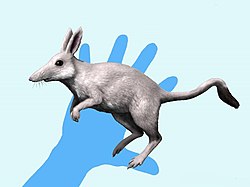
Picture of Polydolopimorphia
- Source
- Wikipedia/Commons
- Credit
- Nobu Tamura (nobu.tamura@yahoo.com)
- Licence
- CC BY-SA 4.0
- Commercial use
- the licence allows it
No 3D scan of Polydolopimorphia was found in MorphoSource and Sketchfab.
Smithsonian Open Access was not reached for this taxon, so this list is what the others held rather than everything there is.
The description on this site
- Licence
- CC BY-SA 4.0
This is what the site found, which is not the same as what exists.
Keep going
What may have been alongside itMarsupialiformes through timeFormations of the EoceneThe world it lived on
Occurrence data from the Paleobiology Database, CC BY 4.0. (Archer 1984)