Plateosaurus gracilis

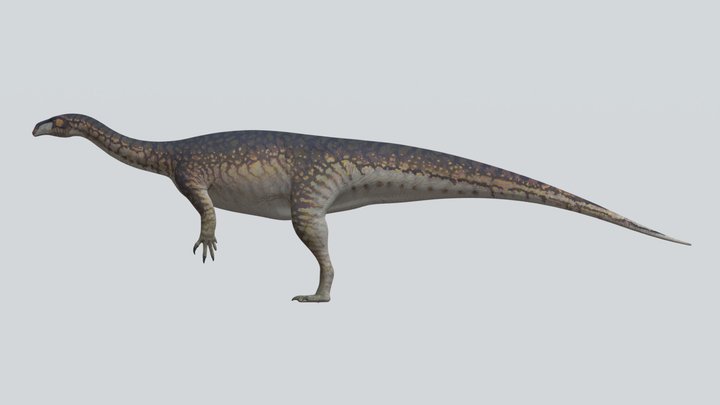
Nobu Tamura ( http://spinops.blogspot.com ) Arms and other edits made by User:FunkMonk · CC BY 2.5 · via Wikidata/Commons. May be a photograph of a specimen, or an artist’s reconstruction — an interpretation of a skeleton, since colour and soft tissue are almost never preserved.
On record
Recorded, not inferred- Sits inside
- PlateosaurusPBDB
- Diet
- herbivorePBDB, for Plateosaurus
- Motility
- actively mobilePBDB, for Osteichthyes
- Environment
- terrestrialPBDB, for Diapsida
Time the record covers
At most 22 million years on record.
Every occurrence read is dated to somewhere between 227.3 Mya and 205.7 Mya, and nothing in the dating separates them, so that window is what the record shows rather than a span.
5 occurrences of Plateosaurus gracilis on record, most of them in the Late Triassic. Bar height is expected occurrences, not a count: each fossil is spread across the span it is dated to, so a tall narrow bar means tight dating and a low wide one means loose.
When
5 occurrences- Late Triassic100%
These are dates about fossils, not the animal: the record can only begin after it arose and end before it died out, so either end may reach further. Shares are expected occurrences: a fossil dated to a span is counted partly in each period it straddles. More on what this infers.
Found in
1 formation
- Löwenstein Formation · Keuper Group5
Loading coastlines…
The named rock units Plateosaurus gracilis has been recovered from, largest first. Drawn where the rock is now, not where it formed.
Plateosaurus gracilis and its relatives
Late TriassicWhere Plateosaurus gracilis and its relatives were recorded in the Late Triassic.
Found in the same rock
19 taxa- Nicrosaurus meyeri2 sites
- Aetosaurus ferratus1 site
- Apatosuchus orbitoangulatus1 site
- Cyclotosaurus posthumus1 site
- Efraasia minor1 site
- Gerrothorax pulcherrimus1 site
- Mystriosuchus1 site
- Mystriosuchus westphali1 site
- Nicrosaurus1 site
- Nicrosaurus kapffi1 site
- Paratypothorax andressorum1 site
- Procompsognathus triassicus1 site
- Proganochelys quenstedtii1 site
- Saltoposuchus connectens1 site
- Saltoposuchus longipes1 site
- Suchia1 site
- Tanystropheus1 site
- Teratosaurus suevicus1 site
- Theropoda1 site
The Paleobiology Database records 4 sites for Plateosaurus gracilis, and this reads all of them. The number is how many of those sites it was catalogued from too.
This is not a list of everything alive at the time. It is only what has come out of the same ground as this animal and been written down.
Entered from
4 references- Prosauropod dinosaur Sellosaurus gracilis (Upper Triassic, Germany): third sacral vertebra as either a dorsosacral or a caudosacral2
- The species taxonomy of the sauropodomorph dinosaurs from the Löwenstein Formation (Norian, Late Triassic) of Germany1
- Cranial anatomy of the prosauropod dinosaur Sellosaurus gracilis from the Middle Stubensandstein (Upper Triassic) of Nordwürttemberg, West Germany1
- Trias-Dinosaurier Europas [European Triassic dinosaurs]1
Each of the 5 occurrences read was entered from one of these publications, ordered by how many each accounts for. This is not a search for papers mentioning the name. Entries link to doi.org where the Paleobiology Database holds an identifier, and to its own record where it does not. Relayed as the Paleobiology Database holds them, not checked against what they resolve to.
Media and terms
Media content2
Picture of Plateosaurus gracilis
- Source
- Wikidata/Commons
- Credit
- Nobu Tamura ( http://spinops.blogspot.com ) Arms and other edits made by User:FunkMonk
- Licence
- CC BY 2.5
- Commercial use
- the licence allows it
Smithsonian Open Access was not reached for this taxon, so this list is what the others held rather than everything there is.
This is what the site found, which is not the same as what exists.
Keep going
What may have been alongside itPlateosaurus through timeFormations of the Late TriassicThe world it lived on
Occurrence data from the Paleobiology Database, CC BY 4.0. (Huene 1905)