Oviraptor
Oviraptor is a genus of oviraptorid dinosaur that lived in Asia during the Late Cretaceous period. The first remains were collected from the Djadokhta Formation of Mongolia in 1923 during a paleontological expedition led by Roy Chapman Andrews, and in the following year the genus and type species Oviraptor philoceratops were named by Henry Fairfield Osborn. The genus name refers to the initial thought of egg-stealing habits, and the specific name was intended to reinforce this view indicating a preference over ceratopsian eggs. Despite the fact that numerous specimens have been referred to the genus, Oviraptor is only known from a single partial skeleton regarded as the holotype, as well as a nest of about fifteen eggs and several small fragments from a juvenile.

Internet Archive Book Images · Public Domain · via Wikipedia/Commons. May be a photograph of a specimen, or an artist’s reconstruction — an interpretation of a skeleton, since colour and soft tissue are almost never preserved.
On record
Recorded, not inferred- Sits inside
- OviraptoridaePBDB
- Diet
- omnivorePBDB
- Life habit
- ground dwelling, solitaryPBDB
- Motility
- actively mobilePBDB
- Environment
- terrestrialPBDB
- Length
- 2 mWikidata
Time the record covers
At most 18 million years on record.
Every occurrence read is dated to somewhere between 89.8 Mya and 72.2 Mya, and nothing in the dating separates them, so that window is what the record shows rather than a span.
3 occurrences of Oviraptor on record, most of them in the Late Cretaceous. Bar height is expected occurrences, not a count: each fossil is spread across the span it is dated to, so a tall narrow bar means tight dating and a low wide one means loose.
When
3 occurrences- Late Cretaceous100%
These are dates about fossils, not the animal: the record can only begin after it arose and end before it died out, so either end may reach further. Shares are expected occurrences: a fossil dated to a span is counted partly in each period it straddles. More on what this infers.
Found in
2 formations
Loading coastlines…
The named rock units Oviraptor has been recovered from, largest first. Drawn where the rock is now, not where it formed.
Oviraptor and its relatives
Late CretaceousWhere Oviraptor and its relatives were recorded in the Late Cretaceous.
Found in the same rock
49 taxa- Protoceratops andrewsi2 sites
- Velociraptor mongoliensis2 sites
- Abelisauridae1 site
- Alectrosaurus1 site
- Ankylosauridae1 site
- Archaeornithomimus asiaticus1 site
- Bactrosaurus1 site
- Ceratopsia1 site
- Conicodontosaurus djadochtaensis1 site
- Deltatheridium pretrituberculare1 site
- Deltatheroides cretacicus1 site
- Djadochtatherium matthewi1 site
- Elongatoolithidae1 site
- Elongatoolithus1 site
- Elongatoolithus subtitectorius1 site
- Gilmoreteius ferrugenous1 site
- Gobipteryx1 site
- Gobivenator mongoliensis1 site
- Hadrosauridae1 site
- Hydotherium dobsoni1 site
- Isodontosaurus gracilis1 site
- Jaxartosaurus aralensis1 site
- Lacertilia1 site
- Lepidosauria1 site
The Paleobiology Database records 3 sites for Oviraptor, and this reads all of them. The number is how many of those sites it was catalogued from too. The 24 sharing the most are listed.
This is not a list of everything alive at the time. It is only what has come out of the same ground as this animal and been written down.
Entered from
3 references- Transformation of the pectoral girdle in pennaraptorans: critical steps in the formation of the modern avian shoulder joint1
- Some results of the studies of the Upper Cretaceous dinosaurian fauna from the vicinity of the station Sary-Agach, South Kazakhstan1
- Three new Theropoda, Protoceratops zone, central Mongolia1
Each of the 3 occurrences read was entered from one of these publications, ordered by how many each accounts for. This is not a search for papers mentioning the name. Entries link to doi.org where the Paleobiology Database holds an identifier, and to its own record where it does not. Relayed as the Paleobiology Database holds them, not checked against what they resolve to.
Media and terms
Media content2

Picture of Oviraptor
- Source
- Wikipedia/Commons
- Credit
- Internet Archive Book Images
- Licence
- Public Domain
- Commercial use
- the licence allows it
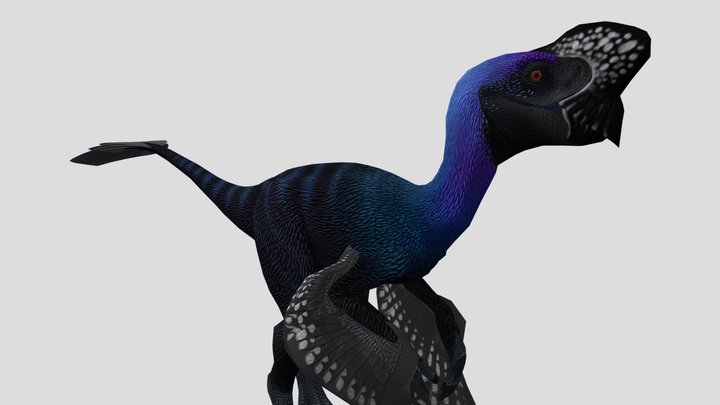
3D model
- Source
- Sketchfab
- Credit
- seth the yutyrannus
- Licence
- CC Attribution
- Commercial use
- cannot be read from the licence given — check the record
Smithsonian Open Access and MorphoSource were not reached for this taxon, so this list is what the others held rather than everything there is.
The description on this site
- Source
- Wikipedia, “Oviraptor”
- Licence
- CC BY-SA 4.0
This is what the site found, which is not the same as what exists.
Keep going
What may have been alongside itOviraptoridae through timeFormations of the Late CretaceousThe world it lived on
Occurrence data from the Paleobiology Database, CC BY 4.0. Osborn 1924