Otodus obliquus
Otodus obliquus is an extinct species of large mackerel shark that lived in Early Paleocene to Early Eocene, between 65 and 54 million years ago. It is considered one of first members of Otodus sharks and the type species of genus. It is considered the ancestor of the famous giant mackerel shark, Megalodon. The largest individuals would have measured 8–9 metres (26–30 ft) long.

Joanbanjo · CC BY-SA 4.0 · via Wikipedia/Commons. May be a photograph of a specimen, or an artist’s reconstruction — an interpretation of a skeleton, since colour and soft tissue are almost never preserved.
On record
Recorded, not inferred- Sits inside
- OtodusPBDB
- Diet
- carnivorePBDB, for Lamniformes
- Life habit
- nektonicPBDB, for Lamniformes
- Motility
- actively mobilePBDB, for Lamniformes
Time the record covers
At least 58 million years on record.
The record covers at least 72.2 Mya to 13.82 Mya. No occurrence read is dated outside 83.6 Mya to 0 Mya.
71 occurrences of Otodus obliquus on record, most of them in the Eocene. Bar height is expected occurrences, not a count: each fossil is spread across the span it is dated to, so a tall narrow bar means tight dating and a low wide one means loose.
When
71 occurrences- Late Cretaceous1%
- Paleocene37%
- Eocene58%
- Oligoceneunder 1%
- Miocene3%
- Plioceneunder 1%
- Pleistoceneunder 1%
These are dates about fossils, not the animal: the record can only begin after it arose and end before it died out, so either end may reach further. Shares are expected occurrences: a fossil dated to a span is counted partly in each period it straddles. More on what this infers.
Found in
25 formations
- London Clay Formation9
- Aquia Formation8
- Landana Formation7
- Tuffeau de St-Omer Formation3
- Calvert Formation · Chesapeake Group2
- Akzhar Formation2
Loading coastlines…
The named rock units Otodus obliquus has been recovered from, largest first. Drawn where the rock is now, not where it formed. One further formation holds fewer occurrences and is not listed. 19 occurrences have no formation on record, which is common for older literature.
Otodus obliquus and its relatives
EoceneWhere Otodus obliquus and its relatives were recorded in the Eocene.
Found in the same rock
841 taxa- Aetomylaeus dixoni22 sites
- Carcharias hopei19 sites
- Carcharias macrotus19 sites
- Odontaspis winkleri14 sites
- Palaeohypotodus rutoti14 sites
- Cretalamna appendiculata12 sites
- Pachygaleus lefevrei12 sites
- Striatolamia macrota12 sites
- Isurolamna inflata11 sites
- Squatina prima11 sites
- Anomotodon novus10 sites
- Striatolamia striata10 sites
- Physogaleus secundus9 sites
- Aetobatus irregularis8 sites
- Jaekelotodus robustus8 sites
- Otodus auriculatus8 sites
- Palaeogaleus vincenti8 sites
- Squalus minor8 sites
- Sylvestrilamia teretidens8 sites
- Abdounia beaugei7 sites
- Carcharias cuspidatus7 sites
- Odontaspis substriata7 sites
- Premontreia (Oxyscyllium) gilberti7 sites
- Brachycarcharias koerti6 sites
The Paleobiology Database records 66 sites for Otodus obliquus, and this reads all of them. The number is how many of those sites it was catalogued from too. The 24 sharing the most are listed.
This is not a list of everything alive at the time. It is only what has come out of the same ground as this animal and been written down.
Entered from
34 references- Les poissons fossiles du Bas-Congo et des régions voisines15
- Casier, 19668
- Contribution a l'etude des faunes ichthyologiques marines des terrains tertiaires de la plaine cotiere Atlantique et du centre des Etats-Unis7
- Les sélaciens des terrains néocrétacés and paléocènes de Belgique and des contrées limitrophes. Eléments d'une biostratigraphie intercontinentale4
- Les élasmobranches du Thanétien (Paléocène) du Nord de la France, des carrières de Templeuve et de Leforest3
- Pisces3
- Small vertebrates from the Late Cretaceous and Early Tertiary of the northeastern Aral Sea region, Kazakhstan2
- Contribution à l'étude des élasmobranches du Thanétien (Paléocène) du Bassin de Paris. 1. Découverte d'une faune d'elasmobranches dans la partie supérieure des Sables de Bracheux (Thanétien, Paléocène du Bassin de Paris) des régions de Compiègne (Oise) et de Montdidier (Somme)2
- Faunal Horizons of the Barton Beds in Hampshire2
- Chondrichthyans from the Tallahatta-Lisbon Formatino contact (Middle Eocene), Silas, Choctaw County, Alabama1
- Eocene (Lutetian) Shark-Rich Coastal Paleoenvironments of the Southern North Sea Basin in Europe: Biodiversity of the Marine Fu ̈rstenau Formation Including Early White and Megatooth Sharks1
- First prorastomid sirenian from Senegal (Western Africa) and the Old World origin of sea cows1
Each of the 71 occurrences read was entered from one of these publications, ordered by how many each accounts for. This is not a search for papers mentioning the name. 22 further references are not listed. Entries link to doi.org where the Paleobiology Database holds an identifier, and to its own record where it does not. Relayed as the Paleobiology Database holds them, not checked against what they resolve to.
Media and terms
Media content2

Picture of Otodus obliquus
- Source
- Wikipedia/Commons
- Credit
- Joanbanjo
- Licence
- CC BY-SA 4.0
- Commercial use
- the licence allows it
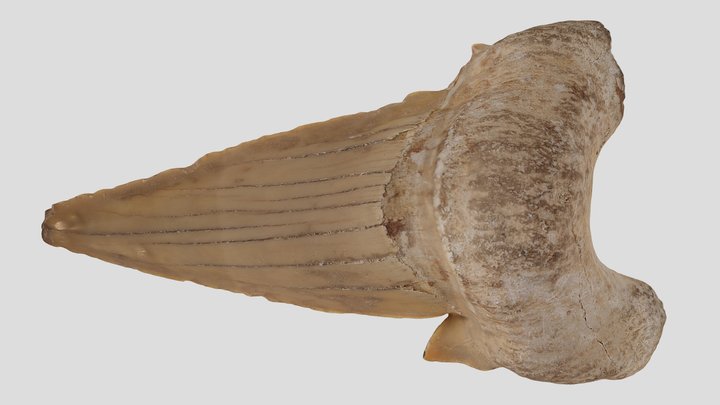
3D model
- Source
- Sketchfab
- Credit
- Yale Peabody Museum
- Licence
- CC Attribution
- Commercial use
- cannot be read from the licence given — check the record
Smithsonian Open Access and MorphoSource were not reached for this taxon, so this list is what the others held rather than everything there is.
The description on this site
- Licence
- CC BY-SA 4.0
This is what the site found, which is not the same as what exists.
Keep going
What may have been alongside itOtodus through timeFormations of the EoceneThe world it lived on
Occurrence data from the Paleobiology Database, CC BY 4.0. (Agassiz 1838)