Orthaspidoceras
Orthaspidoceras is an extinct ammonoid cephalopod genus belonging to the family Aspidoceratidae. These nektonic carnivores lived during the Jurassic period, Kimmeridgian age.

Hectonichus · CC BY-SA 3.0 · via Wikipedia/Commons. May be a photograph of a specimen, or an artist’s reconstruction — an interpretation of a skeleton, since colour and soft tissue are almost never preserved.
On record
Recorded, not inferred- Sits inside
- AspidoceratinaePBDB
- Diet
- carnivorePBDB, for Ammonoidea
- Life habit
- nektonicPBDB, for Ammonoidea
- Motility
- fast-movingPBDB, for Ammonoidea
- Vision
- well-developedPBDB, for Cephalopoda
- Environment
- marinePBDB, for Cephalopoda
Time the record covers
At most 19 million years on record.
Every occurrence read is dated to somewhere between 161.5 Mya and 143.1 Mya, and nothing in the dating separates them, so that window is what the record shows rather than a span.
21 occurrences of Orthaspidoceras on record, most of them in the Late Jurassic. Bar height is expected occurrences, not a count: each fossil is spread across the span it is dated to, so a tall narrow bar means tight dating and a low wide one means loose.
When
21 occurrences- Late Jurassic100%
These are dates about fossils, not the animal: the record can only begin after it arose and end before it died out, so either end may reach further. Shares are expected occurrences: a fossil dated to a span is counted partly in each period it straddles. More on what this infers.
Found in
5 formations
Loading coastlines…
The named rock units Orthaspidoceras has been recovered from, largest first. Drawn where the rock is now, not where it formed. 15 occurrences have no formation on record, which is common for older literature.
Orthaspidoceras and its relatives
Late JurassicWhere Orthaspidoceras and its relatives were recorded in the Late Jurassic.
Found in the same rock
67 taxa- Taramelliceras compsum5 sites
- Taramelliceras (Taramelliceras) compsum compsum4 sites
- Aspidoceras3 sites
- Aspidoceras sesquinodosum3 sites
- Glochiceras (Lingulaticeras) fialar3 sites
- Taramelliceras (Taramelliceras)3 sites
- Aspidoceras longispinum2 sites
- Creniceras dentatum2 sites
- Hybonoticeras2 sites
- Lithacoceras (Progeronia)2 sites
- Pachysphinctes major2 sites
- Streblites weinlandi2 sites
- Sutneria (Enosphinctes) eumela2 sites
- Sutneria (Enosphinctes) hoelderi2 sites
- Sutneria (Enosphinctes) zeissi2 sites
- Taramelliceras2 sites
- Taramelliceras (Taramelliceras) compsum bicostatum2 sites
- Taramelliceras (Taramelliceras) compsum franciscanus2 sites
- Taramelliceras (Taramelliceras) compsum kochi2 sites
- Aspidoceras acanthicum1 site
- Aulacosphinctoides1 site
- Calliphylloceras benacense1 site
- Ceratosphinctes rachistrophus1 site
- Dorsoplanites1 site
The Paleobiology Database records 15 sites for Orthaspidoceras, and this reads all of them. The number is how many of those sites it was catalogued from too. The 24 sharing the most are listed.
This is not a list of everything alive at the time. It is only what has come out of the same ground as this animal and been written down.
Entered from
10 references- Kimmeridgian-Lower Tithonian ammonite assemblages from Ghilcoş-Hăghimaş Massif (eastern Carpathians, Romania)10
- Revision of the Bivalvia from the Upper Jurassic Reuchenette Formation, Northwest Switzerland—Ostreoidea2
- The stratigraphy and palaeogeographic position of the Jurassic successions of the Priborzhavske-Perechin Zone in the Pieniny Klippen Belt of the Transcarpathian Ukraine2
- Ammonite assemblages in the Lower to Upper Kimmeridgian boundary interval (Cymodoce to Mutabilis zones) of Tatarstan (central European Russia) and their correlation importance1
- The Oppeliidae of the Acanthicum Zone (Upper Kimmeridgian) from Mount Crussol (Ardèche, France): ontogeny, variability and dimorphism of the genera Taramelliceras and Streblites (Ammonoidea)1
- Ceratosphinctes (Ammonitina, Kimmeridgian) in Mexico: from rare but typical inhabitant of west-Tethyan epioceanic and epicontinental waters to a geographically widespread ammonite genus1
- The Middle Jurassic-Lower Cretaceous Rosso Ammonitico succession of Monte Inici (Trapanese Domain, western Sicily): sedimentology, biostratigraphy and isotope stratigraphy1
- Ammonite Biostratigraphy and Correlations in the Upper Jurassic-Lowermost Cretaceous La Caja Formation of North-Central Mexico (Sierra de Catorce, San Luis de Potosí)1
- The Jurassic and Lower Cretaceous of Wadi Hajar, southern Yemen1
- Atlas des fossiles caractéristiques de Madagascar (ammonites) - Fascicule V (Kimmerigien)1
Each of the 21 occurrences read was entered from one of these publications, ordered by how many each accounts for. This is not a search for papers mentioning the name. Entries link to doi.org where the Paleobiology Database holds an identifier, and to its own record where it does not. Relayed as the Paleobiology Database holds them, not checked against what they resolve to.
Media and terms
Media content1
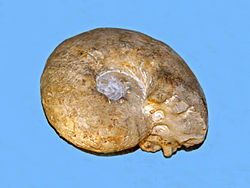
Picture of Orthaspidoceras
- Source
- Wikipedia/Commons
- Credit
- Hectonichus
- Licence
- CC BY-SA 3.0
- Commercial use
- the licence allows it
No 3D scan of Orthaspidoceras was found in Sketchfab.
Smithsonian Open Access and MorphoSource were not reached for this taxon, so this list is what the others held rather than everything there is.
The description on this site
- Licence
- CC BY-SA 4.0
This is what the site found, which is not the same as what exists.
Keep going
What may have been alongside itAspidoceratinae through timeFormations of the Late JurassicThe world it lived on
Occurrence data from the Paleobiology Database, CC BY 4.0.