Ophiura
Ophiura is a genus of echinoderms belonging to the family Ophiuridae.

Hans Hillewaert · CC BY-SA 4.0 · via Wikipedia/Commons. May be a photograph of a specimen, or an artist’s reconstruction — an interpretation of a skeleton, since colour and soft tissue are almost never preserved.
On record
Recorded, not inferred- Sits inside
- OphiuridaePBDB
- Diet
- detritivore, suspension feederPBDB, for Ophiuroidea
- Life habit
- low-level epifaunalPBDB, for Ophiuroidea
- Motility
- slow-movingPBDB, for Ophiuroidea
- Vision
- blindPBDB, for Ophiuroidea
- Environment
- marinePBDB, for Ophiuroidea
Time the record covers
At least 201 million years on record.
The record covers at least 201.4 Mya to 129 ka. No occurrence read is dated outside 205.7 Mya to 11.7 ka.
86 occurrences of Ophiura on record, most of them in the Late Cretaceous. The Paleobiology Database records this as a living group. Bar height is expected occurrences, not a count: each fossil is spread across the span it is dated to, so a tall narrow bar means tight dating and a low wide one means loose.
When
86 occurrences- Late Triassic2%
- Early Jurassic8%
- Middle Jurassic4%
- Late Jurassicunder 1%
- Early Cretaceous10%
- Late Cretaceous44%
- Paleocene3%
- Eocene15%
- Oligocene2%
- Miocene2%
- Pliocene1%
- Pleistocene8%
These are dates about fossils, not the animal: the record can only begin after it arose and end before it died out, so either end may reach further. Shares are expected occurrences: a fossil dated to a span is counted partly in each period it straddles. More on what this infers.
Found in
27 formations
- La Meseta Formation11
- Craie de Sens Formation4
- Maastricht Formation3
- Bìlà Hora Formation3
- Vincentown Formation2
- Denison Formation · Washita Group2
Loading coastlines…
The named rock units Ophiura has been recovered from, largest first. Drawn where the rock is now, not where it formed. 3 further formations hold fewer occurrences each and are not listed. 35 occurrences have no formation on record, which is common for older literature.
Ophiura and its relatives
Late CretaceousWhere Ophiura and its relatives were recorded in the Late Cretaceous.
Found in the same rock
1,078 taxa- Ophiocoma senonensis15 sites
- Ophioderma substriatum13 sites
- Stegophiura hagenowi12 sites
- Ophiomusium granulosum11 sites
- Ophiomusium10 sites
- Ophiosmilax alternatus9 sites
- Applinocrinus cretaceus8 sites
- Ophiacantha danica8 sites
- Sinosura brodiei8 sites
- Amphiura plana7 sites
- Trichaster ornatus7 sites
- Chomataster acules6 sites
- Ophiomyxa jekerica6 sites
- Gauthieria pseudoradiata5 sites
- Hemiaster5 sites
- Hemipneustes striatoradiatus5 sites
- Lophidiaster pygmaeus5 sites
- Mesophiomusium geisingense5 sites
- Ophiarachna liasica5 sites
- Ophiocoma rasmusseni5 sites
- Ophiocten seeweni5 sites
- Ophioderma radiatum5 sites
- Placometra laticirra5 sites
- Serpula5 sites
The Paleobiology Database records 81 sites for Ophiura, and this reads all of them. The number is how many of those sites it was catalogued from too. The 24 sharing the most are listed.
This is not a list of everything alive at the time. It is only what has come out of the same ground as this animal and been written down.
Entered from
40 references- Eocene stelleroids (Echinodermata) at Seymour Island, Antarctic Peninsula11
- Late Cretaceous-Early Paleocene echinoderms and the K/T boundary in the southeast Netherlands and the northeast Belgium. - part 3: Ophiuroids8
- Ophiuroid remains from the nearshore environments of the Bohemian Cretaceous basin (Cenomanian - Turonian boundary interval). A preliminary report.7
- Campanian-Maastrichtian ophiuroids (Echinodermata) from Tercis les Bains (Landes, France)6
- Echinodermata aus dem Ober-Toarcium und Aalenium Deutschlands II: Ophiuroidea4
- The Mesozoic and Cenozoic Echinodermata of the United States4
- Les Ophiures de la Craie des Environs de Sens4
- Albian Ophiuroids from Cerro de Cristo Rey, Dona Ana County, New Mexico3
- Contributions to the Quaternary geology of northern West Greenland especially the raised marine deposits3
- Late Turonian ophiuroids (Echinodermata) from the Bohemian Cretaceous Basin, Czech Republic2
- Gli ofiuroidi del Pleistocene di San Nicomede (PR)2
- The stratigraphy of the Atherfield Clay Formation (Lower Aptian, Lower Cretaceous) at the type and other localities in southern England2
Each of the 86 occurrences read was entered from one of these publications, ordered by how many each accounts for. This is not a search for papers mentioning the name. 28 further references are not listed. Entries link to doi.org where the Paleobiology Database holds an identifier, and to its own record where it does not. Relayed as the Paleobiology Database holds them, not checked against what they resolve to.
Media and terms
Media content2

Picture of Ophiura
- Source
- Wikipedia/Commons
- Credit
- Hans Hillewaert
- Licence
- CC BY-SA 4.0
- Commercial use
- the licence allows it
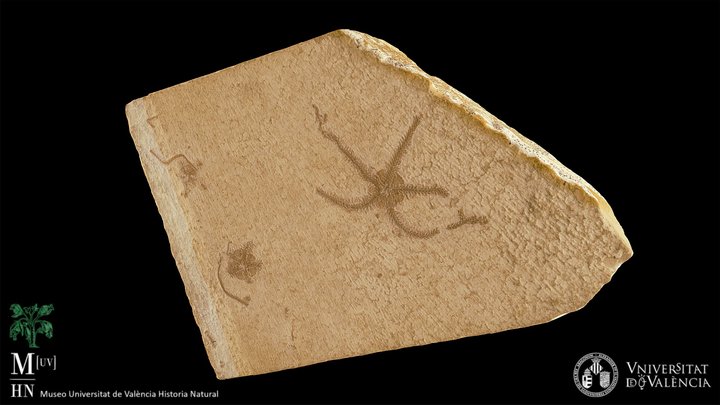
3D model
- Source
- Sketchfab
- Licence
- CC Attribution
- Commercial use
- cannot be read from the licence given — check the record
Smithsonian Open Access and MorphoSource were not reached for this taxon, so this list is what the others held rather than everything there is.
The description on this site
- Source
- Wikipedia, “Ophiura”
- Licence
- CC BY-SA 4.0
This is what the site found, which is not the same as what exists.
Keep going
What may have been alongside itOphiuridae through timeFormations of the Late CretaceousThe world it lived on
Occurrence data from the Paleobiology Database, CC BY 4.0. Lamarck 1801