Ophiacanthidae
Ophiacanthidae is a family of brittle stars. Axel Vilhelm Ljungman circumscribed this taxon in 1867; he initially named the subfamily Ophiacanthinae within the family Amphiuridae. Gordon L. J. Paterson promoted its rank to family in 1985.

NOAA Okeanos Explorer · Public Domain · via Wikipedia/Commons. May be a photograph of a specimen, or an artist’s reconstruction — an interpretation of a skeleton, since colour and soft tissue are almost never preserved.
On record
Recorded, not inferred- Sits inside
- OphiacanthinaPBDB
- Diet
- carnivorePBDB
- Life habit
- epifaunalPBDB
- Motility
- actively mobilePBDB
- Vision
- blindPBDB, for Ophiuroidea
- Environment
- marinePBDB, for Ophiuroidea
Time the record covers
At least 167 million years on record.
The record covers at least 233.6 Mya to 66 Mya. No occurrence read is dated outside 237 Mya to 61.66 Mya.
58 occurrences of Ophiacanthidae on record, most of them in the Late Cretaceous. The Paleobiology Database records this as a living group, and the chart stops with its fossils rather than at the present. Bar height is expected occurrences, not a count: each fossil is spread across the span it is dated to, so a tall narrow bar means tight dating and a low wide one means loose.
When
58 occurrences- Late Triassic9%
- Early Jurassic16%
- Middle Jurassic9%
- Late Jurassic17%
- Early Cretaceous9%
- Late Cretaceous39%
- Paleocene2%
These are dates about fossils, not the animal: the record can only begin after it arose and end before it died out, so either end may reach further. Shares are expected occurrences: a fossil dated to a span is counted partly in each period it straddles. More on what this infers.
Found in
17 formations
- White Chalk Formation5
- Gulpen Formation4
- Humeralis Schichten Formation2
- Maastricht Formation2
- Renggeri-Ton Formation2
- Nayband Formation2
Loading coastlines…
The named rock units Ophiacanthidae has been recovered from, largest first. Drawn where the rock is now, not where it formed. 30 occurrences have no formation on record, which is common for older literature.
Ophiacanthidae and its relatives
Late CretaceousWhere Ophiacanthidae and its relatives were recorded in the Late Cretaceous.
Found in the same rock
789 taxa- Ophiopetra oertlii11 sites
- Ophiacantha danica10 sites
- Ophiocoma senonensis10 sites
- Ophiura serrata10 sites
- Sinosura brodiei9 sites
- Amphiura plana8 sites
- Monoceratina8 sites
- Ophiomusium8 sites
- Ophiomusium granulosum8 sites
- Cytherella7 sites
- Goniasteridae7 sites
- Lenticulina7 sites
- Ophiacantha toarcensis7 sites
- Ophiosmilax alternatus7 sites
- Sinosura wolburgi7 sites
- Stegophiura hagenowi7 sites
- Dentalina6 sites
- Frondicularia6 sites
- Gauthieria pseudoradiata6 sites
- Isocrinus6 sites
- Mesophiomusium scabrum6 sites
- Nodosaria6 sites
- Ophiacantha6 sites
- Ophioderma substriatum6 sites
The Paleobiology Database records 41 sites for Ophiacanthidae, and this reads all of them. The number is how many of those sites it was catalogued from too. The 24 sharing the most are listed.
This is not a list of everything alive at the time. It is only what has come out of the same ground as this animal and been written down.
Entered from
26 references- Late Cretaceous-Early Paleocene echinoderms and the K/T boundary in the southeast Netherlands and the northeast Belgium. - part 3: Ophiuroids15
- Echinodermata aus dem Ober-Toarcium und Aalenium Deutschlands II: Ophiuroidea5
- Mikropaläontologische Untersuchungen an Ophiuren. V. Die Ophiuren aus dem Argovien (unteres Ober-Oxford) von Guldenthal (Kt. Solothurn) und von Savigna (Dépt. Jura)4
- Campanian-Maastrichtian ophiuroids (Echinodermata) from Tercis les Bains (Landes, France)3
- Mikropaläontologische Untersuchungen an Ophiuren. VII. Die Ophiuren aus den Humeralis-Schichten (Ober-Oxford) von Raedersdorf (Haut-Rhin)3
- Mikropaläontologische Untersuchungen an Ophiuren II. Die Ophiuren aus dem Lias (Pliensbachien-Toarcien) von Seewen (Kt. Solothurn)3
- Barremian ophiuroids from the Serre de Bleyton (Drôme, SE France)2
- Ophiuroid remains from the nearshore environments of the Bohemian Cretaceous basin (Cenomanian - Turonian boundary interval). A preliminary report.2
- Paleontological evidence for the Triassic age of rocks dredged from the northern Exmouth Plateau (Tethyan foraminifers, echinoderms, and ostracodes)2
- Beiträge zur Kenntnis der Trias von Persien. I - Revision der Triasgliederung, Rhätfazies in Raum von Isfaham und Kossener Fazieseinschlag bei Waliabad SE Abadeh2
- Mikropaläontologische Untersuchungen an Ophiuren. IV. Die Ophiuren aus dem Renggeri-Ton (Unter-Oxford) von Chapois (Jura) und Longecombe (Ain)2
- Exceptionally well-preserved brittle stars from the Pliensbachian (Early Jurassic) of the French Ardennes1
Each of the 58 occurrences read was entered from one of these publications, ordered by how many each accounts for. This is not a search for papers mentioning the name. 14 further references are not listed. Entries link to doi.org where the Paleobiology Database holds an identifier, and to its own record where it does not. Relayed as the Paleobiology Database holds them, not checked against what they resolve to.
Media and terms
Media content1
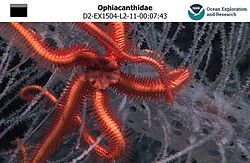
Picture of Ophiacanthidae
- Source
- Wikipedia/Commons
- Credit
- NOAA Okeanos Explorer
- Licence
- Public Domain
- Commercial use
- the licence allows it
No 3D scan of Ophiacanthidae was found in MorphoSource and Sketchfab.
Smithsonian Open Access was not reached for this taxon, so this list is what the others held rather than everything there is.
The description on this site
- Licence
- CC BY-SA 4.0
This is what the site found, which is not the same as what exists.
Keep going
What may have been alongside itOphiacanthina through timeFormations of the Late CretaceousThe world it lived on
Occurrence data from the Paleobiology Database, CC BY 4.0. Perrier 1893