Oliva (Oliva)
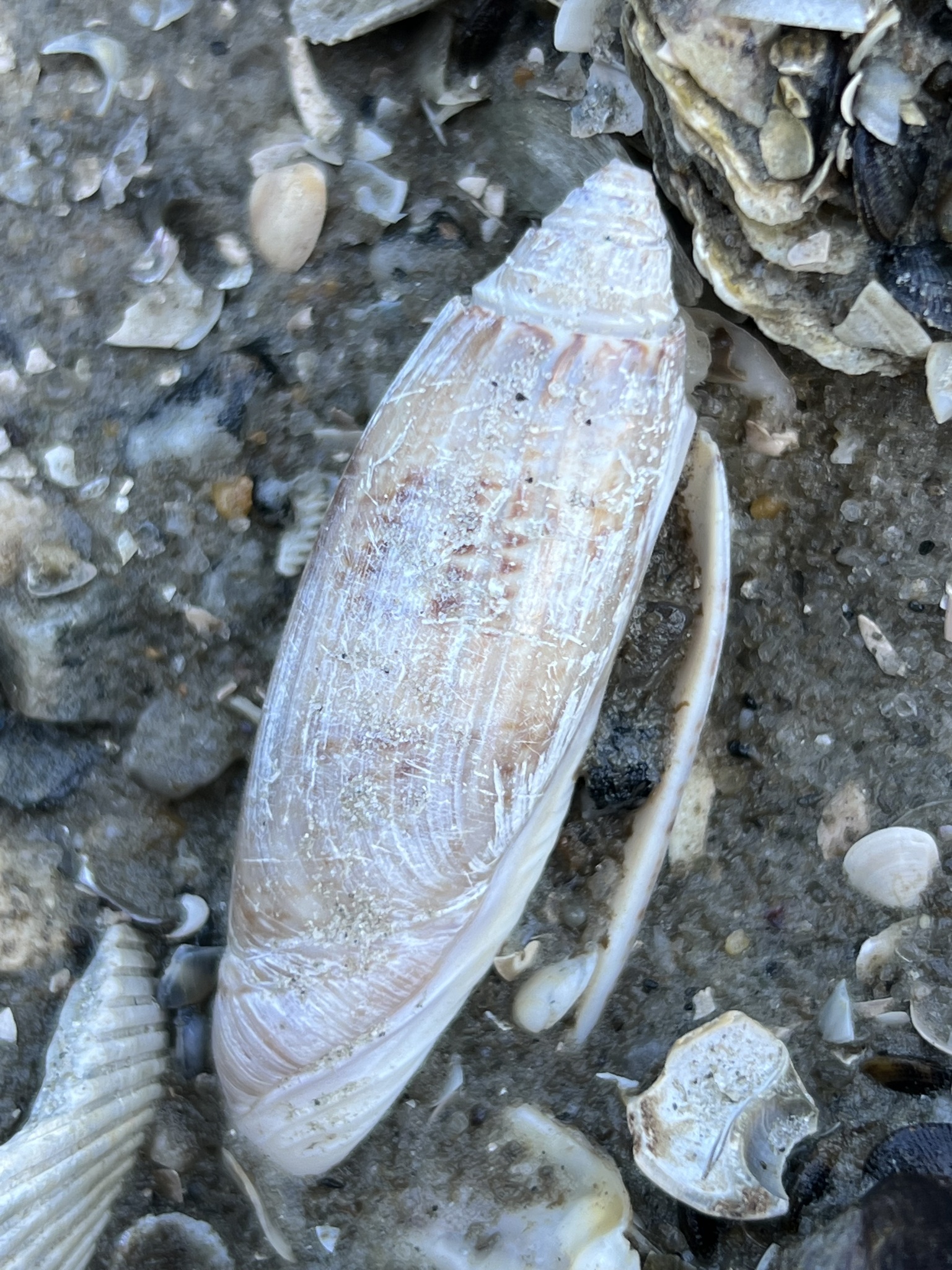
The Leach · CC BY-NC 4.0 · via GBIF. May be a photograph of a specimen, or an artist’s reconstruction — an interpretation of a skeleton, since colour and soft tissue are almost never preserved.
Time the record covers
At least 22 million years on record.
The record covers at least 23.04 Mya to 129 ka. No occurrence read is dated outside 33.9 Mya to 11.7 ka.
149 occurrences of Oliva (Oliva) on record, most of them in the Miocene. Bar height is expected occurrences, not a count: each fossil is spread across the span it is dated to, so a tall narrow bar means tight dating and a low wide one means loose.
When
149 occurrences- Oligocene3%
- Miocene64%
- Pliocene22%
- Pleistocene11%
These are dates about fossils, not the animal: the record can only begin after it arose and end before it died out, so either end may reach further. Shares are expected occurrences: a fossil dated to a span is counted partly in each period it straddles. More on what this infers.
Found in
41 formations
- Gatun Formation21
- Chipola Formation · Alum Bluff Group19
- Olcese Formation13
- Vaqueros Formation9
- Cayo Agua Formation · Bocas del Toro Group7
- Shoal River Formation · Alum Bluff Group7
Loading coastlines…
The named rock units Oliva (Oliva) has been recovered from, largest first. Drawn where the rock is now, not where it formed. 17 further formations hold fewer occurrences each and are not listed. 9 occurrences have no formation on record, which is common for older literature.
Oliva (Oliva) and its relatives
MioceneWhere Oliva (Oliva) and its relatives were recorded in the Miocene.
Found in the same rock
1,211 taxa- Conus14 sites
- Neverita (Glossaulax) andersoni13 sites
- Trophon (Austrotrophon) kernensis12 sites
- Crepidula rostralis11 sites
- Turritella ocoyana11 sites
- Bruclarkia barkeriana10 sites
- Conus chipolanus10 sites
- Conus sulculus10 sites
- Oliva (Omogymna) liodes10 sites
- Oliva (Omogymna) martensii10 sites
- Alabina (Caloosalba) boiplex9 sites
- Alabina (Caloosalba) turbatrix9 sites
- Antillophos posunculensis9 sites
- Conus gardnerae9 sites
- Conus isomatratus9 sites
- Ficus (Trophosycon) kerniana9 sites
- Hemicerithium cossmanni9 sites
- Megasurcula howei9 sites
- Polinices (Neverita) reclusianus andersoni9 sites
- Rhinoclavis (Ochetoclava) chipolana9 sites
- Alaba chipolana8 sites
- Cancellaria (Euclia) joaquinensis8 sites
- Conus demiurgus8 sites
- Molopophorus anglonanus8 sites
The Paleobiology Database records 62 sites for Oliva (Oliva), and this reads all of them. The number is how many of those sites it was catalogued from too. The 24 sharing the most are listed.
This is not a list of everything alive at the time. It is only what has come out of the same ground as this animal and been written down.
Entered from
33 references- A paleobiotic survey of Caribbean faunas from the Neogene of the Isthmus of Panama42
- Olivinae (Mollusca: Gastropoda) from the Alum Bluff Group of northwestern Florida21
- Unpublished notes on Caribbean collection of the Naturhistorisches Museum Basel15
- Miocene Gastropods and Biostratigraphy of the Kern River Area, California15
- The Vaqueros Formation, Lower Miocene of California. I. Paleontology9
- Unpublished census data from Atlantic coastal plain and circum-Caribbean Neogene assemblages and taxonomic opinions7
- Mollusca: Shoal River Formation (Middle Miocene4
- Skwarko, 19943
- Geology and paleontology of canal zone and adjoing parts of Panama: Description of Tertiary mollusks (gastropods: Columbellidae to Volutidae).3
- Unpublished notes on Caribbean collection of Jack and Winifred Gibson-Smith, Naturhistorisches Museum Basel2
- Age and stratigraphic significance for Lyellian correlation of the fauna of the Vigo Formation, Luzon, Phillipines2
- Geology and paleontology of canal zone and adjoing parts of Panama: Description of Tertiary mollusks (gastropods: Eulimidae, Marginellidae to Helminthoglyptidae).2
Each of the 149 occurrences read was entered from one of these publications, ordered by how many each accounts for. This is not a search for papers mentioning the name. 21 further references are not listed. Entries link to doi.org where the Paleobiology Database holds an identifier, and to its own record where it does not. Relayed as the Paleobiology Database holds them, not checked against what they resolve to.
Media and terms
Media content2
Picture of Oliva (Oliva)
- Source
- GBIF
- Credit
- The Leach
- Licence
- CC BY-NC 4.0
- Commercial use
- the licence does not allow it
Photogrammetry
- Source
- MorphoSource
- Licence
- not stated by the source
- Commercial use
- cannot be read from the licence given — check the record
- Specimen
- oliva sayana · MST:PALEO:MST-SP-2966
This is what the site found, which is not the same as what exists.
Keep going
What may have been alongside itFormations of the MioceneThe world it lived on
Occurrence data from the Paleobiology Database, CC BY 4.0.