Noasauridae
Noasauridae is an extinct family of theropod dinosaurs belonging to the group Ceratosauria. They were closely related to the short-armed abelisaurids, although most noasaurids had much more traditional body types generally similar to other theropods. Their heads, on the other hand, had unusual adaptations depending on the subfamily. 'Traditional' noasaurids, sometimes grouped in the subfamily Noasaurinae, had sharp teeth which splayed outwards from a downturned lower jaw.

Eduard Solà · CC BY-SA 3.0 · via Wikipedia/Commons. May be a photograph of a specimen, or an artist’s reconstruction — an interpretation of a skeleton, since colour and soft tissue are almost never preserved.
On record
Recorded, not inferred- Sits inside
- CeratosauriaPBDB
- Diet
- carnivorePBDB, for Theropoda
- Life habit
- ground dwelling, solitaryPBDB, for Theropoda
- Motility
- actively mobilePBDB, for Theropoda
- Environment
- terrestrialPBDB, for Theropoda
Time the record covers
At least 89 million years on record.
The record covers at least 161.5 Mya to 72.2 Mya. No occurrence read is dated outside 174.7 Mya to 66 Mya.
67 occurrences of Noasauridae on record, most of them in the Late Cretaceous. Bar height is expected occurrences, not a count: each fossil is spread across the span it is dated to, so a tall narrow bar means tight dating and a low wide one means loose.
When
67 occurrencesThese are dates about fossils, not the animal: the record can only begin after it arose and end before it died out, so either end may reach further. Shares are expected occurrences: a fossil dated to a span is counted partly in each period it straddles. More on what this infers.
Found in
22 formations
- Maevarano Formation29
- Lameta Formation6
- Baharîje Formation4
- Shishugou Formation3
- Tendaguru Formation2
- Bajo de la Carpa Formation · Neuquén Group2
Loading coastlines…
The named rock units Noasauridae has been recovered from, largest first. Drawn where the rock is now, not where it formed. 3 occurrences have no formation on record, which is common for older literature.
Noasauridae and its relatives
Late CretaceousWhere Noasauridae and its relatives were recorded in the Late Cretaceous.
Found in the same rock
288 taxa- Masiakasaurus knopfleri29 sites
- Theropoda13 sites
- Majungasaurus crenatissimus10 sites
- Sauropoda8 sites
- Simosuchus clarki7 sites
- Crocodyliformes6 sites
- Deltadromeus agilis5 sites
- Madtsoia madagascariensis5 sites
- Titanosauria5 sites
- Beelzebufo ampinga4 sites
- Mammalia4 sites
- Osteichthyes4 sites
- Titanosauridae4 sites
- Abelisauridae3 sites
- Anura3 sites
- Dinosauria3 sites
- Enantiornithes3 sites
- Limusaurus inextricabilis3 sites
- Ornithischia3 sites
- Plesiosauria3 sites
- Testudines3 sites
- Titanosauriformes3 sites
- Actinopterygii2 sites
- Aves2 sites
The Paleobiology Database records 61 sites for Noasauridae, and this reads all of them. The number is how many of those sites it was catalogued from too. The 24 sharing the most are listed.
This is not a list of everything alive at the time. It is only what has come out of the same ground as this animal and been written down.
Entered from
34 references- New materials of Masiakasaurus knopfleri Sampson, Carrano, and Forster, 2001, and implications for the morphology of the Noasauridae (Theropoda: Ceratosauria)24
- Predatory dinosaurs from the Sahara and Late Cretaceous faunal differentiation5
- Paleoenvironment and paleoecology of Majungasaurus crenatissimus (Theropoda: Abelisauridae) from the Late Cretaceous of Madagascar3
- The last ceratosaur of Asia: a new noasaurid from the Early Cretaceous Great Siberian Refugium2
- Noasaurids are a component of the Australian ‘mid’-cretaceous theropod fauna2
- Dinosaur death pits from the Jurassic of China2
- The Cretaceous Saurischia and Ornithischia of the Central Provinces of India2
- A new abelisauroid (Dinosauria: Theropoda) from the Huincul formation (lower upper Cretaceous, Neuquén Basin) of Patagonia, Argentina1
- A new desert-dwelling dinosaur (Theropoda, Noasaurinae) from the Cretaceous of south Brazil1
- Paleontological discoveries in the Chorrillo Formation (upper Campanian-lower Maastrichtian, Upper Cretaceous), Santa Cruz Province, Patagonia, Argentina1
- Osteology and bone microstructure of new, small theropod dinosaur material from the early Late Cretaceous of Morocco1
- New specimen of Velocisaurus unicus (Theropoda, Abelisauroidea) from the Paso Córdova locality (Santonian), Río Negro1
Each of the 67 occurrences read was entered from one of these publications, ordered by how many each accounts for. This is not a search for papers mentioning the name. 22 further references are not listed. Entries link to doi.org where the Paleobiology Database holds an identifier, and to its own record where it does not. Relayed as the Paleobiology Database holds them, not checked against what they resolve to.
Media and terms
Media content1
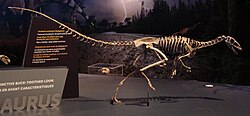
Picture of Noasauridae
- Source
- Wikipedia/Commons
- Credit
- Eduard Solà
- Licence
- CC BY-SA 3.0
- Commercial use
- the licence allows it
No 3D scan of Noasauridae was found in MorphoSource and Sketchfab.
Smithsonian Open Access was not reached for this taxon, so this list is what the others held rather than everything there is.
The description on this site
- Source
- Wikipedia, “Noasauridae”
- Licence
- CC BY-SA 4.0
This is what the site found, which is not the same as what exists.
Keep going
What may have been alongside itCeratosauria through timeFormations of the Late CretaceousThe world it lived on
Occurrence data from the Paleobiology Database, CC BY 4.0. Bonaparte and Powell 1980