Myrmeciinae
Myrmeciinae is a subfamily of the Formicidae, ants once found worldwide but now restricted to Australia and New Caledonia. This subfamily is one of several ant subfamilies which possess gamergates, female worker ants which are able to mate and reproduce, thus sustaining the colony after the loss of the queen. The Myrmeciinae subfamily was formerly composed of only one genus, Myrmecia, but the subfamily was redescribed by Ward & Brady in 2003 to include two tribes and four genera. An additional three genera, one form genus, and 9 species were described in 2006 from the Early Eocene of Denmark, Canada, and Washington. Subsequently an additional fossil genus was moved from the family Rhopalosomatidae in 2018, and a new genus was described in 2021.

Peter bertok at English Wikipedia · CC BY-SA 3.0 · via Wikipedia/Commons. May be a photograph of a specimen, or an artist’s reconstruction — an interpretation of a skeleton, since colour and soft tissue are almost never preserved.
On record
Recorded, not inferred- Also called
- bulldog antPBDB
- Sits inside
- MyrmeciomorphaPBDB
- Motility
- actively mobilePBDB, for Arthropoda
- Environment
- terrestrialPBDB, for Insecta
Time the record covers
At least 31 million years on record.
The record covers at least 59.24 Mya to 27.3 Mya. No occurrence read is dated outside 61.66 Mya to 23.04 Mya.
42 occurrences of Myrmeciinae on record, most of them in the Eocene. The Paleobiology Database records this as a living group, and the chart stops with its fossils rather than at the present. Bar height is expected occurrences, not a count: each fossil is spread across the span it is dated to, so a tall narrow bar means tight dating and a low wide one means loose.
When
42 occurrencesThese are dates about fossils, not the animal: the record can only begin after it arose and end before it died out, so either end may reach further. Shares are expected occurrences: a fossil dated to a span is counted partly in each period it straddles. More on what this infers.
Found in
7 formations
- Green River Formation8
- Klondike Mountain Formation3
- Ventana Formation2
- Ølst Formation2
- Messel Formation1
- Fur Formation1
Loading coastlines…
The named rock units Myrmeciinae has been recovered from, largest first. Drawn where the rock is now, not where it formed. 24 occurrences have no formation on record, which is common for older literature.
Myrmeciinae and its relatives
EoceneWhere Myrmeciinae and its relatives were recorded in the Eocene.
Found in the same rock
2,494 taxa- Archimyrmex rostratus8 sites
- Formicidae8 sites
- Gesomyrmex hoernesi8 sites
- Nylanderia pygmaea6 sites
- Prenolepis henschei6 sites
- Tetraponera simplex6 sites
- Yantaromyrmex geinitzi6 sites
- Aphaenogaster sommerfeldti5 sites
- Lasius schiefferdeckeri5 sites
- Plagiolepis kuenowi5 sites
- Prionomyrmex longiceps5 sites
- Tetraponera ocellata5 sites
- Braconidae4 sites
- Corynoptera klebsii4 sites
- Ctenobethylus goepperti4 sites
- Dinokanaga dowsonae4 sites
- Dolichoderus balticus4 sites
- Dolichoderus tertiarius4 sites
- Eocamponotus mengei4 sites
- Eotemnothorax gracilis4 sites
- Formica flori4 sites
- Formica phaethusa4 sites
- Ichneumonidae4 sites
- Leptosciarella (Leptosciarella) botuli4 sites
The Paleobiology Database records 32 sites for Myrmeciinae, and this reads all of them. The number is how many of those sites it was catalogued from too. The 24 sharing the most are listed.
This is not a list of everything alive at the time. It is only what has come out of the same ground as this animal and been written down.
Entered from
16 references- Bulldog Ants of the Eocene Okanagan Highlands and History of the Subfamily (Hymenoptera: Formicidae: Myrmeciinae)12
- Ants (Hymenoptera: Formicidae) of Formation Green River and some other middle Eocene deposits of North America7
- New finds of the fossil ant genus Prionomyrmex Mayr (Hymenoptera, Formicidae, Myrmeciinae) in Late Eocene European amber4
- Giant ants from the Paleogene of Denmark with a discussion of the fossil history and early evolution of ants (Hymenoptera: Formicidae)3
- Modernisation of the Hymenoptera: ants, bees, wasps, and sawflies of the early Eocene Okanagan Highlands of western North America2
- The ants (Hymenoptera: Formicidae) of Bol'shaya Svetlovodnaya (late Eocene of Sikhote-Alin, Russian far east)2
- New fossil ants of the subfamily Myrmeciinae (Hymenoptera, Formicidae) from Germany2
- Die Ameisen des baltischen Bernsteins2
- The oldest Cenozoic ant fossil: †Tyrannomecia gen. nov. (Formicidae: Myrmeciinae) from the Palaeocene Menat Formation (France)1
- First record of a female stylopid (Strepsiptera: ? Mymecolacidae) parasite of a prionomyrmecine ant (Hymenoptera: Formicidae) in Baltic amber1
- Rediscovery of the Baltic amber ant genus Prionomyrmex (Hymenoptera, Formicidae) and its taxonomic consequences1
- Two new species of aculeate hymenopterans (Vespida=Hymenoptera) from the Middle Eocene of the United States1
Each of the 42 occurrences read was entered from one of these publications, ordered by how many each accounts for. This is not a search for papers mentioning the name. 4 further references are not listed. Entries link to doi.org where the Paleobiology Database holds an identifier, and to its own record where it does not. Relayed as the Paleobiology Database holds them, not checked against what they resolve to.
Media and terms
Media content1
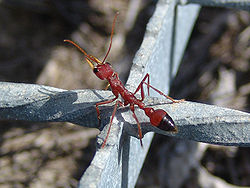
Picture of Myrmeciinae
- Source
- Wikipedia/Commons
- Credit
- Peter bertok at English Wikipedia
- Licence
- CC BY-SA 3.0
- Commercial use
- the licence allows it
No 3D scan of Myrmeciinae was found in Sketchfab.
Smithsonian Open Access and MorphoSource were not reached for this taxon, so this list is what the others held rather than everything there is.
The description on this site
- Source
- Wikipedia, “Myrmeciinae”
- Licence
- CC BY-SA 4.0
This is what the site found, which is not the same as what exists.
Keep going
What may have been alongside itMyrmeciomorpha through timeFormations of the EoceneThe world it lived on
Occurrence data from the Paleobiology Database, CC BY 4.0. Smith 1851