Mcewanella
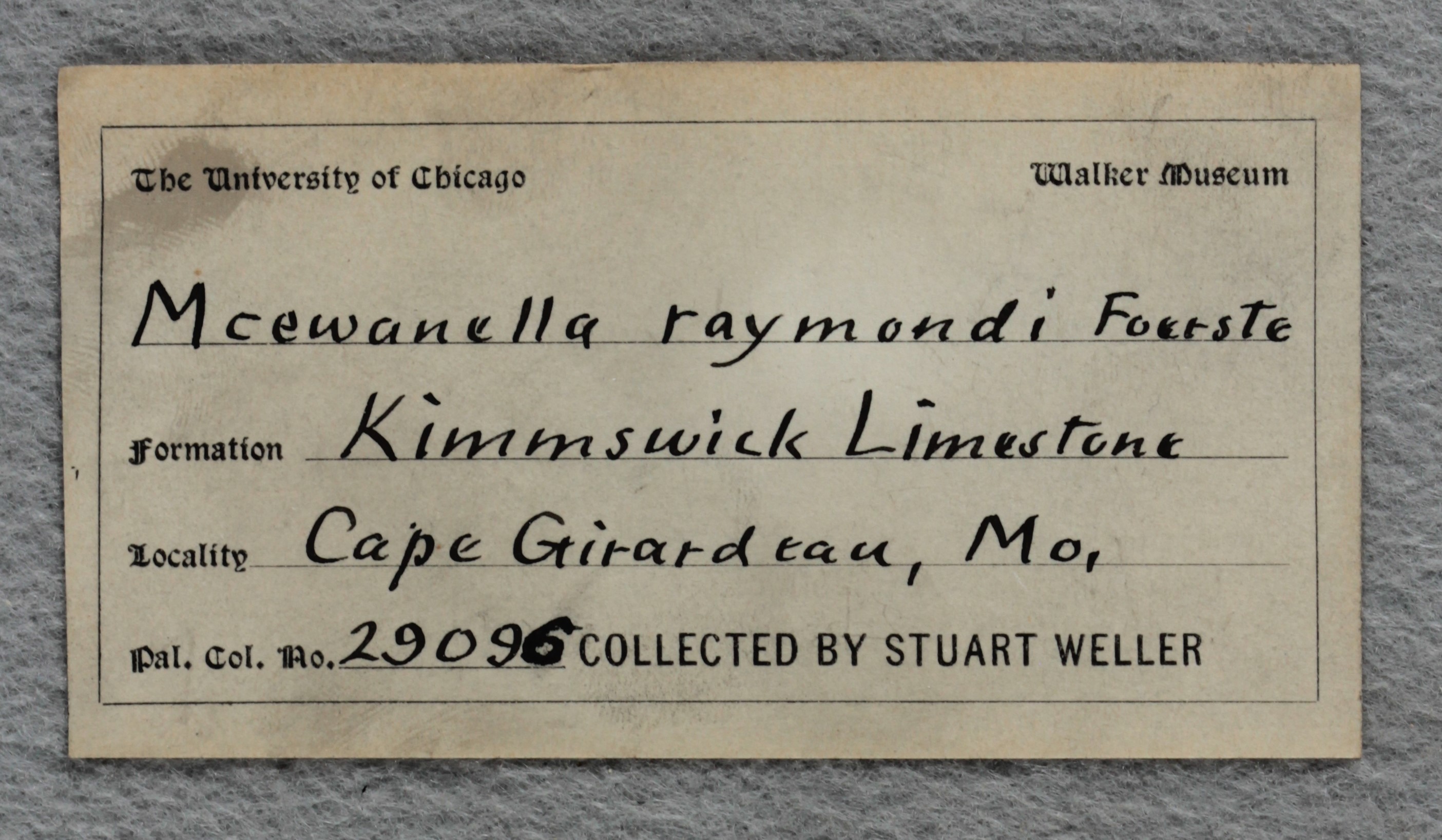
via iDigBio · via iDigBio. May be a photograph of a specimen, or an artist’s reconstruction — an interpretation of a skeleton, since colour and soft tissue are almost never preserved.
On record
Recorded, not inferred- Sits inside
- PlatystrophiidaePBDB
- Diet
- suspension feederPBDB, for Platystrophiidae
- Life habit
- epifaunalPBDB, for Platystrophiidae
- Motility
- stationary, attachedPBDB, for Platystrophiidae
- Vision
- blindPBDB, for Rhynchonellata
- Environment
- marinePBDB, for Lophophorata
Time the record covers
At least 9 million years on record.
The record covers at least 458.2 Mya to 449.2 Mya. No occurrence read is dated outside 469.4 Mya to 443.1 Mya.
10 occurrences of Mcewanella on record, most of them in the Ordovician. Bar height is expected occurrences, not a count: each fossil is spread across the span it is dated to, so a tall narrow bar means tight dating and a low wide one means loose.
When
10 occurrences- Ordovician100%
These are dates about fossils, not the animal: the record can only begin after it arose and end before it died out, so either end may reach further. Shares are expected occurrences: a fossil dated to a span is counted partly in each period it straddles. More on what this infers.
Found in
8 formations
- Furuberget Formation · Kirkerud Group2
- Tufs et calcaires de Rosan Formation1
- Porto de Santa Anna Formation · Venda Nova Group1
- El Castro Formation1
- Whittery Shales Formation1
- Portrane Limestone Formation · Duncannon Group1
Loading coastlines…
The named rock units Mcewanella has been recovered from, largest first. Drawn where the rock is now, not where it formed. 1 occurrence has no formation on record, which is common for older literature.
Mcewanella and its relatives
OrdovicianWhere Mcewanella and its relatives were recorded in the Ordovician.
Found in the same rock
235 taxa- Dalmanella5 sites
- Hedstroemina3 sites
- Nicolella actoniae3 sites
- Oxoplecia3 sites
- Plectorthis3 sites
- Rhactorthis3 sites
- Rostricellula3 sites
- Bancroftina2 sites
- Eridorthis2 sites
- Flexicalymene2 sites
- Glyptorthis2 sites
- Hesperorthis2 sites
- Leptaena2 sites
- Leptaena ventricosa2 sites
- Leptestiina2 sites
- Nicolella2 sites
- Parastrophinella2 sites
- Porambonites2 sites
- Ptychopleurella2 sites
- Remopleurides lunnerensis2 sites
- Schizotreta2 sites
- Stenopareia glaber2 sites
- Aberia1 site
- Acanthambonia portranensis1 site
The Paleobiology Database records 10 sites for Mcewanella, and this reads all of them. The number is how many of those sites it was catalogued from too. The 24 sharing the most are listed.
This is not a list of everything alive at the time. It is only what has come out of the same ground as this animal and been written down.
Entered from
9 references- The Caradoc brachiopod and trilobite fauna of the Upper Kirkerud Group, Hadeland, Norway2
- Ordovician Sedimentary Basin and Paleobiotas of the Gorny Altai1
- Late Ordovician (Katian) brachiopods from the Southern Uplands of Scotland: biogeographic patterns on the edge of Laurentia1
- Brachiopodes articules de la coupe de l'ile de Rosan (Crozon, Finistere); formation des tufs et calcaires de Rosan (Caradoc-Ashgill)1
- Brachiopods from volcanoclastic Middle and Upper Ordovician of Asturias (northern Spain)1
- A reassessment of facies and faunas the type Llandeilo (Ordovician), Wales1
- An outline of the stratigraphy and palaeontology of the Ordovician rocks of Central Portugal1
- Ordovician Brachiopoda from the Shelve District, Shropshire1
- The Fauna of the Potrane Limestone, II1
Each of the 10 occurrences read was entered from one of these publications, ordered by how many each accounts for. This is not a search for papers mentioning the name. Entries link to doi.org where the Paleobiology Database holds an identifier, and to its own record where it does not. Relayed as the Paleobiology Database holds them, not checked against what they resolve to.
Media and terms
Media content1
Picture of Mcewanella
- Source
- iDigBio
- Credit
- via iDigBio
- Licence
- not stated by the source
- Commercial use
- cannot be read from the licence given — check the record
No 3D scan of Mcewanella was found in Sketchfab.
Smithsonian Open Access and MorphoSource were not reached for this taxon, so this list is what the others held rather than everything there is.
This is what the site found, which is not the same as what exists.
Keep going
What may have been alongside itPlatystrophiidae through timeFormations of the OrdovicianThe world it lived on
Occurrence data from the Paleobiology Database, CC BY 4.0. Foerste 1920