Massospondylidae
Massospondylidae is a family of early massopod dinosaurs that existed in Asia, Africa, North America, South America and Antarctica during the Late Triassic to the Early Jurassic periods. Several dinosaurs have been classified as massospondylids over the years. The largest cladistic analysis of early sauropodomorphs, which was presented by Apaldetti and colleagues in November 2011, found Adeopapposaurus, Coloradisaurus, Glacialisaurus, Massospondylus, Leyesaurus and Lufengosaurus to be massospondylids. This result supports many previous analyses that tested fewer taxa. However, this analysis found the two recently described North American massopods, Sarahsaurus and Seitaad, and the South African Ignavusaurus to nest outside Massospondylidae, as opposed to some provisional proposals. Earlier in 2011, Pradhania, a sauropodomorph from India, was tested for the first time in a large cladistic analysis and was found to be a relatively basal massospondylid. Mussaurus and Xixiposaurus may also be included within Massospondylidae.

Uncredited · via Wikipedia/Commons. May be a photograph of a specimen, or an artist’s reconstruction — an interpretation of a skeleton, since colour and soft tissue are almost never preserved.
On record
Recorded, not inferred- Sits inside
- MassopodaPBDB
- Motility
- actively mobilePBDB, for Osteichthyes
- Environment
- terrestrialPBDB, for Diapsida
Time the record covers
At least 52 million years on record.
The record covers at least 227.3 Mya to 174.7 Mya. No occurrence read is dated outside 237 Mya to 168.2 Mya.
121 occurrences of Massospondylidae on record, most of them in the Early Jurassic. Bar height is expected occurrences, not a count: each fossil is spread across the span it is dated to, so a tall narrow bar means tight dating and a low wide one means loose.
When
121 occurrences- Late Triassic4%
- Early Jurassic95%
- Middle Jurassicunder 1%
These are dates about fossils, not the animal: the record can only begin after it arose and end before it died out, so either end may reach further. Shares are expected occurrences: a fossil dated to a span is counted partly in each period it straddles. More on what this infers.
Found in
15 formations
- Elliot Formation · Stormberg Group57
- Lufeng Formation26
- Mpandi Formation8
- Elliot Formation · Stormberg Group6
- Forest Sandstone Formation · Karoo Group5
- Clarens Formation · Stormberg Group4
Loading coastlines…
The named rock units Massospondylidae has been recovered from, largest first. Drawn where the rock is now, not where it formed. 3 occurrences have no formation on record, which is common for older literature.
Massospondylidae and its relatives
Early JurassicWhere Massospondylidae and its relatives were recorded in the Early Jurassic.
Found in the same rock
83 taxa- Massospondylus68 sites
- Tritylodon20 sites
- Lufengosaurus huenei11 sites
- Lufengosaurus magnus11 sites
- Massospondylus carinatus11 sites
- Sinosaurus triassicus9 sites
- Gyposaurus sinensis6 sites
- Yunnanosaurus huangi6 sites
- Pachygenelus5 sites
- Prosauropoda5 sites
- Lufengosaurus4 sites
- Lukousaurus yini4 sites
- Yunnanosaurus robustus4 sites
- Lesothosaurus diagnosticus3 sites
- Ornithischia3 sites
- Sauropodomorpha3 sites
- Syntarsus3 sites
- Yunnanosaurus3 sites
- Adeopapposaurus mognai2 sites
- Archosauria2 sites
- Bienotherium yunnanense2 sites
- Coelophysoidea2 sites
- Coloradisaurus brevis2 sites
- Crocodyliformes2 sites
The Paleobiology Database records 107 sites for Massospondylidae, and this reads all of them. The number is how many of those sites it was catalogued from too. The 24 sharing the most are listed.
This is not a list of everything alive at the time. It is only what has come out of the same ground as this animal and been written down.
Entered from
44 references- Fossils from the Elliot and Clarens Formations (Karoo Sequence) of the northeastern Cape, Orange Free State and Lesotho, and a suggested biozonation based on tetrapods47
- Faunal analysis of Karoo-aged sediments in the northern Limpopo Valley, Zimbabwe8
- The non-therapsid reptiles of the Lufeng Basin, Yunnan, China8
- On Lufengosaurus magnus Young (sp. nov.) and additional finds of Lufengosaurus huenei Young8
- On the skull of Massospondylus carinatus Owen, 1854 (Dinosauria: Sauropodomorpha) from the Elliot and Clarens Formations (Lower Jurassic) of South Africa3
- The prosauropod dinosaur Massospondylus carinatus Owen from Zimbabwe: its biology, mode of life and phylogenetic significance3
- Sedimentology and palaeontology of the Upper Karoo Group in the Mid-Zambezi Basin, Zimbabwe: new localities and their implications for interbasinal correlation2
- Dispersal and diversity in the earliest North American sauropodomorph dinosaurs, with a description of a new taxon2
- Adeopapposaurus mognai, gen. et sp. nov. (Dinosauria: Sauropodomorpha), with comments on adaptations of basal Sauropodomorpha2
- Sauropodomorph dinosaur diversity in the upper Elliot Formation (Massospondylus range zone: Lower Jurassic) of South Africa2
- [Some reptilian fossils from Lufeng, China]2
- Further notes on Gyposaurus sinensis Young2
Each of the 121 occurrences read was entered from one of these publications, ordered by how many each accounts for. This is not a search for papers mentioning the name. 32 further references are not listed. Entries link to doi.org where the Paleobiology Database holds an identifier, and to its own record where it does not. Relayed as the Paleobiology Database holds them, not checked against what they resolve to.
Media and terms
Media content1
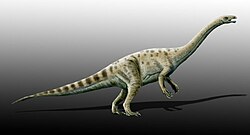
Picture of Massospondylidae
- Source
- Wikipedia/Commons
- Credit
- nobody named on the record
- Licence
- not stated by the source
- Commercial use
- cannot be read from the licence given — check the record
No 3D scan of Massospondylidae was found in MorphoSource and Sketchfab.
Smithsonian Open Access was not reached for this taxon, so this list is what the others held rather than everything there is.
The description on this site
- Licence
- CC BY-SA 4.0
This is what the site found, which is not the same as what exists.
Keep going
What may have been alongside itMassopoda through timeFormations of the Early JurassicThe world it lived on
Occurrence data from the Paleobiology Database, CC BY 4.0. Huene 1914