Madrepora (Amphihelia)
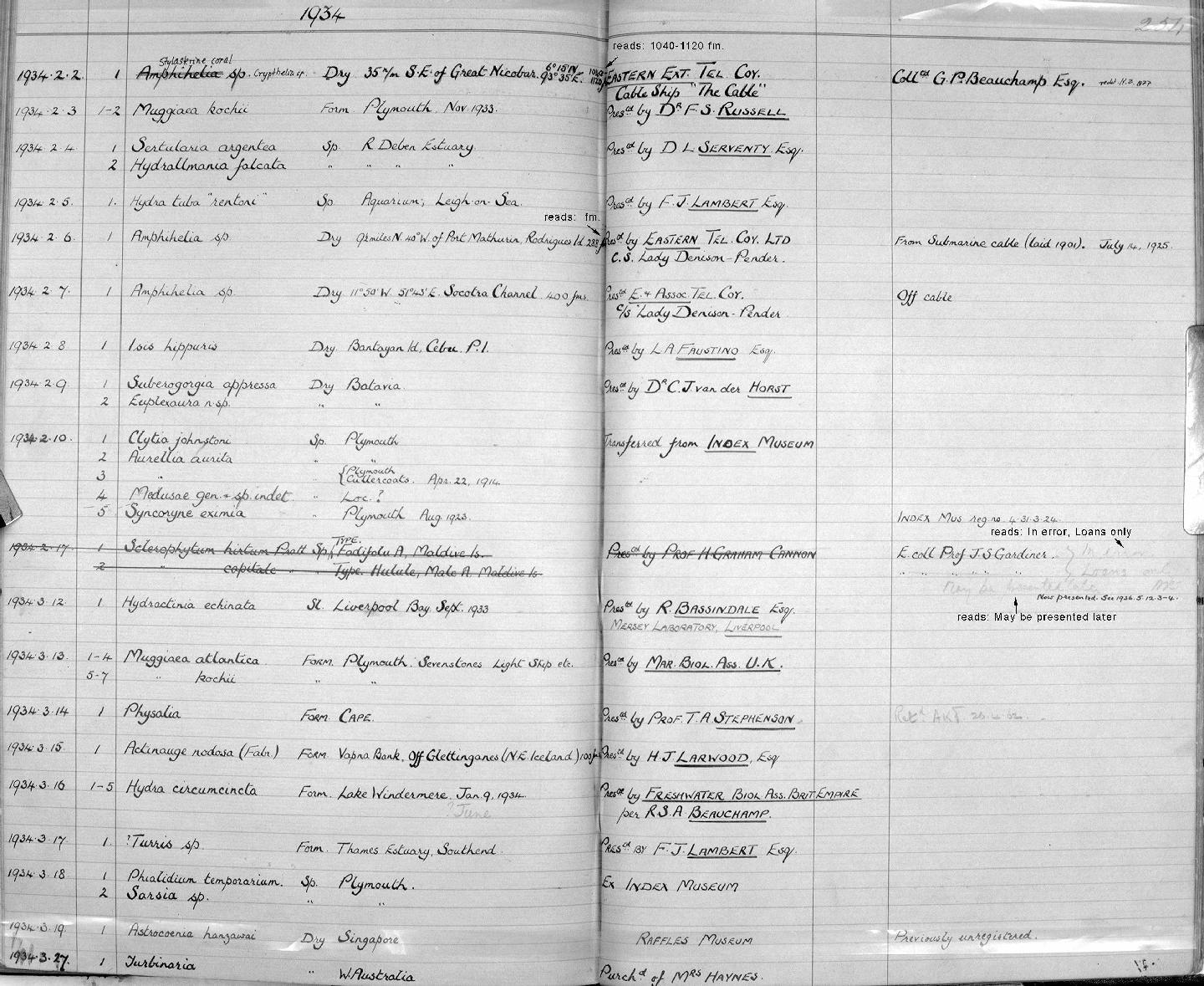
Not Madrepora (Amphihelia). This is Amphihelia Milne Edwards & Haime, 1849, a relative — both are Oculinidae.
Eastern Telegraph Company · CC0 · via GBIF. May be a photograph of a specimen, or an artist’s reconstruction — an interpretation of a skeleton, since colour and soft tissue are almost never preserved.
On record
Recorded, not inferred- Sits inside
- MadreporaPBDB
- Diet
- suspension feederPBDB, for Madrepora
- Life habit
- colonial, clonalPBDB, for Faviina
- Motility
- stationary, attachedPBDB, for Oculinidae
- Vision
- blindPBDB, for Anthozoa
- Environment
- marinePBDB, for Scleractinia
Time the record covers
At least 21 million years on record.
The record covers at least 27.3 Mya to 5.333 Mya. No occurrence read is dated outside 33.9 Mya to 3.6 Mya.
11 occurrences of Madrepora (Amphihelia) on record, most of them in the Oligocene. Bar height is expected occurrences, not a count: each fossil is spread across the span it is dated to, so a tall narrow bar means tight dating and a low wide one means loose.
When
11 occurrencesThese are dates about fossils, not the animal: the record can only begin after it arose and end before it died out, so either end may reach further. Shares are expected occurrences: a fossil dated to a span is counted partly in each period it straddles. More on what this infers.
Found in
2 formations
Loading coastlines…
The named rock units Madrepora (Amphihelia) has been recovered from, largest first. Drawn where the rock is now, not where it formed. 7 occurrences have no formation on record, which is common for older literature.
Madrepora (Amphihelia) and its relatives
OligoceneWhere Madrepora (Amphihelia) and its relatives were recorded in the Oligocene.
Found in the same rock
298 taxa- Alveopora daedalea2 sites
- Alveopora polyacantha2 sites
- Amphihelia alternans2 sites
- Caryophyllia (Acanthocyathus)2 sites
- Caryophyllia (Acanthocyathus) versicostatus2 sites
- Caryophyllia (Ceratocyathus) cornucopia2 sites
- Caryophyllia (Ceratocyathus) undulatus2 sites
- Ceratotrochus (Edwardsotrochus) bellingherianus2 sites
- Conocyathus2 sites
- Cyphastrea gemmulifera2 sites
- Dendrophyllia cladocoracea2 sites
- Desmophyllum2 sites
- Dictyaraea anomala2 sites
- Dictyaraea micrantha2 sites
- Enallopsammia poppelacki2 sites
- Favites2 sites
- Flabellum avicula2 sites
- Flabellum extensum2 sites
- Flabellum foecundum2 sites
- Flabellum zuffardii2 sites
- Madracis ornata2 sites
- Paracyathus turonensis2 sites
- Placosmilia2 sites
- Porites amplectans2 sites
The Paleobiology Database records 4 sites for Madrepora (Amphihelia), and this reads all of them. The number is how many of those sites it was catalogued from too. The 24 sharing the most are listed.
This is not a list of everything alive at the time. It is only what has come out of the same ground as this animal and been written down.
Entered from
5 references- Magyarorszagi Oligocen korallok [Oligocene corals from Hungary]4
- Recherches sur les Madreporaires et les formations recifales Miocenes de la Mediterranee occidentale [Miocene corals and reefs from the western Mediterranean]3
- Die Anthozoenfauna des Jungtertiärs von Borneo [Anthozoa from the Upper Tertiary of Borneo]2
- Les faunes de coraux (Anthozoaires Scléractiniaires) de la façade atlantique française au Chattien et au Miocène1
- Studio do una macrofauna del Pliocene inferiore di Orosei (Sardegna)1
Each of the 11 occurrences read was entered from one of these publications, ordered by how many each accounts for. This is not a search for papers mentioning the name. Each entry links to the Paleobiology Database's own record for the work.
Media and terms
Media content1
Picture of Amphihelia Milne Edwards & Haime, 1849
- Source
- GBIF
- Credit
- Eastern Telegraph Company
- Licence
- CC0
- Commercial use
- the licence allows it
No 3D scan of Madrepora (Amphihelia) was found in MorphoSource and Sketchfab.
Smithsonian Open Access was not reached for this taxon, so this list is what the others held rather than everything there is.
This is what the site found, which is not the same as what exists.
Keep going
What may have been alongside itMadrepora through timeFormations of the OligoceneThe world it lived on
Occurrence data from the Paleobiology Database, CC BY 4.0. (Milne-Edwards and Haime 1857)