Lytvophyllum
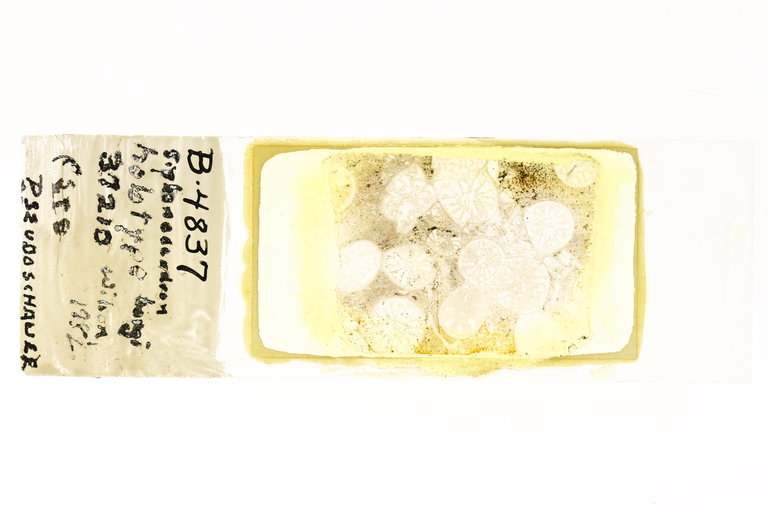
via GBIF · CC BY 4.0 · via GBIF. May be a photograph of a specimen, or an artist’s reconstruction — an interpretation of a skeleton, since colour and soft tissue are almost never preserved.
On record
Recorded, not inferred- Sits inside
- PetalaxidaePBDB
- Diet
- suspension feederPBDB, for Rugosa
- Life habit
- epifaunalPBDB, for Rugosa
- Motility
- stationary, attachedPBDB, for Rugosa
- Vision
- blindPBDB, for Anthozoa
- Environment
- marinePBDB, for Rugosa
Time the record covers
At least 33 million years on record.
The record covers at least 323.4 Mya to 290.1 Mya. No occurrence read is dated outside 335.9 Mya to 283.3 Mya.
18 occurrences of Lytvophyllum on record, most of them in the Permian. Bar height is expected occurrences, not a count: each fossil is spread across the span it is dated to, so a tall narrow bar means tight dating and a low wide one means loose.
When
18 occurrences- Carboniferous11%
- Permian89%
These are dates about fossils, not the animal: the record can only begin after it arose and end before it died out, so either end may reach further. Shares are expected occurrences: a fossil dated to a span is counted partly in each period it straddles. More on what this infers.
Found in
5 formations
- Chuanshan Formation5
- Ambition Formation2
- Hasen Creek Formation2
- Slana Spur Formation2
- Happy Creek Formation1
Loading coastlines…
The named rock units Lytvophyllum has been recovered from, largest first. Drawn where the rock is now, not where it formed. 6 occurrences have no formation on record, which is common for older literature.
Lytvophyllum and its relatives
PermianWhere Lytvophyllum and its relatives were recorded in the Permian.
Found in the same rock
9 taxa- Paraheritschioides bagleyae2 sites
- Carinthiaphyllum eostrotionideum1 site
- Iskutella gunningi1 site
- Langenheimia thomasi1 site
- Paraheritschioides garvinae1 site
- Paraschwagerina1 site
- Protowentzelella cystosa1 site
- Pseudofusulinella1 site
- Stereostylus annae1 site
The Paleobiology Database records 15 sites for Lytvophyllum, and this reads all of them. The number is how many of those sites it was catalogued from too.
This is not a list of everything alive at the time. It is only what has come out of the same ground as this animal and been written down.
Entered from
7 references- Fedorowski et al., 20077
- Anthozoa3
- New occurrences of Permian corals from the McCloud belt in western North America2
- Late late Carboniferous and earliest Permian rugose corals from Jiangxi2
- Early Permian colonial rugose corals from the Stikine River area, British Columbia, Canada2
- Carboniferous buildups in the Donets Basin (Ukraine)1
- Fatsialnaya priurochennost korallov v rannekamennougolnykh moryakh vostochnogo sklona yuzhnogo Urala [Ecologic relationships of corals in Early Carboniferous seas of the eastern slope of the southern Urals]1
Each of the 18 occurrences read was entered from one of these publications, ordered by how many each accounts for. This is not a search for papers mentioning the name. Entries link to doi.org where the Paleobiology Database holds an identifier, and to its own record where it does not. Relayed as the Paleobiology Database holds them, not checked against what they resolve to.
Media and terms
Media content1
Picture of Lytvophyllum
- Source
- GBIF
- Credit
- via GBIF
- Licence
- CC BY 4.0
- Commercial use
- the licence allows it
No 3D scan of Lytvophyllum was found in MorphoSource and Sketchfab.
Smithsonian Open Access was not reached for this taxon, so this list is what the others held rather than everything there is.
This is what the site found, which is not the same as what exists.
Keep going
What may have been alongside itPetalaxidae through timeFormations of the PermianThe world it lived on
Occurrence data from the Paleobiology Database, CC BY 4.0. Dobrolyubova 1941