Lima (Mantellum) duplicata
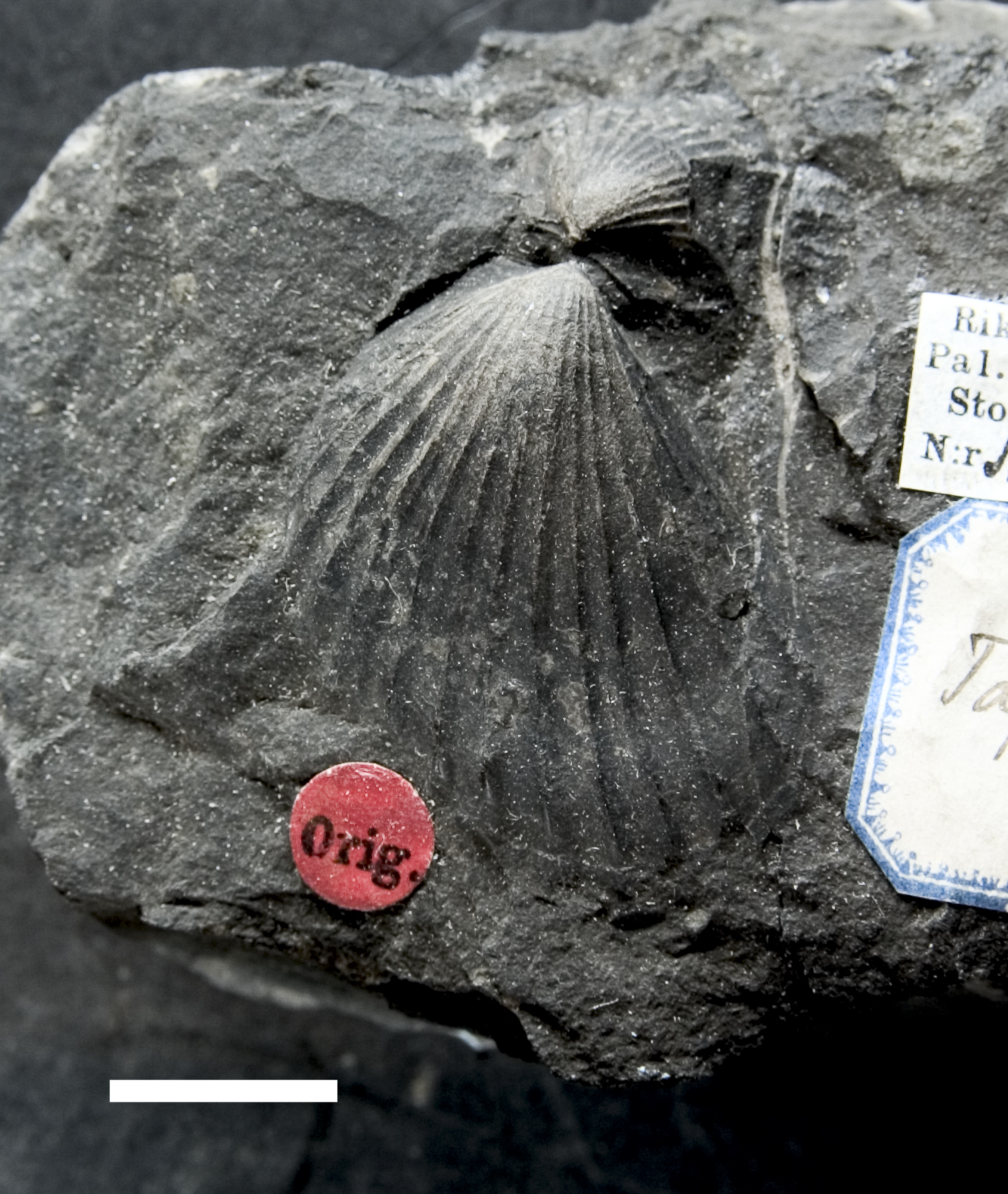
Not Lima (Mantellum) duplicata. This is Lima duplicata (Carle Sowerby, 1827), a relative — both are Limidae.
Nathorst Alfred Gabriel · CC BY 4.0 · via GBIF. May be a photograph of a specimen, or an artist’s reconstruction — an interpretation of a skeleton, since colour and soft tissue are almost never preserved.
On record
Recorded, not inferred- Sits inside
- Lima (Mantellum)PBDB
- Diet
- suspension feederPBDB, for Lima
- Life habit
- epifaunalPBDB, for Lima
- Motility
- facultatively mobilePBDB, for Lima
- Vision
- blindPBDB, for Bivalvia
Time the record covers
At least 21 million years on record.
The record covers at least 182.9 Mya to 161.5 Mya. No occurrence read is dated outside 184.2 Mya to 154.8 Mya.
35 occurrences of Lima (Mantellum) duplicata on record, most of them in the Early Jurassic. Bar height is expected occurrences, not a count: each fossil is spread across the span it is dated to, so a tall narrow bar means tight dating and a low wide one means loose.
When
35 occurrencesThese are dates about fossils, not the animal: the record can only begin after it arose and end before it died out, so either end may reach further. Shares are expected occurrences: a fossil dated to a span is counted partly in each period it straddles. More on what this infers.
Found in
2 formations
- Braunjura alpha & Braunjura beta Formation · Braunjura Group1
- Agardhfjellet Formation1
Loading coastlines…
The named rock units Lima (Mantellum) duplicata has been recovered from, largest first. Drawn where the rock is now, not where it formed. 33 occurrences have no formation on record, which is common for older literature.
Lima (Mantellum) duplicata and its relatives
Early JurassicWhere Lima (Mantellum) duplicata and its relatives were recorded in the Early Jurassic.
Found in the same rock
199 taxa- Grammatodon concinnus18 sites
- Parvamussium pumilum17 sites
- Telothyris pyrenaica16 sites
- Homoeorhynchia meridionalis15 sites
- Serpula14 sites
- Ampullospira13 sites
- Plagiostoma punctatum12 sites
- Gryphaea (Bilobissa) sublobata11 sites
- Parallelodon hirsonensis11 sites
- Pecten (Pecten) dentatus11 sites
- Protocardia striatula11 sites
- Coelopis (Coelopis)10 sites
- Katosira10 sites
- Pseudomelania10 sites
- Gryphaea (Gryphaea) dumortieri9 sites
- Nicaniella (Nicaniella) voltzi9 sites
- Homomya alsatica8 sites
- Montlivaltia8 sites
- Pinna (Pinna) folium8 sites
- Quadratirhynchia attenuata8 sites
- Arcomytilus asper7 sites
- Camptonectes (Camptonectes) auritus7 sites
- Eopecten velatus7 sites
- Inoperna sowerbiana7 sites
The Paleobiology Database records 35 sites for Lima (Mantellum) duplicata, and this reads all of them. The number is how many of those sites it was catalogued from too. The 24 sharing the most are listed.
This is not a list of everything alive at the time. It is only what has come out of the same ground as this animal and been written down.
Entered from
4 references- Palökologie benthischer Faunen aus dem Unter-Toarc SW-Europas32
- Die Gundershoffener Klamm1
- Die Schiehtenfolge des Jura und der Unterkreide an der Ostküste Südwest-Spitzbergens1
- Jurassic Fossils from Jubaland, East Africa, Collected by V. G. Glenday, And the Jurassic Geology of Somaliland1
Each of the 35 occurrences read was entered from one of these publications, ordered by how many each accounts for. This is not a search for papers mentioning the name. Each entry links to the Paleobiology Database's own record for the work.
Media and terms
Media content1
Picture of Lima duplicata (Carle Sowerby, 1827)
- Source
- GBIF
- Credit
- Nathorst Alfred Gabriel
- Licence
- CC BY 4.0
- Commercial use
- the licence allows it
No 3D scan of Lima (Mantellum) duplicata was found in MorphoSource and Sketchfab.
Smithsonian Open Access was not reached for this taxon, so this list is what the others held rather than everything there is.
This is what the site found, which is not the same as what exists.
Keep going
What may have been alongside itLima (Mantellum) through timeFormations of the Early JurassicThe world it lived on
Occurrence data from the Paleobiology Database, CC BY 4.0. (Carle Sowerby 1827)