Lariosaurus
Lariosaurus is an extinct genus of nothosaurid from the Middle Triassic of central and western Europe and China. With a complete specimen of L. xingyiensis measuring 70.5 cm (2.3 ft) long and L. hongguoensis possibly measuring up to 80 cm (2.6 ft) long, it was one of the smallest known nothosaurs. First discovered at Perledo on the Lake Como in 1830, it was named in 1847 by Curioni, its name meaning "Lizard from Larius", the ancient name of the lake. This makes it one of the earliest studied reptiles from the Alps. It is known from an almost complete skeleton holotype and several other fairly complete fossils.

Uncredited · CC BY-SA 4.0 · via Wikipedia/Commons. May be a photograph of a specimen, or an artist’s reconstruction — an interpretation of a skeleton, since colour and soft tissue are almost never preserved.
On record
Recorded, not inferred- Sits inside
- NothosaurinaePBDB
- Motility
- actively mobilePBDB, for Osteichthyes
- Environment
- marinePBDB, for Sauropterygia
Time the record covers
At least 7.5 million years on record.
The record covers at least 247 Mya to 239.48 Mya. No occurrence read is dated outside 250.8 Mya to 237 Mya.
27 occurrences of Lariosaurus on record, most of them in the Middle Triassic. Bar height is expected occurrences, not a count: each fossil is spread across the span it is dated to, so a tall narrow bar means tight dating and a low wide one means loose.
When
27 occurrencesThese are dates about fossils, not the animal: the record can only begin after it arose and end before it died out, so either end may reach further. Shares are expected occurrences: a fossil dated to a span is counted partly in each period it straddles. More on what this infers.
Found in
16 formations
- Falang Formation4
- Perledo-Varenna Formation3
- Trochitenkalk Formation · Muschelkalk Group2
- Muschelkalk Formation2
- Vossenveld Formation · Muschelkalk Group2
- Perledo-Vaenna Formation · Calcare di Perledo Group2
Loading coastlines…
The named rock units Lariosaurus has been recovered from, largest first. Drawn where the rock is now, not where it formed. 1 occurrence has no formation on record, which is common for older literature.
Lariosaurus and its relatives
Middle TriassicWhere Lariosaurus and its relatives were recorded in the Middle Triassic.
Found in the same rock
145 taxa- Actinopterygii2 sites
- Eoeugnathus bellottii2 sites
- Habroichthys minimus2 sites
- Macrocnemus bassanii2 sites
- Nothosaurus2 sites
- Nothosaurus marchicus2 sites
- Perleidus altolepis2 sites
- Protrachyceras2 sites
- Aetheodontus besanensis1 site
- Alcoveria1 site
- Allolepidotus rueppelli1 site
- Altisolepis elongignathus1 site
- Amotosaurus rotfeldensis1 site
- Anarosaurus heterodontus1 site
- Anolcites1 site
- Anolcites doleriticus1 site
- Archaeosemionotus1 site
- Archaeosemionotus connectens1 site
- Askeptosaurus1 site
- Askeptosaurus italicus1 site
- Bathysynactites viai1 site
- Bifungites1 site
- Boreosomus1 site
- Brachychirotherium paraparvum1 site
The Paleobiology Database records 21 sites for Lariosaurus, and this reads all of them. The number is how many of those sites it was catalogued from too. The 24 sharing the most are listed.
This is not a list of everything alive at the time. It is only what has come out of the same ground as this animal and been written down.
Entered from
17 references- The status of the sauropterygian reptile genera Ceresiosaurus, Lariosaurus, and Silvestrosaurus from the Middle Triassic of Europe7
- Middle Triassic Xingyi Fauna: Showing turnover of marine reptiles from coastal to oceanic environments3
- Marine Lariosaurus (Sauropterygia) records from the Middle Triassic Germanic Basin – stratigraphic and palaeobiogeographic importance for Tethyan and Germanic Basin correlation3
- An Early Triassic sauropterygian and associated fauna from South China provide insights into Triassic ecosystem health1
- The earliest record of the genus Lariosaurus from the early middle Anisian (Middle Triassic) of the Germanic Basin1
- A new specimen of Nothosaurus from the latest Anisian (Middle Triassic) Besano formation (Grenzbitumenzone) of Italy1
- A new species of the sauropsid reptile Nothosaurus from the Lower Muschelkalk of the western Germanic Basin, Winterswijk, The Netherlands1
- A new species of Lariosaurus (Reptilia, Sauropterygia) from the Middle Anisian (Middle Triassic) of southwestern China1
- A lariosaur (Reptilia: Sauropterygia) from the Middle Triassic (Ladinian) Gejiu Formation of Yunnan, China1
- A new species of Lariosaurus (Sauropterygia: Nothosauridae) from Triassic of Guizhou, southwest China1
- The status of the sauropterygian reptile Nothosaurus juvenilis from the Middle Triassic of Germany1
- Osteology of Simosaurus gaillardoti and the relationships of stem-group Sauropterygia1
Each of the 27 occurrences read was entered from one of these publications, ordered by how many each accounts for. This is not a search for papers mentioning the name. 5 further references are not listed. Entries link to doi.org where the Paleobiology Database holds an identifier, and to its own record where it does not. Relayed as the Paleobiology Database holds them, not checked against what they resolve to.
Media and terms
Media content2

Picture of Lariosaurus
- Source
- Wikipedia/Commons
- Credit
- nobody named on the record
- Licence
- CC BY-SA 4.0
- Commercial use
- the licence allows it
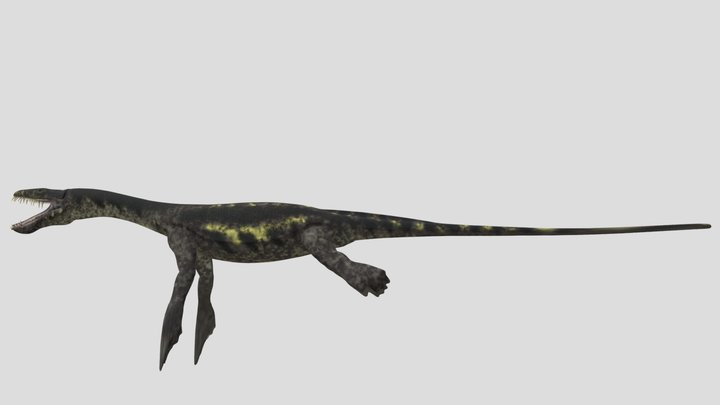
3D model
- Source
- Sketchfab
- Credit
- dinoguy263allo
- Licence
- CC Attribution
- Commercial use
- cannot be read from the licence given — check the record
The description on this site
- Source
- Wikipedia, “Lariosaurus”
- Licence
- CC BY-SA 4.0
This is what the site found, which is not the same as what exists.
Keep going
What may have been alongside itNothosaurinae through timeFormations of the Middle TriassicThe world it lived on
Occurrence data from the Paleobiology Database, CC BY 4.0. Curioni 1847