Kossmaticeras
Kossmaticeras is an extinct ammonoid genus belonging to the desmoceratacean family Kossmaticeratidae. Species in this genus were fast-moving nektonic carnivores. They lived during the Late Cretaceous, from the upper Turonian to the upper Maastrichtian ages. The type species of the genus is K. theobaldianus.

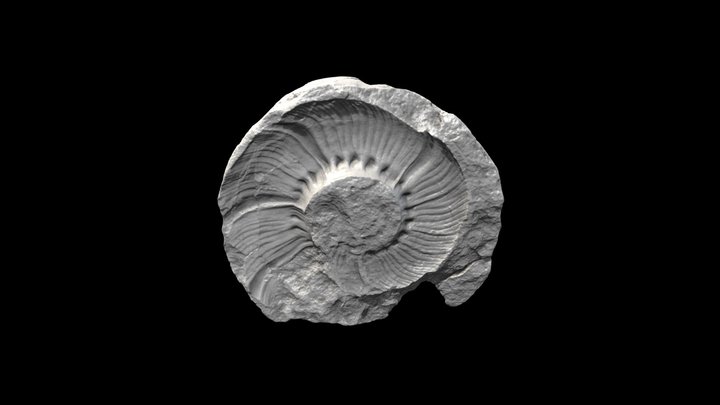
Uncredited · via Wikipedia/Commons. May be a photograph of a specimen, or an artist’s reconstruction — an interpretation of a skeleton, since colour and soft tissue are almost never preserved.
On record
Recorded, not inferred- Sits inside
- KossmaticeratinaePBDB
- Diet
- carnivorePBDB, for Ammonoidea
- Life habit
- nektonicPBDB, for Ammonoidea
- Motility
- fast-movingPBDB, for Ammonoidea
- Vision
- well-developedPBDB, for Cephalopoda
- Environment
- marinePBDB, for Cephalopoda
Time the record covers
At least 28 million years on record.
The record covers at least 100.5 Mya to 72.2 Mya. No occurrence read is dated outside 113.2 Mya to 66 Mya.
55 occurrences of Kossmaticeras on record, most of them in the Late Cretaceous. Bar height is expected occurrences, not a count: each fossil is spread across the span it is dated to, so a tall narrow bar means tight dating and a low wide one means loose.
When
55 occurrencesThese are dates about fossils, not the animal: the record can only begin after it arose and end before it died out, so either end may reach further. Shares are expected occurrences: a fossil dated to a span is counted partly in each period it straddles. More on what this infers.
Found in
15 formations
- St Lucia Formation10
- Quiriquina Formation · Arauco Group9
- Miria Formation5
- Umzamba Formation4
- Anaipadi Formation3
- Otamatea Formation3
Loading coastlines…
The named rock units Kossmaticeras has been recovered from, largest first. Drawn where the rock is now, not where it formed. 9 occurrences have no formation on record, which is common for older literature.
Kossmaticeras and its relatives
Late CretaceousWhere Kossmaticeras and its relatives were recorded in the Late Cretaceous.
Found in the same rock
222 taxa- Eubaculites carinatus8 sites
- Anagaudryceras mikobokense6 sites
- Desmophyllites diphylloides6 sites
- Grossouvrites gemmatus6 sites
- Phyllopachyceras forbesianum6 sites
- Pseudophyllites indra6 sites
- Anagaudryceras subtilineatum5 sites
- Baculites5 sites
- Baculites anceps5 sites
- Baculites rectus5 sites
- Menuites fresvillensis5 sites
- Placenticeras kaffrarium5 sites
- Baculites huenickeni4 sites
- Gunnarites bhavaniformis4 sites
- Gunnarites kalika4 sites
- Hauericeras (Gardeniceras) gardeni4 sites
- Hypophylloceras (Neophylloceras) inflatum4 sites
- Hypophylloceras (Neophylloceras) ramosum4 sites
- Kitchinites spathi4 sites
- Maorites densicostatus4 sites
- Peroniceras (Peroniceras) dravidicum4 sites
- Dimitobelus3 sites
- Forresteria (Forresteria) alluaudi3 sites
- Gaudryceras kayei3 sites
The Paleobiology Database records 44 sites for Kossmaticeras, and this reads all of them. The number is how many of those sites it was catalogued from too. The 24 sharing the most are listed.
This is not a list of everything alive at the time. It is only what has come out of the same ground as this animal and been written down.
Entered from
24 references- Cretaceous faunas from Zululand and Natal, South Africa. The ammonite family Kossmaticeratidae11
- Ammonites from the Maastrichtian (Upper Cretaceous) Quiriquina Formation in central Chile8
- Maastrichtian Non-Heteromorph Ammonites from the Miria Formation, Western Australia5
- Ammonoidea from the Mata Series (Santonian-Maastrichtian) of New Zealand5
- Inoceramids and associated ammonite faunas from the uppermost Turonian-lower Coniacian (Upper Cretaceous) of the Anaipadi–Saradamangalam region of the Cauvery Basin, south-east India3
- Upper Cretaceous Cephalopoda from offshore deposits off the Natal south coast, South Africa.2
- Goniomya from the Trichinopoly Group, Upper Cretaceous, Tamil Nadu2
- A new stegosaurian dinosaur from Upper Cretaceous sediments of south India2
- A new carinate phylloceratid ammonite from the early Albian (Cretaceous) of Zululand, South Africa2
- Coniacian ammonites from James Ross Island, Antarctica1
- Biogeographical and stratigraphical significance of the latest Turonian and Early Coniacian inoceramid/ammonite succession of the Manasoa section on the Onilahy River, south-west Madagascar1
- Upper Cretaceous (Turonian-Coniacian) ammonites from São Nicolau, Angola1
Each of the 55 occurrences read was entered from one of these publications, ordered by how many each accounts for. This is not a search for papers mentioning the name. 12 further references are not listed. Entries link to doi.org where the Paleobiology Database holds an identifier, and to its own record where it does not. Relayed as the Paleobiology Database holds them, not checked against what they resolve to.
Media and terms
Media content2

Picture of Kossmaticeras
- Source
- Wikipedia/Commons
- Credit
- nobody named on the record
- Licence
- not stated by the source
- Commercial use
- cannot be read from the licence given — check the record
Smithsonian Open Access and MorphoSource were not reached for this taxon, so this list is what the others held rather than everything there is.
The description on this site
- Licence
- CC BY-SA 4.0
This is what the site found, which is not the same as what exists.
Keep going
What may have been alongside itKossmaticeratinae through timeFormations of the Late CretaceousThe world it lived on
Occurrence data from the Paleobiology Database, CC BY 4.0. Grossouvre 1901