Incertae sedis
No picture of Incertae sedis was found. Wikidata was searched and had none. Wikipedia has a picture filed under this name, but nothing tied it to Incertae sedis itself, so it was not used. iDigBio and GBIF were not searched: the Paleobiology Database does not place Incertae sedis firmly enough to tell it from something else bearing the same name, and a search on the name alone returns whichever of them was photographed. Smithsonian Open Access did not answer, so this is what the others held rather than everything there is.
Time the record covers
At least 334 million years on record.
The record covers at least 382.31 Mya to 48.07 Mya. No occurrence read is dated outside 387.95 Mya to 37.71 Mya.
34 occurrences of Incertae sedis on record, most of them in the Eocene. Bar height is expected occurrences, not a count: each fossil is spread across the span it is dated to, so a tall narrow bar means tight dating and a low wide one means loose.
When
34 occurrencesThese are dates about fossils, not the animal: the record can only begin after it arose and end before it died out, so either end may reach further. Shares are expected occurrences: a fossil dated to a span is counted partly in each period it straddles. More on what this infers.
Found in
6 formations
- Misoa Formation27
- San Fernando Formation2
- Martin Formation1
- Areniscas de el Limbo Formation1
- "Aachenian" Formation1
- unnamed Formation1
Loading coastlines…
The named rock units Incertae sedis has been recovered from, largest first. Drawn where the rock is now, not where it formed. 1 occurrence has no formation on record, which is common for older literature.
Incertae sedis and its relatives
EoceneWhere Incertae sedis and its relatives were recorded in the Eocene.
Found in the same rock
163 taxa- Bombacacidites brevis3 sites
- Bombacacidites nacimientoensis3 sites
- Cicatricosisporites dorogensis3 sites
- Clavatricolpites densiclavatus3 sites
- Convolutispora3 sites
- Echitetracolpites3 sites
- Foveotriporites hammenii3 sites
- Laevigatosporites tibuensis3 sites
- Lanagiopollis crassa3 sites
- Longapertites proxapertitoides reticuloides3 sites
- Mauritiidites franciscoi franciscoi3 sites
- Mauritiidites franciscoi minutus3 sites
- Monocolpopollenites ovatus3 sites
- Perisyncolporites pokornyi3 sites
- Polypodiaceoisporites fossulatus3 sites
- Polypodiisporites3 sites
- Retibrevitricolporites grandis3 sites
- Retitrescolpites irregularis3 sites
- Rhoipites guianensis3 sites
- Spirosyncolpites spiralis3 sites
- Striatopollis catatumbus3 sites
- Tetracolporopollenites3 sites
- Baculatisporites2 sites
- Cricotriporites elongatoporus2 sites
The Paleobiology Database records 7 sites for Incertae sedis, and this reads all of them. The number is how many of those sites it was catalogued from too. The 24 sharing the most are listed.
This is not a list of everything alive at the time. It is only what has come out of the same ground as this animal and been written down.
Entered from
6 references- Palaeofloristic and palaeovegetational changes across the Paleocene/Eocene boundary in northern South America27
- Middle Paleogene palynology of Central Colombia, South America: A study of pollen and spores from tropical latitudes3
- Late Early Permian plant fossils from the Canadian High Arctic: a rare paleoenvironmental/climatic window in northwest Pangea1
- Middle Devonian (Givetian) plant microfossils from Goe (Belgium)1
- Spores and Associated Macrofossils from the Devonian of Arizona1
- On megaspores, Charophyta fruits and some other small fossils from the Cretaceous1
Each of the 34 occurrences read was entered from one of these publications, ordered by how many each accounts for. This is not a search for papers mentioning the name. Entries link to doi.org where the Paleobiology Database holds an identifier, and to its own record where it does not. Relayed as the Paleobiology Database holds them, not checked against what they resolve to.
Media and terms
Media content1
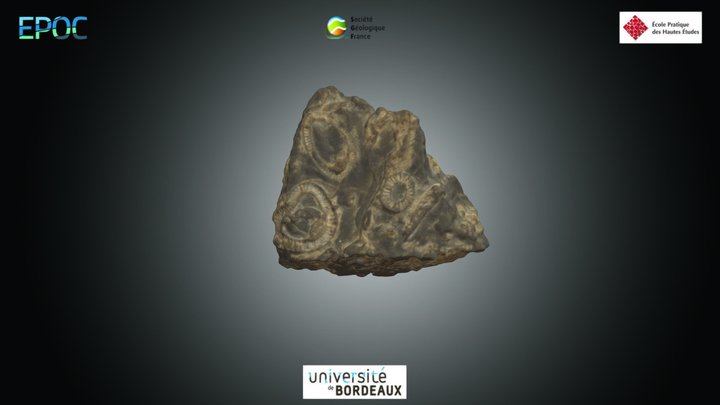
3D model
- Source
- Sketchfab
- Licence
- CC Attribution-NonCommercial-ShareAlike
- Commercial use
- the licence does not allow it
No picture of Incertae sedis was found. Wikidata was searched and had none.
Wikipedia has a picture filed under this name, but nothing tied it to Incertae sedis itself, so it was not used.
iDigBio and GBIF were not searched: the Paleobiology Database does not place Incertae sedis firmly enough to tell it from something else bearing the same name, and a search on the name alone returns whichever of them was photographed.
Smithsonian Open Access did not answer, so this is what the others held rather than everything there is.
Smithsonian Open Access and MorphoSource were not reached for this taxon, so this list is what the others held rather than everything there is.
This is what the site found, which is not the same as what exists.
Keep going
What may have been alongside itFormations of the EoceneThe world it lived on
Occurrence data from the Paleobiology Database, CC BY 4.0.