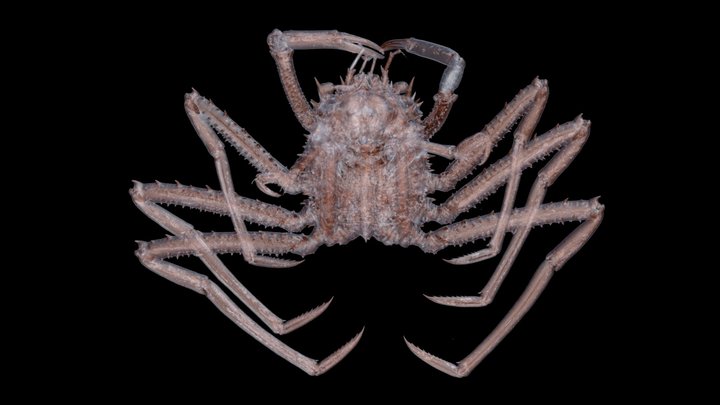
Homolidae

Govern de les Illes Balears · CC BY-SA 3.0 · via Wikidata/Commons. May be a photograph of a specimen, or an artist’s reconstruction — an interpretation of a skeleton, since colour and soft tissue are almost never preserved.
On record
Recorded, not inferred- Sits inside
- HomoloideaPBDB
- Diet
- carnivorePBDB, for Decapoda
- Life habit
- epifaunalPBDB, for Decapoda
- Motility
- actively mobilePBDB, for Malacostraca
- Vision
- well-developedPBDB, for Malacostraca
Time the record covers
At least 120 million years on record.
The record covers at least 143.1 Mya to 23.04 Mya. No occurrence read is dated outside 149.2 Mya to 15.98 Mya.
73 occurrences of Homolidae on record, most of them in the Late Cretaceous. The Paleobiology Database records this as a living group, and the chart stops with its fossils rather than at the present. Bar height is expected occurrences, not a count: each fossil is spread across the span it is dated to, so a tall narrow bar means tight dating and a low wide one means loose.
When
73 occurrencesThese are dates about fossils, not the animal: the record can only begin after it arose and end before it died out, so either end may reach further. Shares are expected occurrences: a fossil dated to a span is counted partly in each period it straddles. More on what this infers.
Found in
30 formations
- Pierre Shale Formation · Montana Group3
- London Clay Formation2
- Shell Creek Shale Formation2
- Santee Formation2
- Merchantville Formation2
- Folkestone Formation · Lower Greensand Group1
Loading coastlines…
The named rock units Homolidae has been recovered from, largest first. Drawn where the rock is now, not where it formed. 6 further formations hold fewer occurrences each and are not listed. 37 occurrences have no formation on record, which is common for older literature.
Homolidae and its relatives
Late CretaceousWhere Homolidae and its relatives were recorded in the Late Cretaceous.
Found in the same rock
654 taxa- Homolopsis edwardsii5 sites
- Latheticocarcinus adelphinus5 sites
- Mecochirus rostratus4 sites
- Notopocorystes stokesi4 sites
- Dakoticancer overanus3 sites
- Distefania incerta3 sites
- Eomunidopsis navarrensis3 sites
- Eomunidopsis orobensis3 sites
- Hoploscaphites angmartussutensis3 sites
- Joeranina broderipi3 sites
- Latheticocarcinus atlanticus3 sites
- Latheticocarcinus brevis3 sites
- Latheticocarcinus brightoni3 sites
- Latheticocarcinus punctatus3 sites
- Mesostylus mortoni3 sites
- Necrocarcinus rathbunae3 sites
- Serraphylctaena multisquamata3 sites
- Vasconilia straeleni3 sites
- Abyssophthalmus mirus2 sites
- Acantholambrus baumi2 sites
- Ampheristus toliapicus2 sites
- Anomotodon sheppeyensis2 sites
- Bournelyreidus oaheensis2 sites
- Callianassa2 sites
The Paleobiology Database records 63 sites for Homolidae, and this reads all of them. The number is how many of those sites it was catalogued from too. The 24 sharing the most are listed.
This is not a list of everything alive at the time. It is only what has come out of the same ground as this animal and been written down.
Entered from
46 references- Upper Cretaceous - Lower Tertiary crustaceans from West Greenland5
- New middle Danian species of anomuran and brachyuran crabs from Fakse, Denmark4
- British Cretaceous Crabs4
- Crustacés décapodes nouveaux ou peu connus de l'époque Crétacique4
- Late Cretaceous crabs from Japan3
- Systematics of 12 Jurassic, Cretaceous, and Paleogene squat lobster taxa (Galatheoidea)2
- New Occurrences of Fossil Homolidae from the Eastern Pacific2
- New and previously known decapod crustaceans from the Late Cretaceous of New Jersey and Delaware, USA2
- New Albian-Cenomanian crabs (Crustacea, Decapoda, Podotremata) from Monte Orobe, Navarra, northern Spain2
- Revision of Jurassic Homoloidea de Haan, 1839, from the Ernstbrunn and Stramberk limestones, Austria and the Czech Republic2
- Unusual Albian (Early Cretaceous) Brachyura (Homoloidea: Componocancroidea new superfamily) from Montana and Wyoming, USA2
- Three new genera and species of crabs from the Lower Eocene London Clay of Essex, England2
Each of the 73 occurrences read was entered from one of these publications, ordered by how many each accounts for. This is not a search for papers mentioning the name. 34 further references are not listed. Entries link to doi.org where the Paleobiology Database holds an identifier, and to its own record where it does not. Relayed as the Paleobiology Database holds them, not checked against what they resolve to.
Media and terms
Media content2
Picture of Homolidae
- Source
- Wikidata/Commons
- Credit
- Govern de les Illes Balears
- Licence
- CC BY-SA 3.0
- Commercial use
- the licence allows it
3D model
- Source
- Sketchfab
- Licence
- CC Attribution-NonCommercial-ShareAlike
- Commercial use
- the licence does not allow it
MorphoSource was not reached for this taxon, so this list is what the others held rather than everything there is.
This is what the site found, which is not the same as what exists.
Keep going
What may have been alongside itHomoloidea through timeFormations of the Late CretaceousThe world it lived on
Occurrence data from the Paleobiology Database, CC BY 4.0. De Haan 1833