Hippoporidra edax

Alison M. Fortunato · CC0 · via Wikidata/Commons. May be a photograph of a specimen, or an artist’s reconstruction — an interpretation of a skeleton, since colour and soft tissue are almost never preserved.
On record
Recorded, not inferred- Sits inside
- HippoporidraPBDB
- Diet
- suspension feederPBDB, for Cheilostomata
- Life habit
- epifaunalPBDB, for Cheilostomata
- Motility
- stationary, attachedPBDB, for Cheilostomata
- Vision
- blindPBDB, for Gymnolaemata
- Environment
- marinePBDB, for Lophophorata
Time the record covers
At least 7.1 million years on record.
The record covers at least 7.246 Mya to 129 ka. No occurrence read is dated outside 11.63 Mya to 11.7 ka.
5 occurrences of Hippoporidra edax on record, most of them in the Pleistocene. The Paleobiology Database records this as a living group. Bar height is expected occurrences, not a count: each fossil is spread across the span it is dated to, so a tall narrow bar means tight dating and a low wide one means loose.
When
5 occurrences- Miocene20%
- Pliocene20%
- Pleistocene60%
These are dates about fossils, not the animal: the record can only begin after it arose and end before it died out, so either end may reach further. Shares are expected occurrences: a fossil dated to a span is counted partly in each period it straddles. More on what this infers.
Found in
4 formations
- Palos Verdes Sand Formation2
- Talbot Formation1
- Escudo de Veraguas Formation · Bocas del Toro Group1
- Gatun Formation1
Loading coastlines…
The named rock units Hippoporidra edax has been recovered from, largest first. Drawn where the rock is now, not where it formed.
Hippoporidra edax and its relatives
PleistoceneWhere Hippoporidra edax and its relatives were recorded in the Pleistocene.
Found in the same rock
540 taxa- Cetorhinus maximus2 sites
- Conopeum commensale2 sites
- Dentiscala funiculata2 sites
- Heterodontus francisci2 sites
- Hirtoscala caamanoi2 sites
- Hirtoscala hindsii2 sites
- Hirtoscala sawinae2 sites
- Hirtoscala tincta2 sites
- Holoporella brunnea2 sites
- Leptocottus armatus2 sites
- Microporella ciliata2 sites
- Myliobatis californica2 sites
- Nitidiscala californica2 sites
- Ophidion scrippsae2 sites
- Romaleon antennarium2 sites
- Semicossyphus pulcher2 sites
- "Phyllonotus" radix nigritus1 site
- Acanthinucella spirata1 site
- Acanthochitona avicula1 site
- Acanthodesia1 site
- Acar bailyi1 site
- Acteocina culcitella1 site
- Acteocina harpa1 site
- Acteocina inculta1 site
The Paleobiology Database records 3 sites for Hippoporidra edax, and this reads all of them. The number is how many of those sites it was catalogued from too. The 24 sharing the most are listed.
This is not a list of everything alive at the time. It is only what has come out of the same ground as this animal and been written down.
Entered from
5 references- Neogene cheilostome Bryozoa of tropical America: Comparison and contrast between the Central American Isthmus (Panama, Costa Rica) and the north-central Caribbean (Dominican Republic)1
- A paleobiotic survey of Caribbean faunas from the Neogene of the Isthmus of Panama1
- Late Pleistocene invertebrates of the Newport Bay area, California1
- Fossil bryozoa from the Pleistocene of Southern California1
- The Pleistocene marine fauna of Wailes Bluff and Langley Bluff, Maryland1
Each of the 5 occurrences read was entered from one of these publications, ordered by how many each accounts for. This is not a search for papers mentioning the name. Entries link to doi.org where the Paleobiology Database holds an identifier, and to its own record where it does not. Relayed as the Paleobiology Database holds them, not checked against what they resolve to.
Media and terms
Media content2
Picture of Hippoporidra edax
- Source
- Wikidata/Commons
- Credit
- Alison M. Fortunato
- Licence
- CC0
- Commercial use
- the licence allows it
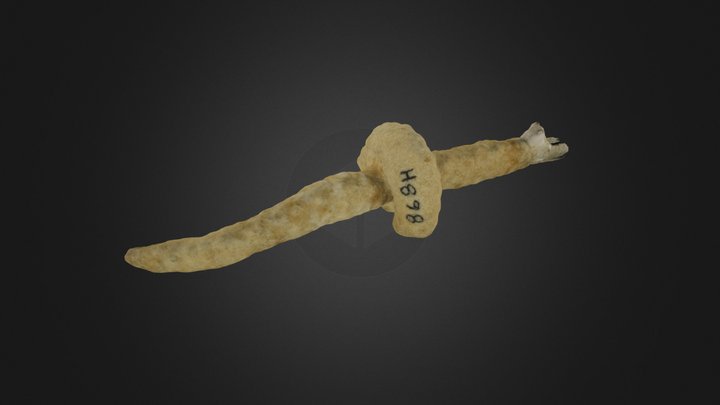
3D model
- Source
- Sketchfab
- Licence
- CC0 Public Domain
- Commercial use
- the licence allows it
Smithsonian Open Access was not reached for this taxon, so this list is what the others held rather than everything there is.
This is what the site found, which is not the same as what exists.
Keep going
What may have been alongside itHippoporidra through timeFormations of the PleistoceneThe world it lived on
Occurrence data from the Paleobiology Database, CC BY 4.0. (Busk 1859)