Himantura
Himantura is a genus of stingray in the family Dasyatidae that is native to the Indo-Pacific. In a 2016 taxonomic revision, many of the species formerly assigned to Himantura were reassigned to other genera.

Aurimas Mikalauskas from Paliūniškis, Lithuania · CC BY-SA 2.0 · via Wikipedia/Commons. May be a photograph of a specimen, or an artist’s reconstruction — an interpretation of a skeleton, since colour and soft tissue are almost never preserved.
On record
Recorded, not inferred- Sits inside
- UrogymninaePBDB
- Diet
- carnivorePBDB, for Myliobatiformes
- Life habit
- nektobenthicPBDB, for Myliobatiformes
- Motility
- actively mobilePBDB, for Myliobatiformes
Time the record covers
At least 32 million years on record.
The record covers at least 37.71 Mya to 5.333 Mya. No occurrence read is dated outside 48.07 Mya to 3.6 Mya.
14 occurrences of Himantura on record, most of them in the Eocene. The Paleobiology Database records this as a living group, and the chart stops with its fossils rather than at the present. Bar height is expected occurrences, not a count: each fossil is spread across the span it is dated to, so a tall narrow bar means tight dating and a low wide one means loose.
When
14 occurrencesThese are dates about fossils, not the animal: the record can only begin after it arose and end before it died out, so either end may reach further. Shares are expected occurrences: a fossil dated to a span is counted partly in each period it straddles. More on what this infers.
Found in
8 formations
- Birket Qarun Formation2
- Chitarwata Formation2
- Samlat Formation1
- Midawara Formation1
- Ashawaq Formation1
- Seria Formation1
Loading coastlines…
The named rock units Himantura has been recovered from, largest first. Drawn where the rock is now, not where it formed. 4 occurrences have no formation on record, which is common for older literature.
Himantura and its relatives
EoceneWhere Himantura and its relatives were recorded in the Eocene.
Found in the same rock
287 taxa- Carcharhinus7 sites
- Rhizoprionodon7 sites
- Dasyatis6 sites
- Myliobatis6 sites
- Rhinoptera6 sites
- Hemipristis serra5 sites
- Rhinobatos5 sites
- Pristis4 sites
- Rhynchobatus4 sites
- Rhynchobatus pristinus4 sites
- Sphyrna4 sites
- Aetomylaeus3 sites
- Carcharhinus perseus3 sites
- Chiloscyllium3 sites
- Gymnura3 sites
- Nebrius3 sites
- Negaprion3 sites
- Pristis lathami3 sites
- Squatina3 sites
- Taeniura3 sites
- Abdounia2 sites
- Aetobatus2 sites
- Anomaluridae2 sites
- Anoxypristis2 sites
The Paleobiology Database records 12 sites for Himantura, and this reads all of them. The number is how many of those sites it was catalogued from too. The 24 sharing the most are listed.
This is not a list of everything alive at the time. It is only what has come out of the same ground as this animal and been written down.
Entered from
10 references- Shark and ray faunas in the Middle and Late Eocene of the Fayum Area, Egypt3
- Rupelian fossil elasmobranch from Omani Thaytiniti fauna fill a chronological gap in the elasmobranch fossil record of west Indian Ocean2
- New tropical carcharhinids (Chondrichthyes, Carcharhiniformes) from the late Eocene-early Oligocene of Balochistan, Pakistan: Paleoenvironmental and paleogeographic implications2
- Remarkable multicuspid teeth in a new elusive skate (Chondrichthyes, Rajiformes) from the Mediterranean Pliocene1
- Diversity and renewal of tropical elasmobranchs around the Middle Eocene Climatic Optimum (MECO) in North Africa: New data from the lagoonal deposits of Djebel el Kébar, Central Tunisia1
- First report on a diverse Neogene cartilaginous fish fauna from Borneo (Ambug Hill, Brunei Darussalam)1
- Neogene sharks and rays from the Brazilian 'Blue Amazon'1
- Miocene shark and batoid fauna from Nosy Makamby (Mahajanga Basin, northwestern Madagascar)1
- A Middle–Late Eocene vertebrate fauna (marine fish and mammals) from southwestern Morocco; preliminary report: age and palaeobiogeographical implications1
- Les sélaciens du Pliocène de la région d'Alba (Piémont, Italie Nord-Ouest)1
Each of the 14 occurrences read was entered from one of these publications, ordered by how many each accounts for. This is not a search for papers mentioning the name. Entries link to doi.org where the Paleobiology Database holds an identifier, and to its own record where it does not. Relayed as the Paleobiology Database holds them, not checked against what they resolve to.
Media and terms
Media content2
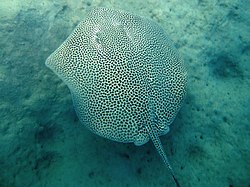
Picture of Himantura
- Source
- Wikipedia/Commons
- Credit
- Aurimas Mikalauskas from Paliūniškis, Lithuania
- Licence
- CC BY-SA 2.0
- Commercial use
- the licence allows it
CT scan
- Source
- MorphoSource
- Licence
- In Copyright
- Commercial use
- cannot be read from the licence given — check the record
- Specimen
- Himantura imbricata · TCWC:Ichthyology:12272.01
Smithsonian Open Access was not reached for this taxon, so this list is what the others held rather than everything there is.
The description on this site
- Source
- Wikipedia, “Himantura”
- Licence
- CC BY-SA 4.0
This is what the site found, which is not the same as what exists.
Keep going
What may have been alongside itUrogymninae through timeFormations of the EoceneThe world it lived on
Occurrence data from the Paleobiology Database, CC BY 4.0. Müller and Henle 1837