Hesperornis
Hesperornis is a genus of cormorant-like ornithuran that spanned throughout the Campanian age, and possibly even up to the early Maastrichtian age, of the Late Cretaceous period. One of the lesser-known discoveries of the paleontologist O. C. Marsh in the late 19th century Bone Wars, it was an early find in the history of avian paleontology. Locations for Hesperornis fossils include the Late Cretaceous marine limestones from Kansas and the marine shales from Canada. Nine species are recognised, eight of which have been recovered from rocks in North America and one from Russia.

Ryan Schwark · CC0 · via Wikipedia/Commons. May be a photograph of a specimen, or an artist’s reconstruction — an interpretation of a skeleton, since colour and soft tissue are almost never preserved.
On record
Recorded, not inferred- Sits inside
- HesperornithidaePBDB
- Diet
- piscivorePBDB
- Life habit
- aquaticPBDB
- Motility
- actively mobilePBDB, for Theropoda
- Environment
- marinePBDB, for Hesperornithiformes
Time the record covers
At least 11 million years on record.
The record covers at least 83.6 Mya to 72.2 Mya. No occurrence read is dated outside 100.5 Mya to 66 Mya.
65 occurrences of Hesperornis on record, most of them in the Late Cretaceous. Bar height is expected occurrences, not a count: each fossil is spread across the span it is dated to, so a tall narrow bar means tight dating and a low wide one means loose.
When
65 occurrences- Late Cretaceous100%
These are dates about fossils, not the animal: the record can only begin after it arose and end before it died out, so either end may reach further. Shares are expected occurrences: a fossil dated to a span is counted partly in each period it straddles. More on what this infers.
Found in
15 formations
- Pierre Shale Formation · Montana Group34
- Pierre Shale Formation · Montana Group3
- Rybushka Formation3
- Niobrara Formation · Colorado Group2
- Kanguk Formation1
- Smoking Hills Formation1
Loading coastlines…
The named rock units Hesperornis has been recovered from, largest first. Drawn where the rock is now, not where it formed. 12 occurrences have no formation on record, which is common for older literature.
Hesperornis and its relatives
Late CretaceousWhere Hesperornis and its relatives were recorded in the Late Cretaceous.
Found in the same rock
124 taxa- Hesperornithiformes6 sites
- Chatangiella4 sites
- Laciniadinium4 sites
- Platecarpus4 sites
- Hesperornithidae3 sites
- Isabelidinium acuminatum3 sites
- Polycotylidae3 sites
- Spinidinium3 sites
- Bananogmius2 sites
- Chamydophorella nyei2 sites
- Elasmobranchii2 sites
- Enchodus2 sites
- Fromea fragilis2 sites
- Heterosphaeridium2 sites
- Isabelidinium cooksoniae2 sites
- Osteichthyes2 sites
- Plesiosauria2 sites
- Plioplatecarpinae2 sites
- Protosphyraena2 sites
- Rhiptocorys veligera2 sites
- Squalicorax falcatus2 sites
- Squalicorax kaupi2 sites
- Theropoda2 sites
- Toxochelys latiremis2 sites
The Paleobiology Database records 50 sites for Hesperornis, and this reads all of them. The number is how many of those sites it was catalogued from too. The 24 sharing the most are listed.
This is not a list of everything alive at the time. It is only what has come out of the same ground as this animal and been written down.
Entered from
23 references- Hesperornithiformes (Aves: Ornithurae) from the Upper Cretaceous Pierre Shale, Southern Manitoba, Canada30
- Cretaceous vertebrates from the Anderson River N. W. T5
- Hesperornis (Aves) from Ellesmere Island and palynological correlation of known Canadian localities4
- Fossil vertebrates from the marine Cretaceous of Manitoba3
- New finds of hesperornithids in the European Russia, with comments on the systematics of Eurasian Hesperornithidae2
- Hesperornithiform birds from the Late Cretaceous (Campanian) of Arkansas, USA2
- Aquatic birds from the Upper Cretaceous (lower Campanian) of Sweden and the biology and distribution of hesperornithiforms2
- Notice of new Odontornithes2
- Upper Cretaceous European theropod palaeobiodiversity, palaeobiogeography and the intra‐Maastrichtian faunal turnover: new contributions from the Iberian fossil site of Laño1
- Fossil Vertebrate Collections1
- New information on the hesperornithiform radiation1
- Mesozoic birds of Mongolia and the former USSR1
Each of the 65 occurrences read was entered from one of these publications, ordered by how many each accounts for. This is not a search for papers mentioning the name. 11 further references are not listed. Entries link to doi.org where the Paleobiology Database holds an identifier, and to its own record where it does not. Relayed as the Paleobiology Database holds them, not checked against what they resolve to.
Media and terms
Media content3

Picture of Hesperornis
- Source
- Wikipedia/Commons
- Credit
- Ryan Schwark
- Licence
- CC0
- Commercial use
- the licence allows it
Laser scan
- Source
- MorphoSource
- Licence
- In Copyright
- Commercial use
- cannot be read from the licence given — check the record
- Specimen
- Hesperornis regalis · YPM:VP:YPM VP 001476
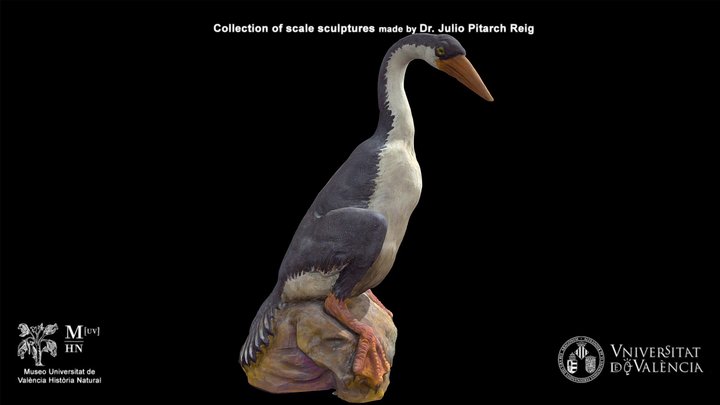
3D model
- Source
- Sketchfab
- Licence
- CC Attribution
- Commercial use
- cannot be read from the licence given — check the record
Smithsonian Open Access was not reached for this taxon, so this list is what the others held rather than everything there is.
The description on this site
- Source
- Wikipedia, “Hesperornis”
- Licence
- CC BY-SA 4.0
This is what the site found, which is not the same as what exists.
Keep going
What may have been alongside itHesperornithidae through timeFormations of the Late CretaceousThe world it lived on
Occurrence data from the Paleobiology Database, CC BY 4.0. Marsh 1872