Hemigrapsus oregonensis
Hemigrapsus oregonensis is a small shore crab of the family Varunidae; formerly classified under the family Grapsidae. It is known under several common names, including yellow shore crab, hairy shore crab, green shore crab, mud-flat crab, bay shore crab and Oregon shore crab. Despite its common name, the crab actually has a wide variety of coloration. It is found along the West Coast of the United States and Canada, specifically along shorelines and similar geographical areas. In 2009, H. oregonensis was included on a list of animals petitioning for the endangered species label, but there was not enough scientific information available for it to be considered as such, so it remains unevaluated to the present day.

Ciar · CC BY-SA 3.0 · via Wikipedia/Commons. May be a photograph of a specimen, or an artist’s reconstruction — an interpretation of a skeleton, since colour and soft tissue are almost never preserved.
On record
Recorded, not inferred- Also called
- yellow shore crabPBDB
- Sits inside
- HemigrapsusPBDB
- Diet
- detritivorePBDB, for Grapsoidea
- Life habit
- infaunalPBDB, for Varunidae
- Motility
- actively mobilePBDB, for Malacostraca
- Vision
- well-developedPBDB, for Malacostraca
Time the record covers
At most 2.6 million years on record.
Every occurrence read is dated to somewhere between 2.58 Mya and 0 Mya, and nothing in the dating separates them, so that window is what the record shows rather than a span.
4 occurrences of Hemigrapsus oregonensis on record, most of them in the Pleistocene. Bar height is expected occurrences, not a count: each fossil is spread across the span it is dated to, so a tall narrow bar means tight dating and a low wide one means loose.
When
4 occurrences- Pleistocene100%
These are dates about fossils, not the animal: the record can only begin after it arose and end before it died out, so either end may reach further. Shares are expected occurrences: a fossil dated to a span is counted partly in each period it straddles. More on what this infers.
Found in
2 formations
Loading coastlines…
The named rock units Hemigrapsus oregonensis has been recovered from, largest first. Drawn where the rock is now, not where it formed. 2 occurrences have no formation on record, which is common for older literature.
Hemigrapsus oregonensis and its relatives
PleistoceneWhere Hemigrapsus oregonensis and its relatives were recorded in the Pleistocene.
Found in the same rock
628 taxa- Callistochiton crassicostatus3 sites
- Cancer productus3 sites
- Hemigrapsus nudus3 sites
- Metacarcinus gracilis3 sites
- Mopalia acuta3 sites
- Mopalia muscosa3 sites
- Pugettia producta3 sites
- Romaleon jordani3 sites
- Acteocina culcitella2 sites
- Acteocina harpa2 sites
- Admete gracilior2 sites
- Alia carinata2 sites
- Antalis pretiosa2 sites
- Antiplanes catalinae2 sites
- Antisabia panamensis2 sites
- Assiminea translucens2 sites
- Borsonella bartschi2 sites
- Brachystomia nemo2 sites
- Caecum californicum2 sites
- Caecum crebricinctum2 sites
- Caesia fossatus2 sites
- Caesia perpinguis2 sites
- Callianax baetica2 sites
- Callianax biplicata2 sites
The Paleobiology Database records 3 sites for Hemigrapsus oregonensis, and this reads all of them. The number is how many of those sites it was catalogued from too. The 24 sharing the most are listed.
This is not a list of everything alive at the time. It is only what has come out of the same ground as this animal and been written down.
Entered from
2 references- The fossil stalk-eyed Crustacea of the Pacific slope of North America3
- Late Pleistocene invertebrates of the Newport Bay area, California1
Each of the 4 occurrences read was entered from one of these publications, ordered by how many each accounts for. This is not a search for papers mentioning the name. Each entry links to doi.org. Relayed as the Paleobiology Database holds them, not checked against what they resolve to.
Media and terms
Media content1
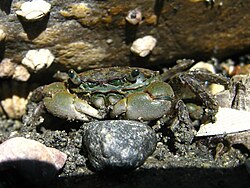
Picture of Hemigrapsus oregonensis
- Source
- Wikipedia/Commons
- Credit
- Ciar
- Licence
- CC BY-SA 3.0
- Commercial use
- the licence allows it
No 3D scan of Hemigrapsus oregonensis was found in MorphoSource and Sketchfab.
Smithsonian Open Access was not reached for this taxon, so this list is what the others held rather than everything there is.
The description on this site
- Licence
- CC BY-SA 4.0
This is what the site found, which is not the same as what exists.
Keep going
What may have been alongside itHemigrapsus through timeFormations of the PleistoceneThe world it lived on
Occurrence data from the Paleobiology Database, CC BY 4.0. (Dana 1851)