Plicatula (Harpax)
Searched as Harpax. The Paleobiology Database treats Plicatula (Harpax) as the accepted name.
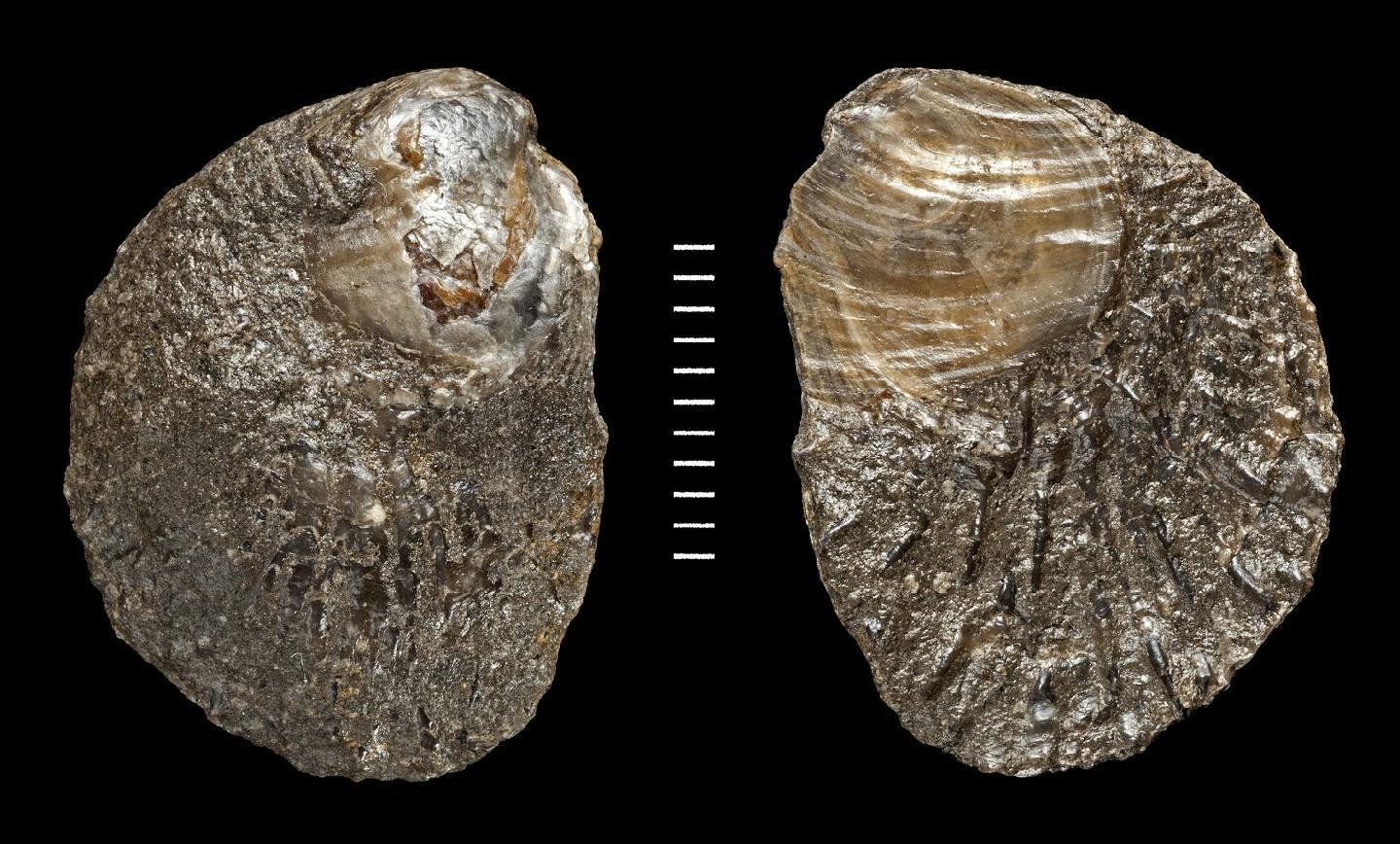
via iDigBio · CC BY · via iDigBio. May be a photograph of a specimen, or an artist’s reconstruction — an interpretation of a skeleton, since colour and soft tissue are almost never preserved.
On record
Recorded, not inferred- Sits inside
- PlicatulaPBDB
- Diet
- suspension feederPBDB, for Plicatula
- Life habit
- epifaunalPBDB, for Plicatula
- Motility
- stationary, attached, epibiontPBDB, for Plicatula
- Vision
- blindPBDB, for Bivalvia
- Environment
- marinePBDB, for Pectinida
Time the record covers
At least 21 million years on record.
The record covers at least 205.7 Mya to 184.2 Mya. No occurrence read is dated outside 227.3 Mya to 170.9 Mya.
197 occurrences of Plicatula (Harpax) on record, most of them in the Early Jurassic. Bar height is expected occurrences, not a count: each fossil is spread across the span it is dated to, so a tall narrow bar means tight dating and a low wide one means loose.
When
197 occurrences- Late Triassic2%
- Early Jurassic98%
- Middle Jurassicunder 1%
These are dates about fossils, not the animal: the record can only begin after it arose and end before it died out, so either end may reach further. Shares are expected occurrences: a fossil dated to a span is counted partly in each period it straddles. More on what this infers.
Found in
17 formations
- São Gião Formation25
- Turmiel Fm Formation14
- Puchenque Formation8
- Turmiel Formation6
- Amaltheenton Formation6
- Piedra Pintada Formation4
Loading coastlines…
The named rock units Plicatula (Harpax) has been recovered from, largest first. Drawn where the rock is now, not where it formed. 108 occurrences have no formation on record, which is common for older literature.
Plicatula (Harpax) and its relatives
Early JurassicWhere Plicatula (Harpax) and its relatives were recorded in the Early Jurassic.
Found in the same rock
228 taxa- Gryphaea (Bilobissa) sublobata41 sites
- Protocardia striatula38 sites
- Grammatodon concinnus36 sites
- Serpula35 sites
- Pecten (Pecten) dentatus29 sites
- Limea (Pseudolimea) roemeri26 sites
- Pinna (Pinna) folium23 sites
- Nannirhynchia pygmaea22 sites
- Parallelodon hirsonensis22 sites
- Pseudopecten (Pseudopecten) equivalvis22 sites
- Quadratirhynchia attenuata22 sites
- Parvamussium pumilum20 sites
- Telothyris pyrenaica20 sites
- Cucullaea (Idonearca) muensteri19 sites
- Katosira19 sites
- Nicaniella (Nicaniella) voltzi19 sites
- Plagiostoma punctatum19 sites
- Eopecten velatus17 sites
- Gibbirhynchia micra16 sites
- Gryphaea (Catinula) crickleyensis16 sites
- Lobothyris punctata16 sites
- Homoeorhynchia meridionalis15 sites
- Pseudomelania (Oonia)15 sites
- Gryphaea (Gryphaea) dumortieri14 sites
The Paleobiology Database records 111 sites for Plicatula (Harpax), and this reads all of them. The number is how many of those sites it was catalogued from too. The 24 sharing the most are listed.
This is not a list of everything alive at the time. It is only what has come out of the same ground as this animal and been written down.
Entered from
26 references- Palökologie benthischer Faunen aus dem Unter-Toarc SW-Europas73
- Reductions in body size of benthic macroinvertebrates as a precursor of the early Toarcian (Early Jurassic) extinction event in the Lusitanian Basin, Portugal25
- Temperature-related body size change of marine benthic macroinvertebrates across the Early Toarcian Anoxic Event19
- Early Jurassic bivalves of Argentina: Part 3, Superfamilies Monotoidea, Pectinoidea, Plicatuloidea and Dimyoidea13
- Early Jurassic Bivalvia of Argentina: Part 1, Stratigraphical introduction and superfamilies Nuculanacea, Arcacea, Mytilacea and Pinnacea11
- Triassic-Jurassic stratigraphy and Bivalvia of northern Priokhotye.8
- Upper Pliensbachian–lowermost Toarcian macroinvertebrates (Ammonites, Bivalves) succession prior to the TOAE extinction interval. The example of Fonte Coberta section - Stop 2.16
- Palokologie und zeitliche Verbreitung benthischer Faunengemeinschaften im Unterjura von Chile5
- Stratigraphic and environmental control on marine benthic community change through the early Toarcian extinction event (Iberian Range, Spain)4
- Palaeoenvironmental and biotic change through the Lower Jurassic in Bulgaria4
- Early Jurassic Bivalvia of northern Chile. Part I. Subclasses Palaeotaxodonta, Pteriomorphia, and Isofilibranchia4
- Das Ober-Pliensbachium (Domerium) der Herforder Liasmulde-Teil 3-Taxonomie und Paläoökologie der Bivalvia aus der Amaltheenton-Formation (Unterjura) der Herforder Liasmulde3
Each of the 197 occurrences read was entered from one of these publications, ordered by how many each accounts for. This is not a search for papers mentioning the name. 14 further references are not listed. Entries link to doi.org where the Paleobiology Database holds an identifier, and to its own record where it does not. Relayed as the Paleobiology Database holds them, not checked against what they resolve to.
Media and terms
Media content2
Picture of Plicatula (Harpax)
- Source
- iDigBio
- Credit
- via iDigBio
- Licence
- CC BY
- Commercial use
- the licence allows it
3D model
- Source
- Sketchfab
- Credit
- Samuel Datubo Higgwe
- Licence
- CC Attribution
- Commercial use
- cannot be read from the licence given — check the record
Smithsonian Open Access was not reached for this taxon, so this list is what the others held rather than everything there is.
This is what the site found, which is not the same as what exists.
Keep going
What may have been alongside itPlicatula through timeFormations of the Early JurassicThe world it lived on
Occurrence data from the Paleobiology Database, CC BY 4.0. (Parkinson 1811)