Giganotosaurus
Giganotosaurus is a genus of large theropod dinosaur that lived in what is now Argentina, during the Albian age of the Early Cretaceous period, approximately 111 to 106 million years ago. The holotype specimen was discovered in the Candeleros Formation of Patagonia in 1993 and is almost 70% complete. The animal was named Giganotosaurus carolinii in 1995; the genus name translates to "giant southern lizard", and the specific name honors the discoverer, Ruben Carolini. A dentary bone, a tooth, and some tracks, discovered before the holotype, were later assigned to this animal. The genus attracted much interest and became part of a scientific debate about the maximum sizes of theropod dinosaurs.

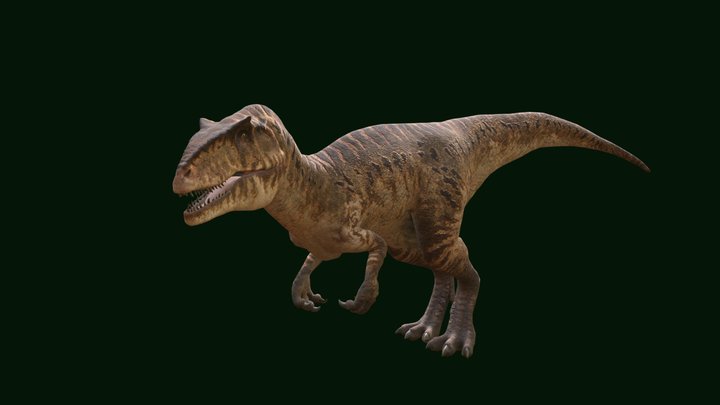
Jonathan Chen · CC BY-SA 4.0 · via Wikipedia/Commons. May be a photograph of a specimen, or an artist’s reconstruction — an interpretation of a skeleton, since colour and soft tissue are almost never preserved.
On record
Recorded, not inferred- Sits inside
- CarcharodontosauridaePBDB
- Diet
- carnivorePBDB, for Theropoda
- Life habit
- ground dwelling, solitaryPBDB, for Theropoda
- Motility
- actively mobilePBDB, for Theropoda
- Environment
- terrestrialPBDB, for Theropoda
- Length
- 13 mWikidata
- Mass
- 13.8 tonneWikidata
Time the record covers
At most 6.9 million years on record.
Every occurrence read is dated to somewhere between 113.2 Mya and 106.3 Mya, and nothing in the dating separates them, so that window is what the record shows rather than a span.
4 occurrences of Giganotosaurus on record, most of them in the Early Cretaceous. Bar height is expected occurrences, not a count: each fossil is spread across the span it is dated to, so a tall narrow bar means tight dating and a low wide one means loose.
When
4 occurrences- Early Cretaceous100%
These are dates about fossils, not the animal: the record can only begin after it arose and end before it died out, so either end may reach further. Shares are expected occurrences: a fossil dated to a span is counted partly in each period it straddles. More on what this infers.
Found in
2 formations
- Candeleros Formation · Neuquén Group3
- Huincul Formation · Neuquén Group1
Loading coastlines…
The named rock units Giganotosaurus has been recovered from, largest first. Drawn where the rock is now, not where it formed.
Giganotosaurus and its relatives
Early CretaceousWhere Giganotosaurus and its relatives were recorded in the Early Cretaceous.
Found in the same rock
3 taxa- Cathartesaura anaerobica1 site
- Prochelidella buitreraensis1 site
- Titanosauriformes1 site
The Paleobiology Database records 4 sites for Giganotosaurus, and this reads all of them. The number is how many of those sites it was catalogued from too.
This is not a list of everything alive at the time. It is only what has come out of the same ground as this animal and been written down.
Entered from
3 references- Dinosaurs and other vertebrates of the Lake Ezequiel Ramos Mexía area, Neuquén-Patagonia, Argentina2
- Nuevos restos craneanos de Carcharodontosauridae (Theropoda, Tetanurae) de “La Buitrera”: provincia de Río Negro, Argentina [New cranial remains of Carcharodontosauridae (Theropoda, Tetanurae) from “La Buitrera”: Río Negro province, Argentina]1
- A new giant carnivorous dinosaur from the Cretaceous of Patagonia1
Each of the 4 occurrences read was entered from one of these publications, ordered by how many each accounts for. This is not a search for papers mentioning the name. Entries link to doi.org where the Paleobiology Database holds an identifier, and to its own record where it does not. Relayed as the Paleobiology Database holds them, not checked against what they resolve to.
Media and terms
Media content2

Picture of Giganotosaurus
- Source
- Wikipedia/Commons
- Credit
- Jonathan Chen
- Licence
- CC BY-SA 4.0
- Commercial use
- the licence allows it
The description on this site
- Licence
- CC BY-SA 4.0
This is what the site found, which is not the same as what exists.
Keep going
What may have been alongside itCarcharodontosauridae through timeFormations of the Early CretaceousThe world it lived on
Occurrence data from the Paleobiology Database, CC BY 4.0. Coria and Salgado 1995