Fungi
A fungus is any member of the group of eukaryotic organisms that includes yeasts, molds, and mushrooms. These organisms are classified in the biological kingdom Fungi.

BorgQueen · CC BY-SA 2.5 · via Wikipedia/Commons. May be a photograph of a specimen, or an artist’s reconstruction — an interpretation of a skeleton, since colour and soft tissue are almost never preserved.
On record
Recorded, not inferred- Sits inside
- HolomycotaPBDB
Time the record covers
At least 719 million years on record.
The record covers at least 720 Mya to 11.7 ka. No occurrence read is dated outside 1000 Mya to 0 Mya.
450 occurrences of Fungi on record, most of them in the Eocene. The Paleobiology Database records this as a living group. Bar height is expected occurrences, not a count: each fossil is spread across the span it is dated to, so a tall narrow bar means tight dating and a low wide one means loose.
When
450 occurrences- Cambrianunder 1%
- Devonian1%
- Permian3%
- Middle Triassicunder 1%
- Late Triassicunder 1%
- Middle Jurassicunder 1%
- Late Jurassicunder 1%
- Early Cretaceous3%
- Late Cretaceous15%
- Paleocene4%
- Eocene54%
- Oligocene3%
- Miocene8%
- Plioceneunder 1%
- Pleistocene3%
- Holocene2%
These are dates about fossils, not the animal: the record can only begin after it arose and end before it died out, so either end may reach further. Shares are expected occurrences: a fossil dated to a span is counted partly in each period it straddles. More on what this infers.
Found in
56 formations
- Deccan Intertrappean Formation34
- Half Three Point Formation24
- Río Turbio Formation22
- Huitrera Formation10
- Neyveli Formation · Cuddalore Group8
- Zarga-Ghazal Formation · Darfur Group6
Loading coastlines…
The named rock units Fungi has been recovered from, largest first. Drawn where the rock is now, not where it formed. 32 further formations hold fewer occurrences each and are not listed. 257 occurrences have no formation on record, which is common for older literature.
Fungi and its relatives
EoceneWhere Fungi and its relatives were recorded in the Eocene.
Found in the same rock
3,118 taxa- Laevigatosporites50 sites
- Cicatricosisporites dorogensis48 sites
- Pediastrum48 sites
- Taxodium48 sites
- Triporopollenites48 sites
- Caryapollenites47 sites
- Thompsonipollis magnificus47 sites
- Casurinidites pulcher46 sites
- Coniferales46 sites
- Microreticulatisporites45 sites
- Liliacidites44 sites
- Pinuspollenites44 sites
- Deltoidospora42 sites
- Gleicheniidites42 sites
- Inapertisporites42 sites
- Osmundacidites41 sites
- Tricolpopollenites41 sites
- Converrucosisporites40 sites
- Momipites40 sites
- Leiotriletes39 sites
- Margocolporites39 sites
- Nudopollis terminalis39 sites
- Ovoidites39 sites
- Divisisporites37 sites
The Paleobiology Database records 151 sites for Fungi, and this reads all of them. Of that, one read hit the database's own return limit, so every count below is a floor rather than a total. The number is how many of those sites it was catalogued from too. The 24 sharing the most are listed.
This is not a list of everything alive at the time. It is only what has come out of the same ground as this animal and been written down.
Entered from
80 references- Distribution of pollen and spores in a subsurface marine Wilcox (Paleocene-Eocene) section in southwest Louisiana174
- A Catalogue of Indian Fossil Plants40
- A Catalogue of Fossil Plants from India Part 4: Cenozoic (Tertiary) Megafossils30
- Upper Cretaceous floras of King George Island, West Antarctica, and their palaeoenvironmental and phytogeographic implications24
- Material fúngico y granos de polen de angiospermas de la Formación Río Turbio (Eoceno), provincia de Santa Cruz, República Argentina24
- Late Cretaceous spore-pollen zonation of the Central African Rift System (CARS), Kaikang Trough, Muglad Basin, South Sudan: angiosperm spread and links to the Elaterates Province11
- Palynostratigraphy of the Paleogene Huitrera Formation in N-W Patagonia, Argeyesina10
- Cretaceous palynomorphs from the James Ross Island area, Antarctica - A pilot Study7
- A Catalogue of Fossil Plants from India Part 6: Cenozoic (Quaternary) Palynology and Palaeobotany6
- Maastrichtian palaeoenvironments and palaeoclimate reconstruction in southern South America (Patagonia, Argentina) based on fossil fungi and algae using open data resources5
- Contribución al conocimiento de la Palinología Estratigráfica de la Formación Lumbrera (Terciario Inferior, grupo Salta)5
- Miocenska Flora ze Starych Gliwic na Slasku (Miocene Flora of Stare Gliwice in Upper Silesia)5
Each of the 450 occurrences read was entered from one of these publications, ordered by how many each accounts for. This is not a search for papers mentioning the name. 68 further references are not listed. Entries link to doi.org where the Paleobiology Database holds an identifier, and to its own record where it does not. Relayed as the Paleobiology Database holds them, not checked against what they resolve to.
Media and terms
Media content1
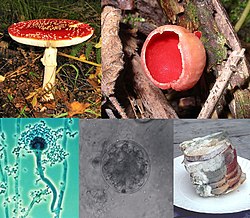
Picture of Fungi
- Source
- Wikipedia/Commons
- Credit
- BorgQueen
- Licence
- CC BY-SA 2.5
- Commercial use
- the licence allows it
No 3D scan of Fungi was found in Sketchfab.
Smithsonian Open Access and MorphoSource were not reached for this taxon, so this list is what the others held rather than everything there is.
The description on this site
- Source
- Wikipedia, “Fungus”
- Licence
- CC BY-SA 4.0
This is what the site found, which is not the same as what exists.
Keep going
What may have been alongside itHolomycota through timeFormations of the EoceneThe world it lived on
Occurrence data from the Paleobiology Database, CC BY 4.0. (Jahn and Jahn 1959)