Eumedlicottia whitneyi
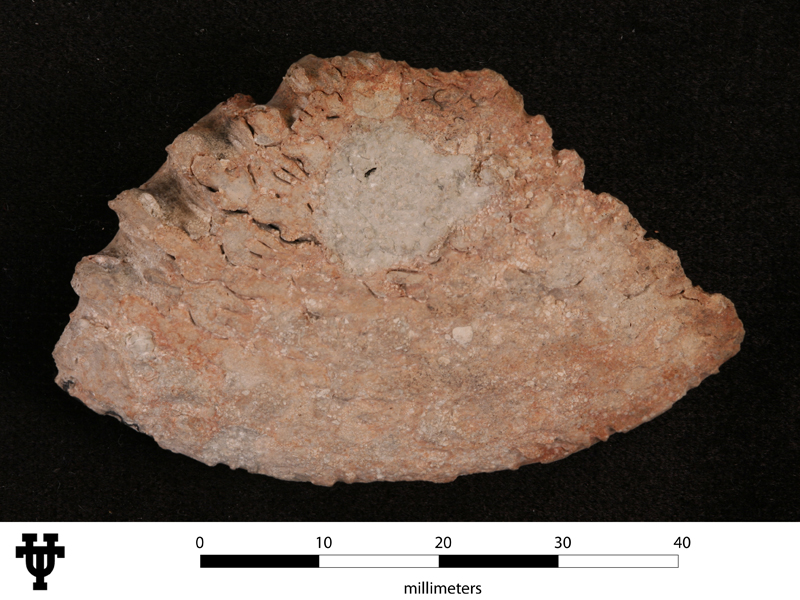
Cummins, W · CC0 · via GBIF. May be a photograph of a specimen, or an artist’s reconstruction — an interpretation of a skeleton, since colour and soft tissue are almost never preserved.
On record
Recorded, not inferred- Sits inside
- EumedlicottiaPBDB
- Diet
- carnivorePBDB, for Ammonoidea
- Life habit
- nektonicPBDB, for Prolecanitida
- Motility
- fast-movingPBDB, for Ammonoidea
- Vision
- well-developedPBDB, for Cephalopoda
- Environment
- marinePBDB, for Cephalopoda
Time the record covers
At most 17 million years on record.
Every occurrence read is dated to somewhere between 283.3 Mya and 266.9 Mya, and nothing in the dating separates them, so that window is what the record shows rather than a span.
13 occurrences of Eumedlicottia whitneyi on record, most of them in the Permian. Bar height is expected occurrences, not a count: each fossil is spread across the span it is dated to, so a tall narrow bar means tight dating and a low wide one means loose.
When
13 occurrences- Permian100%
These are dates about fossils, not the animal: the record can only begin after it arose and end before it died out, so either end may reach further. Shares are expected occurrences: a fossil dated to a span is counted partly in each period it straddles. More on what this infers.
Found in
8 formations
- Road Canyon Formation3
- Cathedral Mountain Formation3
- Blaine Formation2
- Las Sardinas Formation1
- Dog Creek Formation1
- Skinner Ranch Formation1
Loading coastlines…
The named rock units Eumedlicottia whitneyi has been recovered from, largest first. Drawn where the rock is now, not where it formed.
Eumedlicottia whitneyi and its relatives
PermianWhere Eumedlicottia whitneyi and its relatives were recorded in the Permian.
Found in the same rock
232 taxa- Perrinites hilli9 sites
- Bamyaniceras knighti3 sites
- Hustedia3 sites
- Schizodus texanus3 sites
- Altudoceras cooperi2 sites
- Bellerophon (Bellerophon) majusculus2 sites
- Cibecuia gouldii2 sites
- Coelogasteroceras mexicanum2 sites
- Composita mexicana2 sites
- Domatoceras2 sites
- Echinauris2 sites
- Edmondia rotunda2 sites
- Fistulipora2 sites
- Glassoceras normani2 sites
- Hercosia uddeni2 sites
- Heteropecten vanvleeti2 sites
- Leptodesma gouldii2 sites
- Lyroschizodus oklahomensis2 sites
- Medlicottia2 sites
- Meekella calathica2 sites
- Metacoceras inconspicuum2 sites
- Metacrimites newelli2 sites
- Mooreoceras giganteum2 sites
- Nuculavus levatiformis2 sites
The Paleobiology Database records 13 sites for Eumedlicottia whitneyi, and this reads all of them. The number is how many of those sites it was catalogued from too. The 24 sharing the most are listed.
This is not a list of everything alive at the time. It is only what has come out of the same ground as this animal and been written down.
Entered from
8 references- Permian Brachiopods of West Texas, VI4
- Invertebrate Faunas from The Blaine and The Dog Creek Formations of the Permain Leonard Series2
- Permian ammonoids of the Guadalupe Mountain region and adjacent area2
- Permian fusulinids and cephalopods from the vicinity of the Maracaibo basin in northern South America1
- Some exceptional Permian ammonoids from west Texas1
- Geology, Part I of Geology and paleontology of the Permian area northwest of Las Delicias, southwestern Coahulia, Mexico1
- Upper Paleozoic ammonites in Texas1
- The Permo-Carboniferous ammonoids of the Glass Mountains, west Texas, and their stratigraphic significance1
Each of the 13 occurrences read was entered from one of these publications, ordered by how many each accounts for. This is not a search for papers mentioning the name. Entries link to doi.org where the Paleobiology Database holds an identifier, and to its own record where it does not. Relayed as the Paleobiology Database holds them, not checked against what they resolve to.
Media and terms
Media content1
Picture of Eumedlicottia whitneyi
- Source
- GBIF
- Credit
- Cummins, W
- Licence
- CC0
- Commercial use
- the licence allows it
No 3D scan was found. Smithsonian Open Access, MorphoSource and Sketchfab were all searched.
This is what the site found, which is not the same as what exists.
Keep going
What may have been alongside itEumedlicottia through timeFormations of the PermianThe world it lived on
Occurrence data from the Paleobiology Database, CC BY 4.0. (Böse 1919)