Eulichadidae
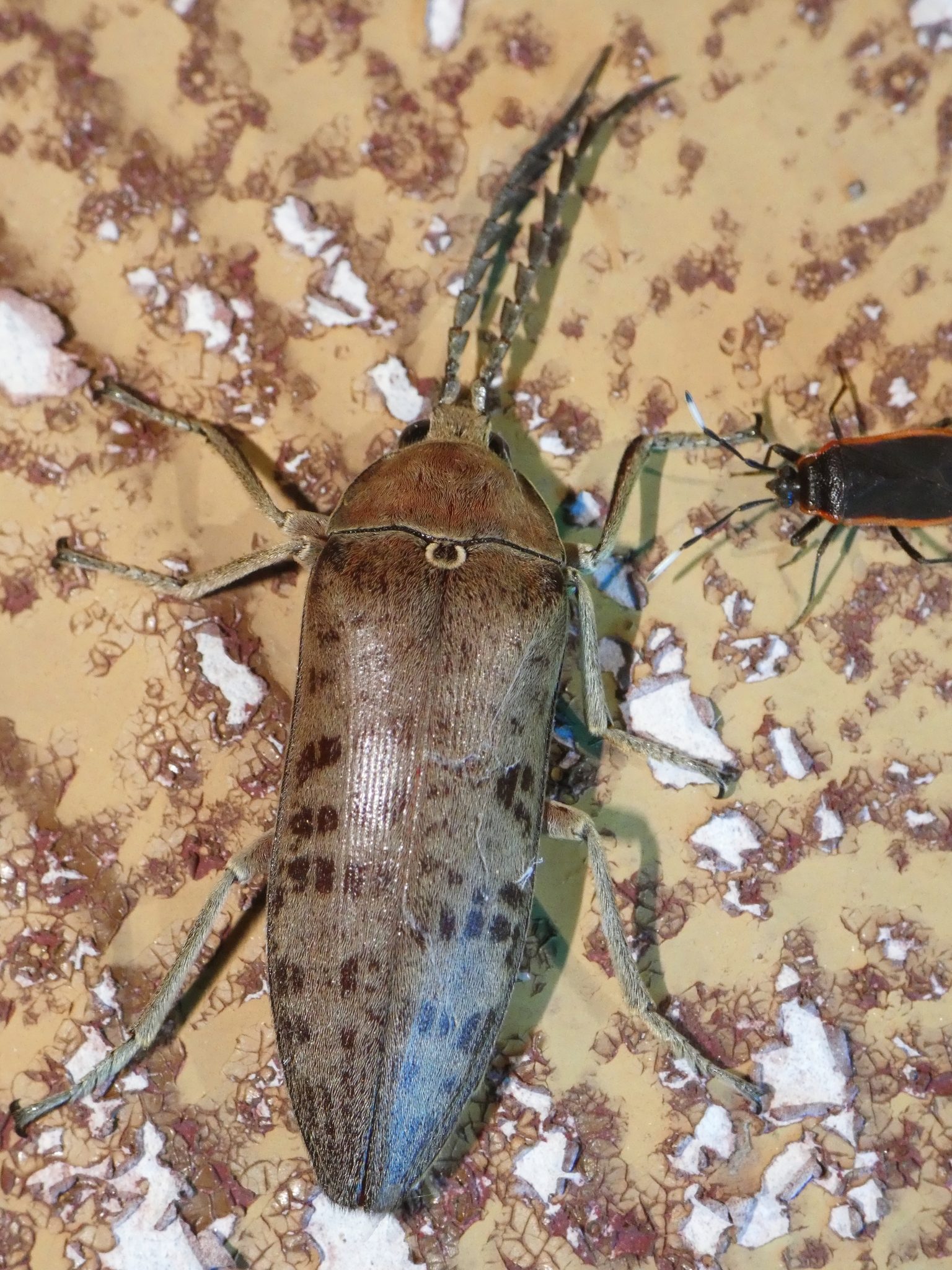
Not Eulichadidae. This is Eulichas fasciolata, a relative — both are Eulichadidae.
Kai Squires · CC BY 4.0 · via GBIF. May be a photograph of a specimen, or an artist’s reconstruction — an interpretation of a skeleton, since colour and soft tissue are almost never preserved.
On record
Recorded, not inferred- Also called
- forest stream beetlePBDB
- Sits inside
- DryopoideaPBDB
- Motility
- actively mobilePBDB, for Arthropoda
- Environment
- terrestrialPBDB, for Insecta
Time the record covers
At least 33 million years on record.
The record covers at least 154.8 Mya to 121.4 Mya. No occurrence read is dated outside 165.3 Mya to 113.2 Mya.
10 occurrences of Eulichadidae on record, most of them in the Early Cretaceous. The Paleobiology Database records this as a living group, and the chart stops with its fossils rather than at the present. Bar height is expected occurrences, not a count: each fossil is spread across the span it is dated to, so a tall narrow bar means tight dating and a low wide one means loose.
When
10 occurrencesThese are dates about fossils, not the animal: the record can only begin after it arose and end before it died out, so either end may reach further. Shares are expected occurrences: a fossil dated to a span is counted partly in each period it straddles. More on what this infers.
Found in
5 formations
- Yixian Formation · Jehol Group4
- Sharteg Formation3
- Karabastau Formation1
- Shar-Tolgoy Formation · Bon-Tsagaan Group1
- Haifanggou Formation1
Loading coastlines…
The named rock units Eulichadidae has been recovered from, largest first. Drawn where the rock is now, not where it formed.
Eulichadidae and its relatives
Early CretaceousWhere Eulichadidae and its relatives were recorded in the Early Cretaceous.
Found in the same rock
296 taxa- Lasiosyne insculpta3 sites
- Shartegoblattina elongata3 sites
- Artematopodites crispulus2 sites
- Artematopodites lepidus2 sites
- Blattula mongolica2 sites
- Blattula vidlickai2 sites
- Clavineta cantabilis2 sites
- Conexicoxa brachycephala2 sites
- Coptoclavidae2 sites
- Cretasyne lata2 sites
- Cretasyne longa2 sites
- Elisama pterostigmata2 sites
- Ilerdocossus fengningensis2 sites
- Mesocinetus aequalis2 sites
- Miracossus ingentius2 sites
- Mongolblatta accurata2 sites
- Protanyderus nebulosus2 sites
- Aenigmagryllus indistinctus1 site
- Aenigmagryllus obscurus1 site
- Aerophasma prynadai1 site
- Aktassoblatta fusca1 site
- Altephialtites altaicus1 site
- Ambolestes zhoui1 site
- Anaglyphites crassipygus1 site
The Paleobiology Database records 9 sites for Eulichadidae, and this reads all of them. The number is how many of those sites it was catalogued from too. The 24 sharing the most are listed.
This is not a list of everything alive at the time. It is only what has come out of the same ground as this animal and been written down.
Entered from
4 references- First record of the beetle family Lasiosynidae (Insecta: Coleoptera) from the Lower Cretaceous of China4
- New beetle species of the genus Lasiosyne (Coleoptera, Lasiosynidae) from the Late Jurassic and Early Cretaceous of Russia and Mongolia4
- Hong, 19831
- K Poznaniyu Iskopaemykh Nasekomykh Yurskikh Slantsev Turkestana. 5. O Nekotorykh Formakh Zhukov (Coleoptera) [ To the knowledge of fossil insects from Jurassic beds in Turkestan 5. On some interesting Coleoptera]1
Each of the 10 occurrences read was entered from one of these publications, ordered by how many each accounts for. This is not a search for papers mentioning the name. Entries link to doi.org where the Paleobiology Database holds an identifier, and to its own record where it does not. Relayed as the Paleobiology Database holds them, not checked against what they resolve to.
Media and terms
Media content1
Picture of Eulichas fasciolata
- Source
- GBIF
- Credit
- Kai Squires
- Licence
- CC BY 4.0
- Commercial use
- the licence allows it
No 3D scan of Eulichadidae was found in MorphoSource and Sketchfab.
Smithsonian Open Access was not reached for this taxon, so this list is what the others held rather than everything there is.
This is what the site found, which is not the same as what exists.
Keep going
What may have been alongside itDryopoidea through timeFormations of the Early CretaceousThe world it lived on
Occurrence data from the Paleobiology Database, CC BY 4.0. Crowson 1973