Estemmenosuchus
Estemmenosuchus is an extinct genus of large herbivorous dinocephalian therapsid. It lived during the Middle Permian around 267 million years ago. The two species, E. uralensis and E. mirabilis, are characterised by distinctive horn-like structures, which were probably used for intra-specific display and/or combat. Both species of Estemmenosuchus are from the Perm region of Russia. It is currently the only recognised genus in the family Estemmenosuchidae. Two other estemmenosuchids, Anoplosuchus and Zopherosuchus, are now considered females of the species E. uralensis. There were many complete and incomplete skeletons found together.

Radim Holiš · CC BY-SA 3.0 cz · via Wikipedia/Commons. May be a photograph of a specimen, or an artist’s reconstruction — an interpretation of a skeleton, since colour and soft tissue are almost never preserved.
On record
Recorded, not inferred- Sits inside
- EstemmenosuchidaePBDB
- Diet
- carnivorePBDB, for Gorgonopsia
- Motility
- actively mobilePBDB, for Osteichthyes
- Environment
- terrestrialPBDB, for Amniota
Time the record covers
At most 11 million years on record.
Every occurrence read is dated to somewhere between 274.4 Mya and 264.28 Mya, and nothing in the dating separates them, so that window is what the record shows rather than a span.
5 occurrences of Estemmenosuchus on record, most of them in the Permian. Bar height is expected occurrences, not a count: each fossil is spread across the span it is dated to, so a tall narrow bar means tight dating and a low wide one means loose.
When
5 occurrences- Permian100%
These are dates about fossils, not the animal: the record can only begin after it arose and end before it died out, so either end may reach further. Shares are expected occurrences: a fossil dated to a span is counted partly in each period it straddles. More on what this infers.
Found in
1 formation
Loading coastlines…
The named rock units Estemmenosuchus has been recovered from, largest first. Drawn where the rock is now, not where it formed. 4 occurrences have no formation on record, which is common for older literature.
Estemmenosuchus and its relatives
PermianWhere Estemmenosuchus and its relatives were recorded in the Permian.
Found in the same rock
11 taxa- Archaeosyodon praeventor1 site
- Biarmosuchus tener1 site
- Bolosauridae1 site
- Chthomaloporus lenocinator1 site
- Collidosuchus tchudinovi1 site
- Davletkulia gigantea1 site
- Eotitanosuchus olsoni1 site
- Kamacops acervalis1 site
- Kazanichthys1 site
- Konzhukovia tarda1 site
- Otsheria netzvetajevi1 site
The Paleobiology Database records 2 sites for Estemmenosuchus, and this reads all of them. The number is how many of those sites it was catalogued from too.
This is not a list of everything alive at the time. It is only what has come out of the same ground as this animal and been written down.
Entered from
2 references- Eotherapsids from the East European Placket (Late Permian)4
- Upper Permian vertebrates and their sedimentological context in the South Urals, Russia1
Each of the 5 occurrences read was entered from one of these publications, ordered by how many each accounts for. This is not a search for papers mentioning the name. Entries link to doi.org where the Paleobiology Database holds an identifier, and to its own record where it does not. Relayed as the Paleobiology Database holds them, not checked against what they resolve to.
Media and terms
Media content2
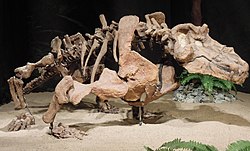
Picture of Estemmenosuchus
- Source
- Wikipedia/Commons
- Credit
- Radim Holiš
- Licence
- CC BY-SA 3.0 cz
- Commercial use
- the licence allows it
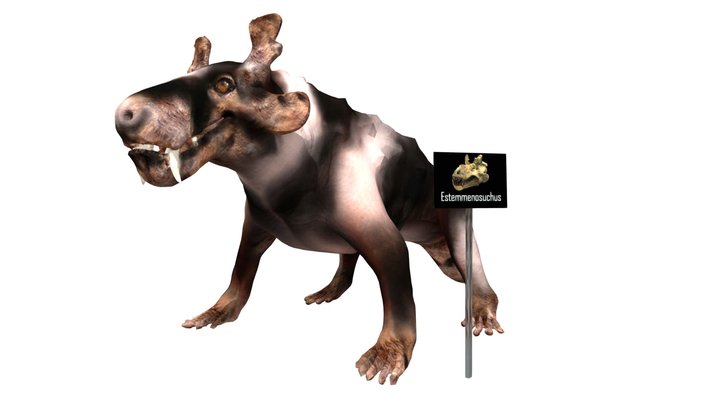
3D model
- Source
- Sketchfab
- Credit
- Robert_the_whale
- Licence
- CC Attribution
- Commercial use
- cannot be read from the licence given — check the record
Smithsonian Open Access and MorphoSource were not reached for this taxon, so this list is what the others held rather than everything there is.
The description on this site
- Licence
- CC BY-SA 4.0
This is what the site found, which is not the same as what exists.
Keep going
What may have been alongside itEstemmenosuchidae through timeFormations of the PermianThe world it lived on
Occurrence data from the Paleobiology Database, CC BY 4.0. Chudinov 1960