Eryon
Eryon is an extinct genus of decapod crustaceans from the Late Jurassic of Germany. Its remains are known from the Solnhofen limestone. It reached a length of around 10 cm (3.9 in), and may have fed on particulate matter on the sea bed. It went extinct sometime after the Late Jurassic, which ended approximately 145 million years ago (Ma). There is no specific date for the extinction of the Eryon genus itself mentioned in the records, only that its existence is confined to the fossil records of the Late Jurassic period.

Didier Descouens · CC BY-SA 4.0 · via Wikipedia/Commons. May be a photograph of a specimen, or an artist’s reconstruction — an interpretation of a skeleton, since colour and soft tissue are almost never preserved.
On record
Recorded, not inferred- Sits inside
- EryonidaePBDB
- Diet
- carnivorePBDB, for Decapoda
- Life habit
- infaunalPBDB, for Polychelida
- Motility
- actively mobilePBDB, for Malacostraca
- Vision
- well-developedPBDB, for Malacostraca
Time the record covers
At least 50 million years on record.
The record covers at least 199.5 Mya to 149.2 Mya. No occurrence read is dated outside 201.4 Mya to 143.1 Mya.
17 occurrences of Eryon on record, most of them in the Late Jurassic. The Paleobiology Database records this as a living group, and the chart stops with its fossils rather than at the present. Bar height is expected occurrences, not a count: each fossil is spread across the span it is dated to, so a tall narrow bar means tight dating and a low wide one means loose.
When
17 occurrencesThese are dates about fossils, not the animal: the record can only begin after it arose and end before it died out, so either end may reach further. Shares are expected occurrences: a fossil dated to a span is counted partly in each period it straddles. More on what this infers.
Found in
4 formations
- Insektenmergel Formation1
- Oxford Clay Formation · Ancholme Group1
- Terrain à Chailles Formation1
- Solnhofen Formation1
Loading coastlines…
The named rock units Eryon has been recovered from, largest first. Drawn where the rock is now, not where it formed. 13 occurrences have no formation on record, which is common for older literature.
Eryon and its relatives
Late JurassicWhere Eryon and its relatives were recorded in the Late Jurassic.
Found in the same rock
93 taxa- Trachysoma rostrata2 sites
- Adamanteryon fourneti1 site
- Aeger brevirostris1 site
- Aeschnopsis tischlingeri1 site
- Antrimpos secretaniae1 site
- Archeosolenocera straeleni1 site
- Atoposaurus oberndorferi1 site
- Bositra buchi1 site
- Bullatimorphites1 site
- Cancrinos claviger1 site
- Chanasia1 site
- Choffatia1 site
- Clausocaris ribeti1 site
- Colossopantopodus boissinensis1 site
- Cycleryon1 site
- Cycleryon elongatus1 site
- Cycleryon orbiculatus1 site
- Cycleryon propinquus1 site
- Cycleryon romani1 site
- Cymatophlebia pumilio1 site
- Dakosaurus maximus1 site
- Decacuminaster solaris1 site
- Diademopsis1 site
- Dollocaris1 site
The Paleobiology Database records 6 sites for Eryon, and this reads all of them. The number is how many of those sites it was catalogued from too. The 24 sharing the most are listed.
This is not a list of everything alive at the time. It is only what has come out of the same ground as this animal and been written down.
Entered from
10 references- Contributions to the Study of Fossil Crustacea8
- The Wattendorf Plattenkalk (Upper Kimmeridgian) - a new conservation lagerstätte from the northern Franconian Alb, southern Germany1
- The Upper Jurassic Solnhofen decapod crustacean fauna review of the types from old descriptions Part I. Infraorders Astacidea, Thalassinidea, and Palinura1
- Remarkable Invertebrates from the Lower Callovian of La Voulte-sur-Rhône (Ardèche, France)1
- Ophioderma escheri Heer aus dem unteren Lias der Schambelen (Kt. Aargau) und verwandete Lias-Ophiuren aus England und Deutschland1
- The Geological Magazine1
- On the decapod crustaceans of the Oxford Clay1
- Notes sur les Crustaces Jurassiques du Bassin Du Jura1
- Description des crustacés fossiles de la Haute-Saône et du Haut-Jura1
- On the classification of some British fossil Crustacea with notices of new forms in the university collection at Cambridge1
Each of the 17 occurrences read was entered from one of these publications, ordered by how many each accounts for. This is not a search for papers mentioning the name. Entries link to doi.org where the Paleobiology Database holds an identifier, and to its own record where it does not. Relayed as the Paleobiology Database holds them, not checked against what they resolve to.
Media and terms
Media content2

Picture of Eryon
- Source
- Wikipedia/Commons
- Credit
- Didier Descouens
- Licence
- CC BY-SA 4.0
- Commercial use
- the licence allows it
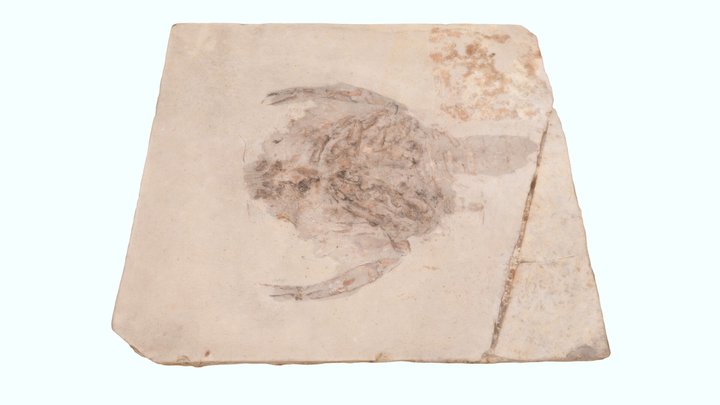
3D model
- Source
- Sketchfab
- Licence
- CC Attribution-NonCommercial-ShareAlike
- Commercial use
- the licence does not allow it
Smithsonian Open Access was not reached for this taxon, so this list is what the others held rather than everything there is.
The description on this site
- Source
- Wikipedia, “Eryon”
- Licence
- CC BY-SA 4.0
This is what the site found, which is not the same as what exists.
Keep going
What may have been alongside itEryonidae through timeFormations of the Late JurassicThe world it lived on
Occurrence data from the Paleobiology Database, CC BY 4.0. Desmarest 1822