Elrathia
Elrathia is a genus of trilobite belonging to Ptychoparioidea known from the mid-Cambrian of Laurentia. E. kingii is one of the most common trilobite fossils in the USA locally found in extremely high concentrations within the Wheeler Formation in the U.S. state of Utah. E. kingii has been considered the most recognizable trilobite. Commercial quarries extract E. kingii in prolific numbers, with just one commercial collector estimating 1.5 million specimens extracted in a 20-year career. 1950 specimens of Elrathia are known from the Greater Phyllopod bed, where they comprise 3.7% of the community."...trilobite occupied the exaerobic zone, at the boundary of anoxic and dysoxic bottom waters. E. kingii consistently occur in settings below the oxygen levels required by other contemporaneous epifaunal and infaunal benthic biota and may have derived energy from a food web that existed independently of phototrophic primary productivity. Although other fossil organisms are known to have preferred such environments, E. kingii is the earliest-known inhabitant of them, extending the documented range of the exaerobic ecological strategy into the Cambrian Period."

Wilson44691 · Public Domain · via Wikipedia/Commons. May be a photograph of a specimen, or an artist’s reconstruction — an interpretation of a skeleton, since colour and soft tissue are almost never preserved.
On record
Recorded, not inferred- Sits inside
- AlokistocaridaePBDB
- Diet
- detritivorePBDB
- Life habit
- epifaunalPBDB
- Motility
- fast-movingPBDB
- Vision
- well-developedPBDB, for Alokistocaridae
- Environment
- marinePBDB, for Trilobita
Time the record covers
At least 8.3 million years on record.
The record covers at least 505.3 Mya to 497 Mya. No occurrence read is dated outside 509.7 Mya to 486.85 Mya.
72 occurrences of Elrathia on record, most of them in the Cambrian. Bar height is expected occurrences, not a count: each fossil is spread across the span it is dated to, so a tall narrow bar means tight dating and a low wide one means loose.
When
72 occurrences- Cambrian100%
These are dates about fossils, not the animal: the record can only begin after it arose and end before it died out, so either end may reach further. Shares are expected occurrences: a fossil dated to a span is counted partly in each period it straddles. More on what this infers.
Found in
28 formations
- Conasauga Formation10
- Shallow Bay Formation · Cow Head Group7
- Holm Dal Formation · Tavsens Iskappe Group7
- Wheeler Formation7
- Burgess Shale Formation · Chancellor Group6
- Upper Wheeler Shale Formation5
Loading coastlines…
The named rock units Elrathia has been recovered from, largest first. Drawn where the rock is now, not where it formed. 4 further formations hold fewer occurrences each and are not listed. 1 occurrence has no formation on record, which is common for older literature.
Elrathia and its relatives
CambrianWhere Elrathia and its relatives were recorded in the Cambrian.
Found in the same rock
536 taxa- Peronopsis25 sites
- Lingulella18 sites
- Modocia15 sites
- Bathyuriscus11 sites
- Olenoides11 sites
- Baltagnostus10 sites
- Micromitra10 sites
- Hyolithes9 sites
- Itagnostus interstrictus9 sites
- Nisusia9 sites
- Haplophrentis carinatus8 sites
- Naraoia compacta8 sites
- Onchonotopsis8 sites
- Pagetia8 sites
- Ptychoparella8 sites
- Alokistocare7 sites
- Chancelloria eros7 sites
- Hazelia7 sites
- Hemirhodon7 sites
- Marpolia spissa7 sites
- Zacanthoides7 sites
- Acrothyra6 sites
- Arthropoda6 sites
- Bolaspidella6 sites
The Paleobiology Database records 68 sites for Elrathia, and this reads all of them. The number is how many of those sites it was catalogued from too. The 24 sharing the most are listed.
This is not a list of everything alive at the time. It is only what has come out of the same ground as this animal and been written down.
Entered from
32 references- Taxonomy and biostratigraphic significance of some Middle Cambrian trilobites from the Conasauga Formation in western Georgia7
- Mid-Cambrian trilobites from the lowest part of the Cow Head Group, western Newfoundland7
- Molluscs of the Holm Dal Formation (late Middle Cambrian), central North Greenland7
- Paleoecology of the Greater Phyllopod Bed community, Burgess Shale6
- Potential Global Standard Stratotype-section and Point (GSSP) for a Cambrian stage boundary defined by the first appearance of the trilobite Ptychagnostus atavus, Drum Mountains, Utah, USA6
- Upper Middle Cambrian stratigraphy of western Utah5
- Evenness, richness and the Cambrian-Paleozoic faunal transition in North America: an assemblage-level perspective3
- The Spence Shale and its fauna3
- Middle Cambrian fossils from Pend Oreille Lake, Idaho3
- The diverse radiodont fauna from the Marjum Formation of Utah, USA (Cambrian: Drumian)2
- Cambrian history of the Grand Canyon region2
- A new, Middle Cambrian, Burgess Shale-type biota, Bolaspidella zone, Chancellor Basin, southeastern British Columbia1
Each of the 72 occurrences read was entered from one of these publications, ordered by how many each accounts for. This is not a search for papers mentioning the name. 20 further references are not listed. Entries link to doi.org where the Paleobiology Database holds an identifier, and to its own record where it does not. Relayed as the Paleobiology Database holds them, not checked against what they resolve to.
Media and terms
Media content3
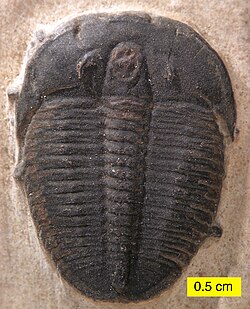
Picture of Elrathia
- Source
- Wikipedia/Commons
- Credit
- Wilson44691
- Licence
- Public Domain
- Commercial use
- the licence allows it
Photogrammetry
- Source
- MorphoSource
- Licence
- not stated by the source
- Commercial use
- cannot be read from the licence given — check the record
- Specimen
- elrathia kingii · MST:PALEO:MST-SP-6257
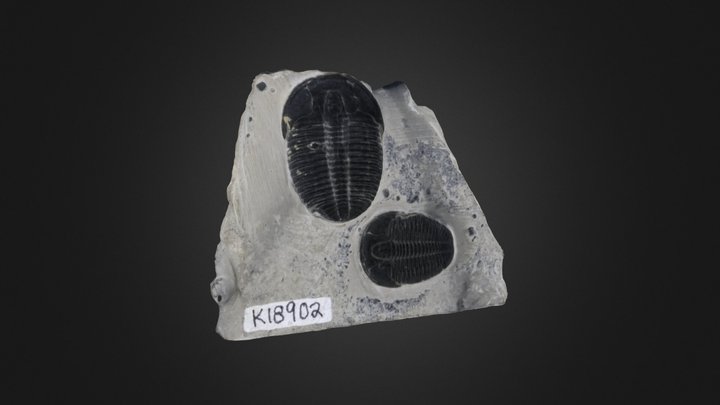
3D model
- Source
- Sketchfab
- Licence
- CC0 Public Domain
- Commercial use
- the licence allows it
The description on this site
- Source
- Wikipedia, “Elrathia”
- Licence
- CC BY-SA 4.0
This is what the site found, which is not the same as what exists.
Keep going
What may have been alongside itAlokistocaridae through timeFormations of the CambrianThe world it lived on
Occurrence data from the Paleobiology Database, CC BY 4.0. Walcott 1924