Dilophosaurus
Dilophosaurus is a genus of theropod dinosaurs that lived in what is now North America during the Early Jurassic, about 186 million years ago. Three skeletons were discovered in northern Arizona in 1940, and the two best preserved were collected in 1942. The most complete specimen became the holotype of a new species in the genus Megalosaurus, named M. wetherilli by Samuel P. Welles in 1954. Welles found a larger skeleton in the same region belonging to the same species in 1964. Realizing it bore crests on its skull, he assigned the species to the new genus Dilophosaurus in 1970, as Dilophosaurus wetherilli. The genus name means "two-crested lizard", and the species name honors John Wetherill, an explorer and amateur archeologist. Further specimens have since been found, including an infant. Fossil footprints have also been attributed to the animal, including resting traces. Another species, Dilophosaurus sinensis from China, was named in 1993, but was later found to belong to the genus Sinosaurus.

Eduard Solà · CC BY-SA 3.0 · via Wikipedia/Commons. May be a photograph of a specimen, or an artist’s reconstruction — an interpretation of a skeleton, since colour and soft tissue are almost never preserved.
On record
Recorded, not inferred- Sits inside
- NeotheropodaPBDB
- Diet
- carnivorePBDB, for Theropoda
- Life habit
- ground dwelling, solitaryPBDB, for Theropoda
- Motility
- actively mobilePBDB, for Theropoda
- Environment
- terrestrialPBDB, for Theropoda
- Length
- 7 mWikidata
- Mass
- 400 kgWikidata
Time the record covers
At most 18 million years on record.
Every occurrence read is dated to somewhere between 201.4 Mya and 184.2 Mya, and nothing in the dating separates them, so that window is what the record shows rather than a span.
14 occurrences of Dilophosaurus on record, most of them in the Early Jurassic. Bar height is expected occurrences, not a count: each fossil is spread across the span it is dated to, so a tall narrow bar means tight dating and a low wide one means loose.
When
14 occurrences- Early Jurassic100%
These are dates about fossils, not the animal: the record can only begin after it arose and end before it died out, so either end may reach further. Shares are expected occurrences: a fossil dated to a span is counted partly in each period it straddles. More on what this infers.
Found in
2 formations
- Kayenta Formation · Glen Canyon Group13
- Dharmaram Formation · Gondwana Group1
Loading coastlines…
The named rock units Dilophosaurus has been recovered from, largest first. Drawn where the rock is now, not where it formed.
Dilophosaurus and its relatives
Early JurassicWhere Dilophosaurus and its relatives were recorded in the Early Jurassic.
Found in the same rock
22 taxa- Archosauria4 sites
- Ornithischia4 sites
- Kayentachelys3 sites
- Kayentatherium3 sites
- Scutellosaurus3 sites
- Scutellosaurus lawleri3 sites
- Syntarsus kayentakatae3 sites
- Theropoda3 sites
- Tritylodontidae3 sites
- Dinnebitodon2 sites
- Oligokyphus2 sites
- Saurischia2 sites
- Testudines2 sites
- Coelophysoidea1 site
- Crocodylomorpha1 site
- Dibothrosuchus1 site
- Edentosuchus1 site
- Lamplughsaura dharmaramensis1 site
- Sarahsaurus aurifontanalis1 site
- Sauropodomorpha1 site
- Tetanurae1 site
- Thyreophora1 site
The Paleobiology Database records 14 sites for Dilophosaurus, and this reads all of them. The number is how many of those sites it was catalogued from too.
This is not a list of everything alive at the time. It is only what has come out of the same ground as this animal and been written down.
Entered from
5 references- A comprehensive anatomical and phylogenetic evaluation of Dilophosaurus wetherilli (Dinosauria, Theropoda) with descriptions of new specimens from the Kayenta Formation of northern Arizona6
- Fossil Vertebrate Collections3
- Vertebrate biostratigraphy of the Glen Canyon Group in northern Arizona2
- New Jurassic dinosaur from the Kayenta Formation of Arizona2
- Basal sauropodomorphs (Dinosauria, Saurischia) from the Lower Jurassic of India: their anatomy and relationships1
Each of the 14 occurrences read was entered from one of these publications, ordered by how many each accounts for. This is not a search for papers mentioning the name. Entries link to doi.org where the Paleobiology Database holds an identifier, and to its own record where it does not. Relayed as the Paleobiology Database holds them, not checked against what they resolve to.
Media and terms
Media content2
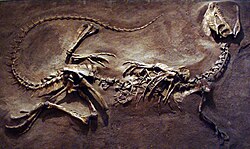
Picture of Dilophosaurus
- Source
- Wikipedia/Commons
- Credit
- Eduard Solà
- Licence
- CC BY-SA 3.0
- Commercial use
- the licence allows it
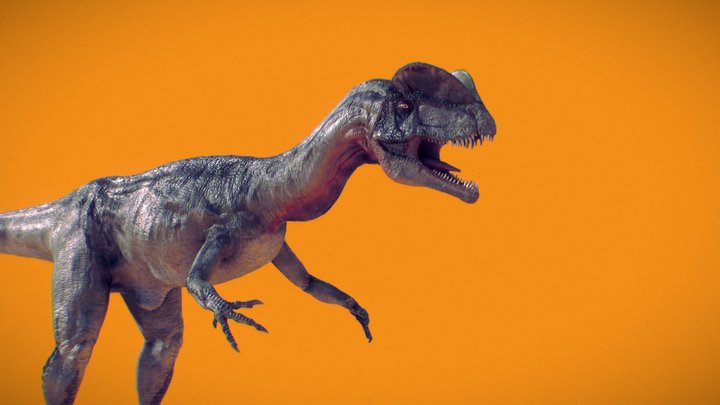
3D model
- Source
- Sketchfab
- Credit
- Marcel Schanz
- Licence
- CC Attribution
- Commercial use
- cannot be read from the licence given — check the record
The description on this site
- Licence
- CC BY-SA 4.0
This is what the site found, which is not the same as what exists.
Keep going
What may have been alongside itNeotheropoda through timeFormations of the Early JurassicThe world it lived on
Occurrence data from the Paleobiology Database, CC BY 4.0. Welles 1970