Decoriconus
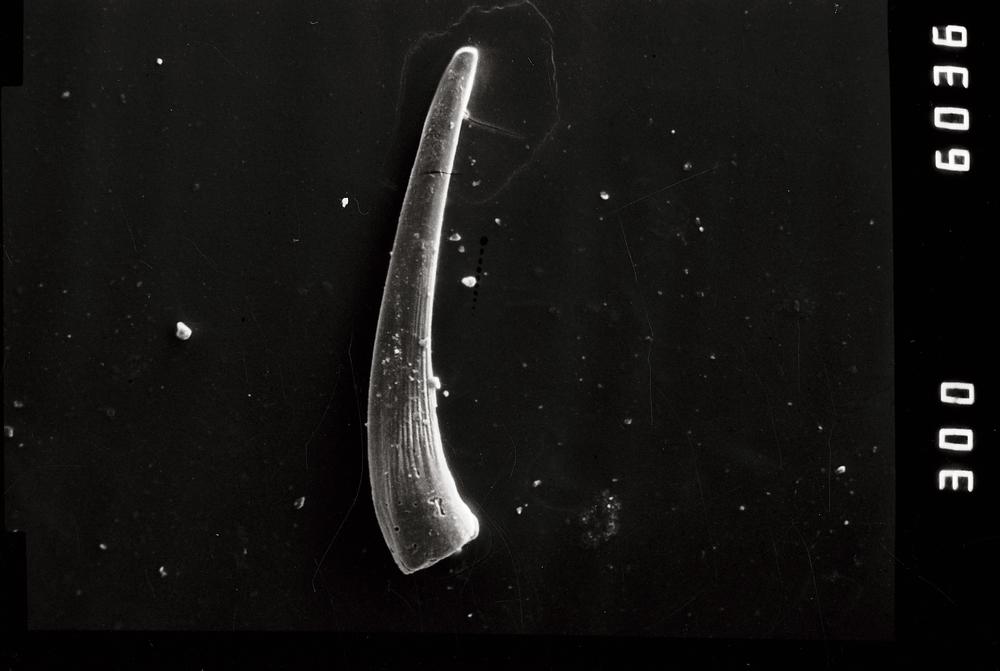
Viira, Viive · CC BY-NC 4.0 · via GBIF. May be a photograph of a specimen, or an artist’s reconstruction — an interpretation of a skeleton, since colour and soft tissue are almost never preserved.
On record
Recorded, not inferred- Sits inside
- StrachanognathidaePBDB
- Diet
- carnivorePBDB, for Conodonta
- Life habit
- nektonicPBDB, for Conodonta
- Motility
- actively mobilePBDB, for Conodonta
- Vision
- well-developedPBDB, for Conodonta
Time the record covers
At least 64 million years on record.
The record covers at least 477.1 Mya to 413.02 Mya. No occurrence read is dated outside 486.85 Mya to 410.62 Mya.
466 occurrences of Decoriconus on record, most of them in the Silurian. Bar height is expected occurrences, not a count: each fossil is spread across the span it is dated to, so a tall narrow bar means tight dating and a low wide one means loose.
When
466 occurrences- Ordovician14%
- Silurian74%
- Devonian12%
These are dates about fossils, not the animal: the record can only begin after it arose and end before it died out, so either end may reach further. Shares are expected occurrences: a fossil dated to a span is counted partly in each period it straddles. More on what this infers.
Found in
83 formations
- Wayne Formation62
- Henryhouse Formation27
- Rauchkofel Formation25
- Jaani Formation22
- Wink Formation · Wristen Group15
- Petes Formation · Hemse Group15
Loading coastlines…
The named rock units Decoriconus has been recovered from, largest first. Drawn where the rock is now, not where it formed. 59 further formations hold fewer occurrences each and are not listed. 33 occurrences have no formation on record, which is common for older literature.
Decoriconus and its relatives
SilurianWhere Decoriconus and its relatives were recorded in the Silurian.
Found in the same rock
173 taxa- Panderodus unicostatus133 sites
- Dapsilodus obliquicostatus116 sites
- Pseudooneotodus bicornis108 sites
- Panderodus90 sites
- Wurmiella excavata82 sites
- Panderodus panderi52 sites
- Walliserodus52 sites
- Pseudooneotodus beckmanni46 sites
- Walliserodus sancticlairi46 sites
- Panderodus equicostatus43 sites
- Ozarkodina excavata excavata42 sites
- Belodella39 sites
- Ozarkodina confluens29 sites
- Kockelella ortus23 sites
- Kockelella22 sites
- Ozarkodina sagitta rhenana22 sites
- Belodella silurica19 sites
- Dapsilodus19 sites
- Oulodus18 sites
- Belodella resima17 sites
- Baltoniodus16 sites
- Kockelella ranuliformis16 sites
- Oulodus siluricus16 sites
- Protopanderodus rectus16 sites
The Paleobiology Database records 281 sites for Decoriconus, and this reads 240 of them. The number is how many of those sites it was catalogued from too. The 24 sharing the most are listed.
This is not a list of everything alive at the time. It is only what has come out of the same ground as this animal and been written down.
Entered from
57 references- Wenlockian (Silurian) Conodont Biostratigraphy, Biofacies, and Carbonate Lithofacies, Wayne Formation, Central Tennessee62
- Conodont biostratigraphy and stable isotope chemostratigraphy of the lower Henryhouse Formation (Gorstian-early Ludfordian, Ludlow, Silurian), southern Oklahoma,USA34
- Conodont Stratigraphy, Facies-Related Distribution Patterns and Stable Isotopes (Carbon and Oxygen)of the Uppermost Silurian to Lower Devonian Seewarte Section(Carnic Alps, Carinthia, Austria)34
- The Llandovery – Wenlock boundary interval in west-central continental Estonia: an example from the Suigu (S-3) core section28
- Siluro-Devonian conodonts from the Camelford Limestone, Wellington, New South Wales, Australia19
- Conodont faunas and stable isotopes across the Mulde Event (late Wenlock; Silurian) in southwestern Laurentia (south-central Oklahoma and subsurface West Texas)18
- Hirnantian (Ordovician) through Wenlock (Silurian) conodont biostratigraphy, bioevents, and integration with graptolite biozones, Cape Phillips Formation slope facies, Cornwallis Island, Canadian Arctic Islands17
- A New Llandovery (Early Silurian) Conodont Biozonation and Conodonts from the Becscie,Merrimack, and Gun River Formations, Anticosti Island, Québec17
- An Early to Middle Ordovician succession of conodont faunas at Mäekalda, northern Estonia15
- (Embargoed dataset for a paper in preparation)14
- Vertebrate dermal remains and conodont distribution in the upper Silurian Hamra and Sundre formations of Gotland, Sweden13
- Distribution of Ordovician and Silurian conodonts11
Each of the 466 occurrences read was entered from one of these publications, ordered by how many each accounts for. This is not a search for papers mentioning the name. 45 further references are not listed. Entries link to doi.org where the Paleobiology Database holds an identifier, and to its own record where it does not. Relayed as the Paleobiology Database holds them, not checked against what they resolve to.
Media and terms
Media content1
Picture of Decoriconus
- Source
- GBIF
- Credit
- Viira, Viive
- Licence
- CC BY-NC 4.0
- Commercial use
- the licence does not allow it
No 3D scan was found. Smithsonian Open Access, MorphoSource and Sketchfab were all searched.
This is what the site found, which is not the same as what exists.
Keep going
What may have been alongside itStrachanognathidae through timeFormations of the SilurianThe world it lived on
Occurrence data from the Paleobiology Database, CC BY 4.0. Cooper 1976