Cymbospondylus
Cymbospondylus is an extinct genus of large ichthyosaurs, of which it is among the oldest representatives, that lived from the Lower to Middle Triassic in what are now North America and Europe. The first known fossils of this taxon are a set of more or less complete vertebrae which were discovered in the 19th century in various mountain ranges of Nevada, in the United States, before being named and described by Joseph Leidy in 1868. It is in the beginning of the 20th century that more complete fossils were discovered through several expeditions to the Fossil Hill Member launched by the University of California, and described in more detail by John Campbell Merriam in 1908, thus visualizing the overall anatomy of the animal. While many species have been assigned to the genus, only five are recognized as valid, the others being considered synonymous, doubtful or belonging to other genera. Cymbospondylus was formerly classified as a representative of the Shastasauridae, but more recent studies consider it to be more basal, view as the type genus of the Cymbospondylidae.

Neil Pezzoni · CC BY 4.0 · via Wikipedia/Commons. May be a photograph of a specimen, or an artist’s reconstruction — an interpretation of a skeleton, since colour and soft tissue are almost never preserved.
On record
Recorded, not inferred- Sits inside
- CymbospondylidaePBDB
- Diet
- carnivorePBDB, for Ichthyosauria
- Life habit
- nektonicPBDB, for Ichthyopterygia
- Motility
- actively mobilePBDB, for Ichthyosauria
- Environment
- marinePBDB, for Ichthyosauria
Time the record covers
At least 5.5 million years on record.
The record covers at least 247 Mya to 241.464 Mya. No occurrence read is dated outside 251.902 Mya to 201.4 Mya.
17 occurrences of Cymbospondylus on record, most of them in the Middle Triassic. Bar height is expected occurrences, not a count: each fossil is spread across the span it is dated to, so a tall narrow bar means tight dating and a low wide one means loose.
When
17 occurrencesThese are dates about fossils, not the animal: the record can only begin after it arose and end before it died out, so either end may reach further. Shares are expected occurrences: a fossil dated to a span is counted partly in each period it straddles. More on what this infers.
Found in
8 formations
- Prida Formation3
- Botneheia Formation2
- Favret Formation · Star Peak Group2
- Thaynes Formation1
- Besano Formation1
- Calcare del Clapsavon Formation1
Loading coastlines…
The named rock units Cymbospondylus has been recovered from, largest first. Drawn where the rock is now, not where it formed. 5 occurrences have no formation on record, which is common for older literature.
Cymbospondylus and its relatives
Middle TriassicWhere Cymbospondylus and its relatives were recorded in the Middle Triassic.
Found in the same rock
27 taxa- Ichthyosauria2 sites
- Acrodus alexandrae1 site
- Acrodus lateralis1 site
- Anarosaurus heterodontus1 site
- Bobasatrania ceresiensis1 site
- Chonespondylus grandis1 site
- Ctenognathichthys bellottii1 site
- Doliovertebra fritschi1 site
- Gymnotoceras blakei1 site
- Hybodus plicatilis1 site
- Meridensia meridensis1 site
- Nothosauridae1 site
- Nothosaurus1 site
- Nothosaurus mirabilis1 site
- Omphalosaurus nevadanus1 site
- Peltopleurus lissocephalus1 site
- Phalarodon atavus1 site
- Phalarodon fraasi1 site
- Pholidopleurus ticinensis1 site
- Placodus gigas1 site
- Platysiagum minus1 site
- Posidonia stella1 site
- Ptycholepis barboi1 site
- Ptycholepis magnus1 site
The Paleobiology Database records 14 sites for Cymbospondylus, and this reads all of them. The number is how many of those sites it was catalogued from too. The 24 sharing the most are listed.
This is not a list of everything alive at the time. It is only what has come out of the same ground as this animal and been written down.
Entered from
12 references- Preliminary note on a new marine reptile from the Middle Triassic of Nevada3
- Notice of some reptilian remains from Nevada3
- Cymbospondylus (Shastasauridae: Ichthyosauria) from the Middle Triassic of Spitsbergen: filling a paleobiogeographic gap2
- A new cymbospondylid ichthyosaur (Ichthyosauria) from the Middle Triassic (Anisian) of the Augusta Mountains, Nevada, USA1
- A new species of Cymbospondylus (Diapsida, Ichthyosauria) from the Middle Triassic of Nevada and a re-evaluation of the skull osteology of the genus1
- New findings of isolated remains of Triassic reptiles from Northeastern Italy1
- Cymbospondylus (Ichthyosauria: Shastasauridae) from the Lower Triassic Thaynes Formation of southeastern Idaho1
- Geographic and stratigraphic distribution of the Triassic Icthyosauria (Reptilia; Diapsida)1
- The large ichthyosaur Cymbospondylus buchseri, sp. nov. from the Middle Triassic of Monte San Giorgio (Switzerland), with a survey of the genus in Europe1
- Über einige Saurierreste aus dem Muschelkalk von Freyburg a. d. Unstrut [On some saurian remains from the Muschelkalk of Freyburg on the Unstrut]1
- Triassic Ichthyosauria1
- A primitive ichthyosaurian limb from the Middle Triassic of Nevada1
Each of the 17 occurrences read was entered from one of these publications, ordered by how many each accounts for. This is not a search for papers mentioning the name. Entries link to doi.org where the Paleobiology Database holds an identifier, and to its own record where it does not. Relayed as the Paleobiology Database holds them, not checked against what they resolve to.
Media and terms
Media content2

Picture of Cymbospondylus
- Source
- Wikipedia/Commons
- Credit
- Neil Pezzoni
- Licence
- CC BY 4.0
- Commercial use
- the licence allows it
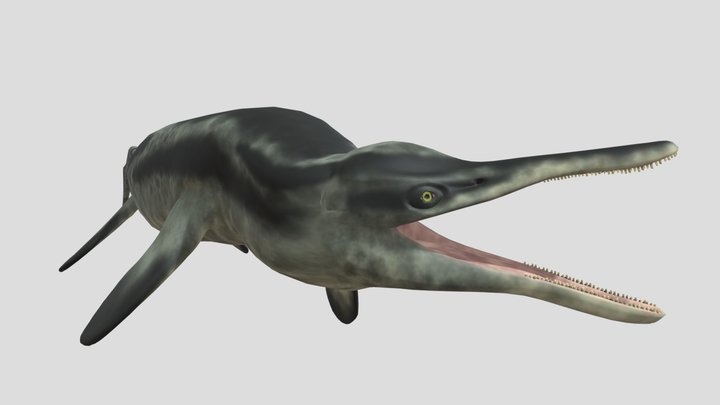
3D model
- Source
- Sketchfab
- Credit
- seth the yutyrannus
- Licence
- CC Attribution
- Commercial use
- cannot be read from the licence given — check the record
Smithsonian Open Access was not reached for this taxon, so this list is what the others held rather than everything there is.
The description on this site
- Licence
- CC BY-SA 4.0
This is what the site found, which is not the same as what exists.
Keep going
What may have been alongside itCymbospondylidae through timeFormations of the Middle TriassicThe world it lived on
Occurrence data from the Paleobiology Database, CC BY 4.0. Leidy 1868