Cucullaea crassatina

Stichting Schepsel Schelp · CC BY 4.0 · via GBIF. May be a photograph of a specimen, or an artist’s reconstruction — an interpretation of a skeleton, since colour and soft tissue are almost never preserved.
On record
Recorded, not inferred- Sits inside
- CucullaeaPBDB
- Diet
- suspension feederPBDB, for Cucullaea
- Life habit
- infaunalPBDB, for Cucullaea
- Motility
- facultatively mobilePBDB, for Cucullaea
- Vision
- limitedPBDB, for Cucullaeidae
Time the record covers
At most 10 million years on record.
Every occurrence read is dated to somewhere between 66 Mya and 56 Mya, and nothing in the dating separates them, so that window is what the record shows rather than a span.
5 occurrences of Cucullaea crassatina on record, most of them in the Paleocene. Bar height is expected occurrences, not a count: each fossil is spread across the span it is dated to, so a tall narrow bar means tight dating and a low wide one means loose.
When
5 occurrences- Paleocene100%
These are dates about fossils, not the animal: the record can only begin after it arose and end before it died out, so either end may reach further. Shares are expected occurrences: a fossil dated to a span is counted partly in each period it straddles. More on what this infers.
Found in
1 formation
Loading coastlines…
The named rock units Cucullaea crassatina has been recovered from, largest first. Drawn where the rock is now, not where it formed. 4 occurrences have no formation on record, which is common for older literature.
Cucullaea crassatina and its relatives
PaleoceneWhere Cucullaea crassatina and its relatives were recorded in the Paleocene.
Found in the same rock
24 taxa- Crassatella3 sites
- Pycnodonte (Phygraea) antiqua antiqua3 sites
- Pholadomya konincki deshayesi2 sites
- Pycnodonte (Phygraea) antiqua pila2 sites
- Sassia2 sites
- Arctica1 site
- Calyptraea (Trochita) aperta1 site
- Cyprina scutellaria1 site
- Dosiniopsis1 site
- Eomiltha contorta1 site
- Maussenetia staadti1 site
- Meiocardia1 site
- Meretrix (Callista) proxima montensis1 site
- Nemocardium1 site
- Panopea1 site
- Priscoficus1 site
- Priscoficus intermedia1 site
- Pycnodonte (Phygraea) antiqua korsunensis1 site
- Pycnodonte (Phygraea) antiqua sartaganica1 site
- Rhinoclavis1 site
- Semiterebellum1 site
- Trochita1 site
- Tudicla cassidariformis1 site
- Turritella arsenei1 site
The Paleobiology Database records 4 sites for Cucullaea crassatina, and this reads all of them. The number is how many of those sites it was catalogued from too.
This is not a list of everything alive at the time. It is only what has come out of the same ground as this animal and been written down.
Entered from
2 references- Karagyuleva, 19644
- Geologische und paläontologische Bearbeitung der Kreide und des Tertiärs im östlichen Rupertiwinkel, nördlich von Salzburg [Geological and paleontological work on the Cretaceous and Tertiary of the eastern Ruperti region, north of Salzburg]1
Each of the 5 occurrences read was entered from one of these publications, ordered by how many each accounts for. This is not a search for papers mentioning the name. Each entry links to the Paleobiology Database's own record for the work.
Media and terms
Media content2
Picture of Cucullaea crassatina
- Source
- GBIF
- Credit
- Stichting Schepsel Schelp
- Licence
- CC BY 4.0
- Commercial use
- the licence allows it
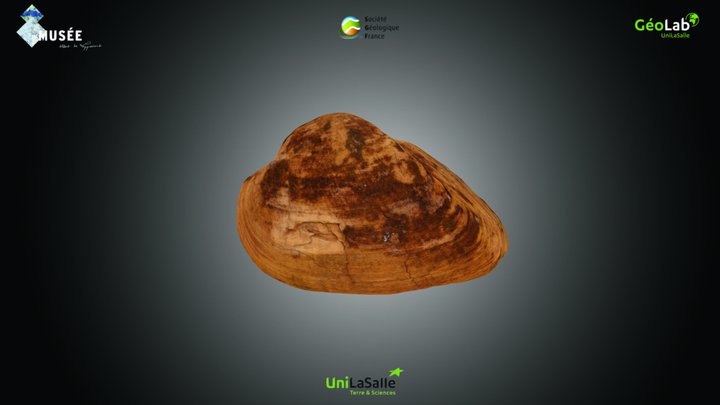
3D model
- Source
- Sketchfab
- Licence
- CC Attribution-NonCommercial-ShareAlike
- Commercial use
- the licence does not allow it
Smithsonian Open Access and MorphoSource were not reached for this taxon, so this list is what the others held rather than everything there is.
This is what the site found, which is not the same as what exists.
Keep going
What may have been alongside itCucullaea through timeFormations of the PaleoceneThe world it lived on
Occurrence data from the Paleobiology Database, CC BY 4.0. Lamarck 1805