Cubozoa
Box jellyfish are cnidarian animals distinguished by their box-like body. Some species of box jellyfish produce potent venom delivered by contact with their tentacles. Stings from some species, including Chironex fleckeri, Carukia barnesi, Malo kingi, and a few others, are extremely painful and often fatal to humans. Some species like the Carybdea murrayana produce a painful sting but are not fatal to humans.

Avispa marina.jpg : Guido Gautsch , Toyota, Japan derivative work: Mithril ( talk ) · CC BY-SA 2.0 · via Wikipedia/Commons. May be a photograph of a specimen, or an artist’s reconstruction — an interpretation of a skeleton, since colour and soft tissue are almost never preserved.
On record
Recorded, not inferred- Also called
- box jellyfishPBDB
- Sits inside
- MedusozoaPBDB
Time the record covers
At least 184 million years on record.
The record covers at least 497 Mya to 312.8 Mya. No occurrence read is dated outside 506.5 Mya to 306 Mya.
3 occurrences of Cubozoa on record, most of them in the Cambrian. The Paleobiology Database records this as a living group, and the chart stops with its fossils rather than at the present. Bar height is expected occurrences, not a count: each fossil is spread across the span it is dated to, so a tall narrow bar means tight dating and a low wide one means loose.
When
3 occurrences- Cambrian67%
- Carboniferous33%
These are dates about fossils, not the animal: the record can only begin after it arose and end before it died out, so either end may reach further. Shares are expected occurrences: a fossil dated to a span is counted partly in each period it straddles. More on what this infers.
Found in
2 formations
Loading coastlines…
The named rock units Cubozoa has been recovered from, largest first. Drawn where the rock is now, not where it formed.
Cubozoa and its relatives
CambrianWhere Cubozoa and its relatives were recorded in the Cambrian.
Found in the same rock
113 taxa- ? Semaeostomae indet.1 site
- Acadagnostus acadica1 site
- Acidusus leptus1 site
- Acidusus occultatus1 site
- Acrothele subsidua1 site
- Altiocculus harrisi1 site
- Ammagnostus1 site
- Ammagnostus laiwuensis1 site
- Anthracomedusa turnbulli1 site
- Aotagnostus lundgreni1 site
- Arthropoda1 site
- Asaphiscus wheeleri1 site
- Athabaskiella1 site
- Bathyuriscidella1 site
- Bathyuriscus1 site
- Bathyuriscus fimbriatus1 site
- Bolaspidella contracta1 site
- Bolaspidella jarrardi1 site
- Branchiocaris pretiosa1 site
- Buccaspinea cooperi1 site
- Burlingia halgedahlae1 site
- Cambrorhytium major1 site
- Canthylotreta1 site
- Caryosyntrips1 site
The Paleobiology Database records 3 sites for Cubozoa, and this reads all of them. The number is how many of those sites it was catalogued from too. The 24 sharing the most are listed.
This is not a list of everything alive at the time. It is only what has come out of the same ground as this animal and been written down.
Entered from
3 references- The diverse radiodont fauna from the Marjum Formation of Utah, USA (Cambrian: Drumian)1
- Exceptionally Preserved Jellyfishes from the Middle Cambrian1
- Pennsylvanian invertebrates of the Mazon Creek area, Illinois: Essex fauna and Medusae1
Each of the 3 occurrences read was entered from one of these publications, ordered by how many each accounts for. This is not a search for papers mentioning the name. Each entry links to doi.org. Relayed as the Paleobiology Database holds them, not checked against what they resolve to.
Media and terms
Media content2
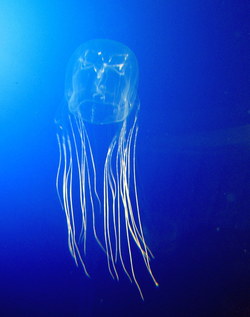
Picture of Cubozoa
- Source
- Wikipedia/Commons
- Credit
- Avispa marina.jpg : Guido Gautsch , Toyota, Japan derivative work: Mithril ( talk )
- Licence
- CC BY-SA 2.0
- Commercial use
- the licence allows it
3D model
- Source
- Sketchfab
- Credit
- Niro Hadus
- Licence
- CC Attribution
- Commercial use
- cannot be read from the licence given — check the record
Smithsonian Open Access and MorphoSource were not reached for this taxon, so this list is what the others held rather than everything there is.
The description on this site
- Licence
- CC BY-SA 4.0
This is what the site found, which is not the same as what exists.
Keep going
What may have been alongside itMedusozoa through timeFormations of the CambrianThe world it lived on
Occurrence data from the Paleobiology Database, CC BY 4.0.