Cruciplacolithus tenuis
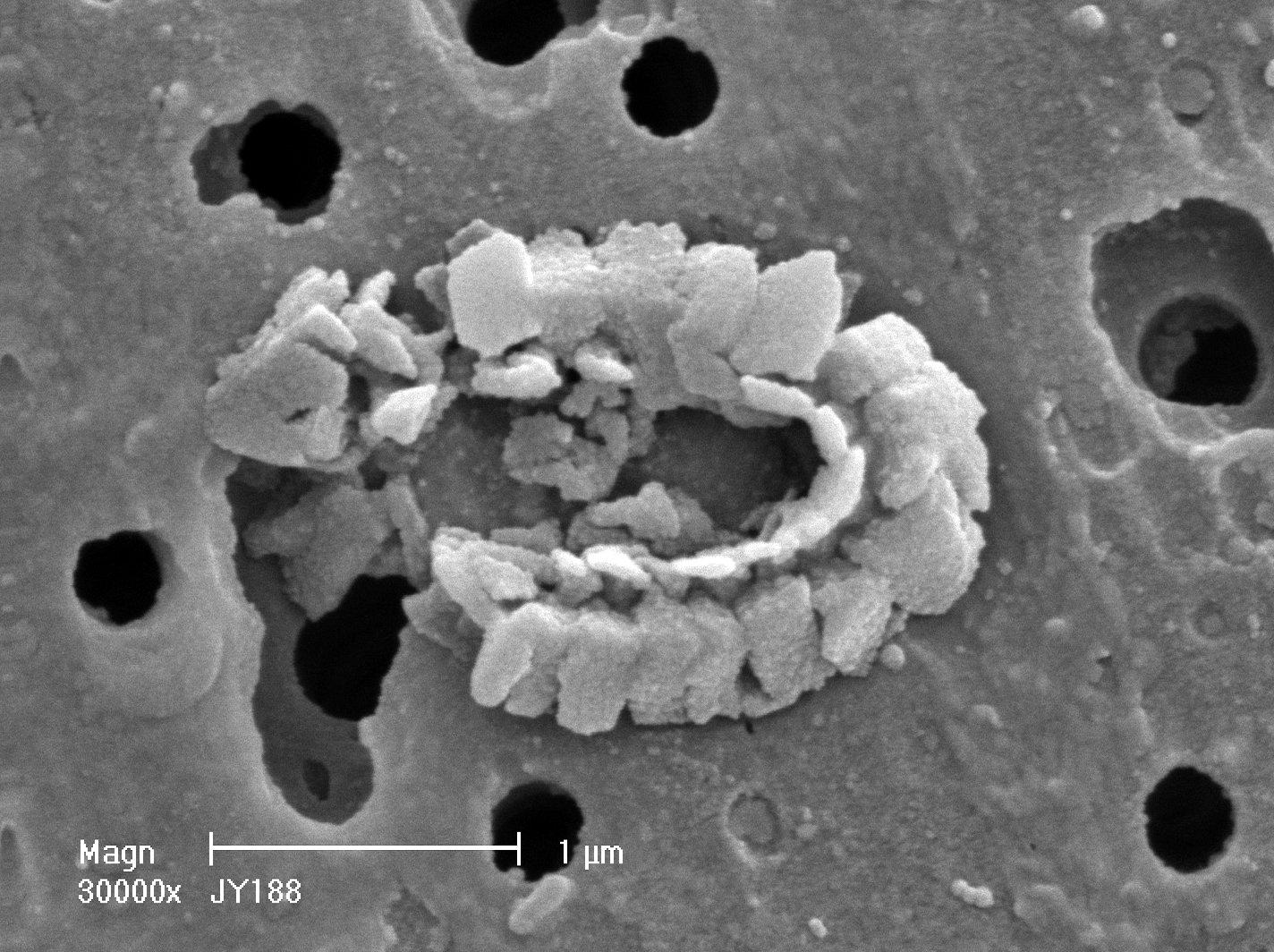
Ian Probert · CC0 · via GBIF. May be a photograph of a specimen, or an artist’s reconstruction — an interpretation of a skeleton, since colour and soft tissue are almost never preserved.
On record
Recorded, not inferred- Sits inside
- CruciplacolithusPBDB
- Diet
- "photoautotroph"PBDB, for Haptophyta
- Life habit
- planktonic, depth=surfacePBDB, for Haptophyta
- Motility
- passively mobilePBDB, for Haptophyta
- Environment
- oceanic,oligotrophic,marine,brackishPBDB, for Haptophyta
Time the record covers
At most 84 million years on record.
Every occurrence read is dated to somewhere between 143.1 Mya and 59.24 Mya, and nothing in the dating separates them, so that window is what the record shows rather than a span.
8 occurrences of Cruciplacolithus tenuis on record, most of them in the Paleocene. Bar height is expected occurrences, not a count: each fossil is spread across the span it is dated to, so a tall narrow bar means tight dating and a low wide one means loose.
When
8 occurrencesThese are dates about fossils, not the animal: the record can only begin after it arose and end before it died out, so either end may reach further. Shares are expected occurrences: a fossil dated to a span is counted partly in each period it straddles. More on what this infers.
Found in
6 formations
- Campo Bola Formation2
- Pedro Luro Formation2
- Porters Creek Formation1
- Clayton Formation1
- Paleocene subsurface Formation1
- Pedro Luro Formation1
Loading coastlines…
The named rock units Cruciplacolithus tenuis has been recovered from, largest first. Drawn where the rock is now, not where it formed.
Cruciplacolithus tenuis and its relatives
PaleoceneWhere Cruciplacolithus tenuis and its relatives were recorded in the Paleocene.
Found in the same rock
103 taxa- Markalius inversus7 sites
- Coccolithus pelagicus6 sites
- Cruciplacolithus primus4 sites
- Hornibrookina teuriensis4 sites
- Micula staurophora4 sites
- Placozygus sigmoides4 sites
- Thoracosphaera4 sites
- Arkhangelskiella cymbiformis3 sites
- Chiasmolithus danicus3 sites
- Micula concava3 sites
- Neochiastozygus concinnus3 sites
- Toweius africanus3 sites
- Braarudosphaera2 sites
- Braarudosphaera bigelowi2 sites
- Braarudosphaera bigelowii2 sites
- Cepekiella2 sites
- Cervisiella operculata2 sites
- Cervisiella saxea2 sites
- Cruciplacolithus edwardsii2 sites
- Eiffellithus turriseiffelii2 sites
- Ericsonia2 sites
- Hornibrookina edwardsii2 sites
- Lanternithus2 sites
- Micrantholithus2 sites
The Paleobiology Database records 8 sites for Cruciplacolithus tenuis, and this reads all of them. The number is how many of those sites it was catalogued from too. The 24 sharing the most are listed.
This is not a list of everything alive at the time. It is only what has come out of the same ground as this animal and been written down.
Entered from
6 references- Calcareous nannofossil events in the late cretaceous at Pedro Luro borehole, Colorado basin, Argentina2
- Biostratigraphy and paleoecology of lower Paleozoic, upper Cretaceous, and lower Tertiary rocks in U.S. Geological Survey New Madrid test wells, Southeastern Missouri2
- Late Maastrichtian to Danian organic-walled dinoflagellate cysts and calcareous nannofossils from eastern Austral Basin, Patagonia, Argentina1
- Primera ingresión atlántica en Peninsula de Valdés: Bioestratigrafía, paleoambiente y paleoclima del Daniano1
- Paleogene calcareous nannofossil biostratigraphy for two boreholes in the eastern Austral Basin, Patagonia, Argentina1
- Nanofósiles calcáreos paleógenos del sudeste de la provincia de Santa Cruz, Patagonia, Argentina1
Each of the 8 occurrences read was entered from one of these publications, ordered by how many each accounts for. This is not a search for papers mentioning the name. Entries link to doi.org where the Paleobiology Database holds an identifier, and to its own record where it does not. Relayed as the Paleobiology Database holds them, not checked against what they resolve to.
Media and terms
Media content1
Picture of Cruciplacolithus tenuis
- Source
- GBIF
- Credit
- Ian Probert
- Licence
- CC0
- Commercial use
- the licence allows it
No 3D scan of Cruciplacolithus tenuis was found in Sketchfab.
Smithsonian Open Access and MorphoSource were not reached for this taxon, so this list is what the others held rather than everything there is.
This is what the site found, which is not the same as what exists.
Keep going
What may have been alongside itCruciplacolithus through timeFormations of the PaleoceneThe world it lived on
Occurrence data from the Paleobiology Database, CC BY 4.0. (Stradner 1961)