Coryssognathus dubius
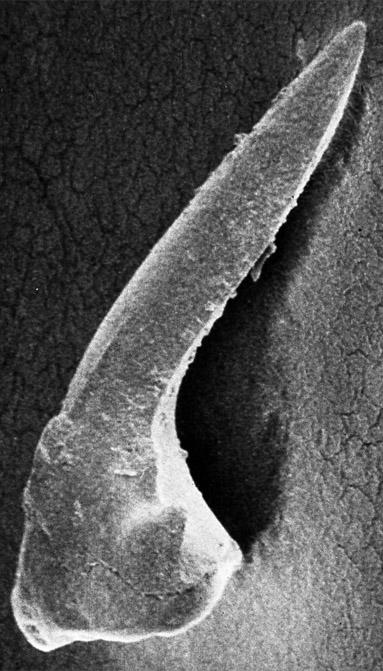
Not Coryssognathus dubius. This is Coryssognathus dubius (Wang, 1980), a relative — both are Cordylodontidae.
Viira, Viive · CC BY-NC 4.0 · via GBIF. May be a photograph of a specimen, or an artist’s reconstruction — an interpretation of a skeleton, since colour and soft tissue are almost never preserved.
On record
Recorded, not inferred- Sits inside
- CoryssognathusPBDB
- Diet
- carnivorePBDB, for Conodonta
- Life habit
- nektonicPBDB, for Conodonta
- Motility
- actively mobilePBDB, for Conodonta
- Vision
- well-developedPBDB, for Conodonta
Time the record covers
At least 10 million years on record.
The record covers at least 432.9 Mya to 422.7 Mya. No occurrence read is dated outside 449.5 Mya to 419.62 Mya.
160 occurrences of Coryssognathus dubius on record, most of them in the Silurian. Bar height is expected occurrences, not a count: each fossil is spread across the span it is dated to, so a tall narrow bar means tight dating and a low wide one means loose.
When
160 occurrences- Ordovicianunder 1%
- Silurian100%
These are dates about fossils, not the animal: the record can only begin after it arose and end before it died out, so either end may reach further. Shares are expected occurrences: a fossil dated to a span is counted partly in each period it straddles. More on what this infers.
Found in
29 formations
- Whitcliffe Formation30
- När Formation · Hemse Group25
- Downton Castle Sandstone Formation · Whitcliffe Group22
- Camelford Formation12
- Upper Whitcliffe Formation8
- Lower Whitcliffe Formation6
Loading coastlines…
The named rock units Coryssognathus dubius has been recovered from, largest first. Drawn where the rock is now, not where it formed. 5 further formations hold fewer occurrences each and are not listed. 20 occurrences have no formation on record, which is common for older literature.
Coryssognathus dubius and its relatives
SilurianWhere Coryssognathus dubius and its relatives were recorded in the Silurian.
Found in the same rock
49 taxa- Panderodus unicostatus20 sites
- Wurmiella excavata19 sites
- Ozarkodina confluens16 sites
- Belodella15 sites
- Belodella resima14 sites
- Thelodus parvidens14 sites
- Walliserodus13 sites
- Panderodus panderi10 sites
- Thelodus9 sites
- Thelodus trilobatus9 sites
- Decoriconus fragilis7 sites
- Panderodus7 sites
- Dapsilodus6 sites
- Panderodus serratus6 sites
- Paralogania ludlowiensis5 sites
- Dvorakia4 sites
- Aspelundia fluegeli3 sites
- Distomodus staurognathoides3 sites
- Ozarkodina crispa3 sites
- Ozarkodina remscheidensis baccata3 sites
- Pseudooneotodus3 sites
- Pseudooneotodus beckmanni3 sites
- Pterospathodus celloni3 sites
- Walliserodus sancticlairi3 sites
The Paleobiology Database records 37 sites for Coryssognathus dubius, and this reads all of them. The number is how many of those sites it was catalogued from too. The 24 sharing the most are listed.
This is not a list of everything alive at the time. It is only what has come out of the same ground as this animal and been written down.
Entered from
17 references- Thelodonts and distribution of associated conodonts from the Llandovery-lowermost Lochkovian of the Welsh Borderland64
- Conodont-based revisions of the Late Ludfordian on Gotland, Sweden20
- Ostracode and conodont distribution across the Ludlow/Pridoli boundary (Silurian) of Wales and the welsh borderland16
- Siluro-Devonian conodonts from the Camelford Limestone, Wellington, New South Wales, Australia15
- Pridoli conodont fauna from tectonically emplaced limestone blocks within the Barnby Hills Shale, central western New South Wales12
- Conodonts from the Upper Ordovician–lower Silurian carbonate platform of North Greenland9
- (Embargoed dataset for a paper in preparation)4
- Chrono-, litho- and conodont bio-stratigraphy of the Rauchkofel Boden Section (Upper Ordovician–Lower Devonian), Carnic Alps, Austria4
- Silurian conodont faunas from Gotland4
- Upper Ordovician – Upper Silurian conodont biostratigraphy, Devon Island and southern Ellesmere Island, Canadian Arctic Islands, with implications for regional stratigraphy, eustasy, and thermal maturation3
- Vertebrate dermal remains and conodont distribution in the upper Silurian Hamra and Sundre formations of Gotland, Sweden2
- Silurian and lowermost Devonian conodonts from the Passo Volaia area (Carnic Alps, Italy)2
Each of the 160 occurrences read was entered from one of these publications, ordered by how many each accounts for. This is not a search for papers mentioning the name. 5 further references are not listed. Entries link to doi.org where the Paleobiology Database holds an identifier, and to its own record where it does not. Relayed as the Paleobiology Database holds them, not checked against what they resolve to.
Media and terms
Media content1
Picture of Coryssognathus dubius (Wang, 1980)
- Source
- GBIF
- Credit
- Viira, Viive
- Licence
- CC BY-NC 4.0
- Commercial use
- the licence does not allow it
No 3D scan was found. Smithsonian Open Access, MorphoSource and Sketchfab were all searched.
This is what the site found, which is not the same as what exists.
Keep going
What may have been alongside itCoryssognathus through timeFormations of the SilurianThe world it lived on
Occurrence data from the Paleobiology Database, CC BY 4.0. (Wang 1980)