Chaperiopsis
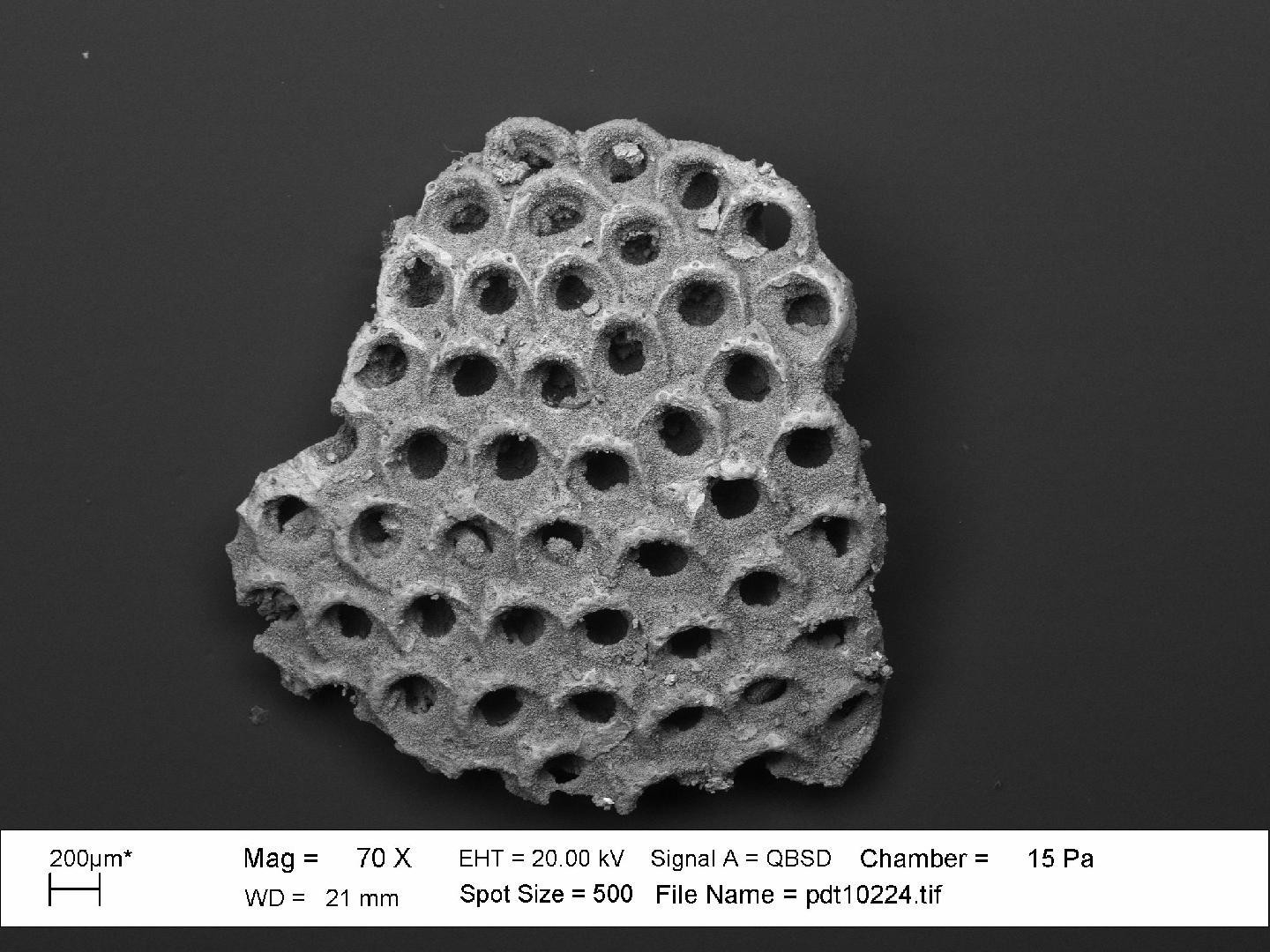
via iDigBio · CC BY · via iDigBio. May be a photograph of a specimen, or an artist’s reconstruction — an interpretation of a skeleton, since colour and soft tissue are almost never preserved.
On record
Recorded, not inferred- Sits inside
- ChaperiidaePBDB
- Diet
- suspension feederPBDB, for Cheilostomata
- Life habit
- epifaunalPBDB, for Cheilostomata
- Motility
- stationary, attachedPBDB, for Cheilostomata
- Vision
- blindPBDB, for Gymnolaemata
- Environment
- marinePBDB, for Lophophorata
Time the record covers
At least 42 million years on record.
The record covers at least 48.07 Mya to 5.333 Mya. No occurrence read is dated outside 56 Mya to 3.6 Mya.
7 occurrences of Chaperiopsis on record, most of them in the Eocene. Bar height is expected occurrences, not a count: each fossil is spread across the span it is dated to, so a tall narrow bar means tight dating and a low wide one means loose.
When
7 occurrencesThese are dates about fossils, not the animal: the record can only begin after it arose and end before it died out, so either end may reach further. Shares are expected occurrences: a fossil dated to a span is counted partly in each period it straddles. More on what this infers.
Chaperiopsis and its relatives
EoceneWhere Chaperiopsis and its relatives were recorded in the Eocene.
Found in the same rock
248 taxa- Hornera4 sites
- Puellina4 sites
- Buffonellaria3 sites
- Cellaria3 sites
- Celleporidae3 sites
- Celleporina3 sites
- Disporella3 sites
- Escharella3 sites
- Escharina3 sites
- Idmidronea3 sites
- Plagioecia3 sites
- Reteporella3 sites
- Caberea2 sites
- Ceriopora2 sites
- Cribellopora2 sites
- Cribrilinidae2 sites
- Crisia2 sites
- Diaperoecia2 sites
- Escharoides2 sites
- Exochella2 sites
- Macroporina waimatukuensis2 sites
- Micropora2 sites
- Microporella2 sites
- Myriapora2 sites
The Paleobiology Database records 5 sites for Chaperiopsis, and this reads all of them. The number is how many of those sites it was catalogued from too. The 24 sharing the most are listed.
This is not a list of everything alive at the time. It is only what has come out of the same ground as this animal and been written down.
Entered from
4 references- Paleoecology of a Late Eocene Mobile Rockground Biota from North Otago, New Zealand4
- Palaeoecology, taphonomy, and preservation of a lower Pliocene shell bed (coquina) froma volcanic oceanic island (Santa Maria Island, Azores)1
- Bryozoa of the Early Eocene Tumaio Limestone, Chatham Island, New Zealand1
- A parautochthonous shallow marine fauna from the Late Burdigalian (early Ottnangian) of Gurlarn (Lower Bavaria, SE Germany): Macrofaunal inventory and paleoecology1
Each of the 7 occurrences read was entered from one of these publications, ordered by how many each accounts for. This is not a search for papers mentioning the name. Each entry links to doi.org. Relayed as the Paleobiology Database holds them, not checked against what they resolve to.
Media and terms
Media content1
Picture of Chaperiopsis
- Source
- iDigBio
- Credit
- via iDigBio
- Licence
- CC BY
- Commercial use
- the licence allows it
No 3D scan of Chaperiopsis was found in MorphoSource and Sketchfab.
Smithsonian Open Access was not reached for this taxon, so this list is what the others held rather than everything there is.
This is what the site found, which is not the same as what exists.
Keep going
What may have been alongside itChaperiidae through timeFormations of the EoceneThe world it lived on
Occurrence data from the Paleobiology Database, CC BY 4.0. Uttley 1949