Cetoniinae
Flower chafers are a group of scarab beetles comprising the subfamily Cetoniinae. Many species are diurnal and visit flowers for pollen and nectar or to browse on the petals. Some species also feed on fruit. The group is also called fruit and flower chafers, flower beetles, and flower scarabs. Around 4,000 species are known, but many of them are still undescribed.

No machine-readable author provided. Jod-let assumed (based on copyright claims). · CC BY-SA 2.5 · via Wikipedia/Commons. May be a photograph of a specimen, or an artist’s reconstruction — an interpretation of a skeleton, since colour and soft tissue are almost never preserved.
On record
Recorded, not inferred- Also called
- flower chaferPBDB
- Sits inside
- ScarabaeidaePBDB
- Motility
- actively mobilePBDB, for Arthropoda
- Environment
- terrestrialPBDB, for Insecta
Time the record covers
At most 6.7 million years on record.
Every occurrence read is dated to somewhere between 20.45 Mya and 13.82 Mya, and nothing in the dating separates them, so that window is what the record shows rather than a span.
5 occurrences of Cetoniinae on record, most of them in the Miocene. The Paleobiology Database records this as a living group, and the chart stops with its fossils rather than at the present. Bar height is expected occurrences, not a count: each fossil is spread across the span it is dated to, so a tall narrow bar means tight dating and a low wide one means loose.
When
5 occurrences- Miocene100%
These are dates about fossils, not the animal: the record can only begin after it arose and end before it died out, so either end may reach further. Shares are expected occurrences: a fossil dated to a span is counted partly in each period it straddles. More on what this infers.
Found in
1 formation
Loading coastlines…
The named rock units Cetoniinae has been recovered from, largest first. Drawn where the rock is now, not where it formed. 1 occurrence has no formation on record, which is common for older literature.
Cetoniinae and its relatives
MioceneWhere Cetoniinae and its relatives were recorded in the Miocene.
Found in the same rock
571 taxa- Bibio shanwangensis2 sites
- Dascillus shandongianus2 sites
- Formica2 sites
- Limois shanwangensis2 sites
- Abia maculosa1 site
- Acanthognathus poinari1 site
- Acaricoris robertae1 site
- Adoretus recticlypeus1 site
- Aeshna ignivora1 site
- Aestilocusta graminea1 site
- Aglyptinus poinari1 site
- Aivalykus dominicanus1 site
- Alethaxius1 site
- Algon spatiosus1 site
- Allecula1 site
- Allecula austriaca1 site
- Allodahlia shanwangensis1 site
- Amberoderma beali1 site
- Anchonus acrolepidotus1 site
- Anechura japonica1 site
- Anisodactylus giganteus1 site
- Anlemmus leptorhinus1 site
- Anomala amblobelia1 site
- Anomala eversa1 site
The Paleobiology Database records 3 sites for Cetoniinae, and this reads all of them. The number is how many of those sites it was catalogued from too. The 24 sharing the most are listed.
This is not a list of everything alive at the time. It is only what has come out of the same ground as this animal and been written down.
Entered from
2 references- Zhang, 19894
- Paleotrichius dominicanus n. gen., n. sp. (Coleoptera; Cetoniidae), a flower beetle in Dominican amber1
Each of the 5 occurrences read was entered from one of these publications, ordered by how many each accounts for. This is not a search for papers mentioning the name. Each entry links to doi.org. Relayed as the Paleobiology Database holds them, not checked against what they resolve to.
Media and terms
Media content1
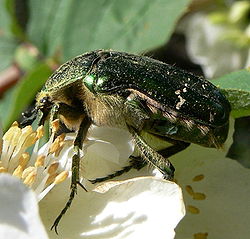
Picture of Cetoniinae
- Source
- Wikipedia/Commons
- Credit
- No machine-readable author provided. Jod-let assumed (based on copyright claims).
- Licence
- CC BY-SA 2.5
- Commercial use
- the licence allows it
No 3D scan of Cetoniinae was found in Sketchfab.
Smithsonian Open Access and MorphoSource were not reached for this taxon, so this list is what the others held rather than everything there is.
The description on this site
- Licence
- CC BY-SA 4.0
This is what the site found, which is not the same as what exists.
Keep going
What may have been alongside itScarabaeidae through timeFormations of the MioceneThe world it lived on
Occurrence data from the Paleobiology Database, CC BY 4.0. (Leach 1815)