Brachycrus
Brachycrus is an extinct genus of oreodont, of the family Merycoidodontidae, endemic to North America. They lived during the Middle Miocene, 16.0—13.6 mya, existing for approximately 2.4 million years.

Apokryltaros at English Wikipedia · CC BY 3.0 · via Wikipedia/Commons. May be a photograph of a specimen, or an artist’s reconstruction — an interpretation of a skeleton, since colour and soft tissue are almost never preserved.
On record
Recorded, not inferred- Sits inside
- BrachycrurinaePBDB
- Diet
- herbivorePBDB, for Merycoidodontidae
- Life habit
- ground dwellingPBDB, for Merycoidodontidae
- Motility
- actively mobilePBDB, for Osteichthyes
- Environment
- terrestrialPBDB, for Artiodactyla
Time the record covers
At least 4.6 million years on record.
The record covers at least 16.3 Mya to 11.63 Mya. No occurrence read is dated outside 23.04 Mya to 5.333 Mya.
73 occurrences of Brachycrus on record, most of them in the Miocene. Bar height is expected occurrences, not a count: each fossil is spread across the span it is dated to, so a tall narrow bar means tight dating and a low wide one means loose.
When
73 occurrences- Miocene100%
These are dates about fossils, not the animal: the record can only begin after it arose and end before it died out, so either end may reach further. Shares are expected occurrences: a fossil dated to a span is counted partly in each period it straddles. More on what this infers.
Found in
17 formations
- Arikaree Formation16
- Olcott Formation10
- Barstow Formation10
- Caliente Formation6
- Sheep Creek Formation4
- Box Butte Formation3
Loading coastlines…
The named rock units Brachycrus has been recovered from, largest first. Drawn where the rock is now, not where it formed. 8 occurrences have no formation on record, which is common for older literature.
Brachycrus and its relatives
MioceneWhere Brachycrus and its relatives were recorded in the Miocene.
Found in the same rock
289 taxa- Aphelops megalodus14 sites
- Merychyus relictus14 sites
- Cynarctoides acridens13 sites
- Equinae13 sites
- Microtomarctus conferta11 sites
- Archaeolaginae10 sites
- Hypohippus10 sites
- Merycodus sabulonis10 sites
- Oreolagus nebrascensis10 sites
- Teleoceras medicornutum10 sites
- Ticholeptus zygomaticus10 sites
- Acritohippus isonesus9 sites
- Brachyerix macrotis9 sites
- Mesogaulus novellus9 sites
- Osbornodon fricki9 sites
- Tomarctus hippophaga9 sites
- Tylocephalonyx skinneri9 sites
- Alphagaulus vetus8 sites
- Camelidae8 sites
- Dromomeryx borealis8 sites
- Geomyoidea8 sites
- Leptocyon leidyi8 sites
- Mesoscalops scopelotemos8 sites
- Paracynarctus kelloggi8 sites
The Paleobiology Database records 70 sites for Brachycrus, and this reads all of them. The number is how many of those sites it was catalogued from too. The 24 sharing the most are listed.
This is not a list of everything alive at the time. It is only what has come out of the same ground as this animal and been written down.
Entered from
17 references- Miocene mammals of the Split Rock area, Granite Mountains basin, central Wyoming16
- Biostratigraphy and Correlation of Hemingfordian and Barstovian Land Mammal Assemblages, Caliente Formation, Cuyama Valley Area, California14
- Merycochoerinae, a new subfamily of oreodonts12
- Synonymies and reidentifications of North American fossil mammals9
- Stratigraphy and biostratigraphy of late Cenozoic deposits in central Sioux County, western Nebraska7
- Stratigraphy Of The Middle Miocene Bopesta Formation, Southern Sierra Nevada, California2
- The Phylogeny of the Oreodonts. Part 1: Merycoidodontinae, Eporeodontinae, and Leptaucheniinae, Three Subfamilies Of Oreodonts, With an Appendix to the Revision Of The Merycoidodontidae, and Part 2. Summary and Conclusions Concerning the Merycoidodontidae2
- Paleontology and nonmarine stratigraphy of the Cuyama Valley badlands, California; Part 1, Geology, faunal interpretations, and systematic descriptions of Chiroptera, Insectivora, and Rodentia2
- Magnetostratigraphy, Biostratigraphy, and Tectonic Rotation of the Miocene Caliente Formation, Ventura County, California1
- Scaphohippus, a new genus of horse (Mammalia: Equidae) from the Barstow Formation of California1
- Road Log Neogene geology of the Española Basin, New Mexico1
- Stratigraphy and geochronology of Miocene strata in the central Mojave Desert, California1
Each of the 73 occurrences read was entered from one of these publications, ordered by how many each accounts for. This is not a search for papers mentioning the name. 5 further references are not listed. Entries link to doi.org where the Paleobiology Database holds an identifier, and to its own record where it does not. Relayed as the Paleobiology Database holds them, not checked against what they resolve to.
Media and terms
Media content1
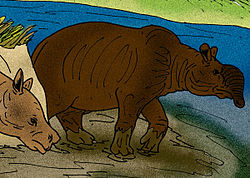
Picture of Brachycrus
- Source
- Wikipedia/Commons
- Credit
- Apokryltaros at English Wikipedia
- Licence
- CC BY 3.0
- Commercial use
- the licence allows it
No 3D scan was found. Smithsonian Open Access, MorphoSource and Sketchfab were all searched.
The description on this site
- Source
- Wikipedia, “Brachycrus”
- Licence
- CC BY-SA 4.0
This is what the site found, which is not the same as what exists.
Keep going
What may have been alongside itBrachycrurinae through timeFormations of the MioceneThe world it lived on
Occurrence data from the Paleobiology Database, CC BY 4.0. (Matthew 1901)