Barbarorthis
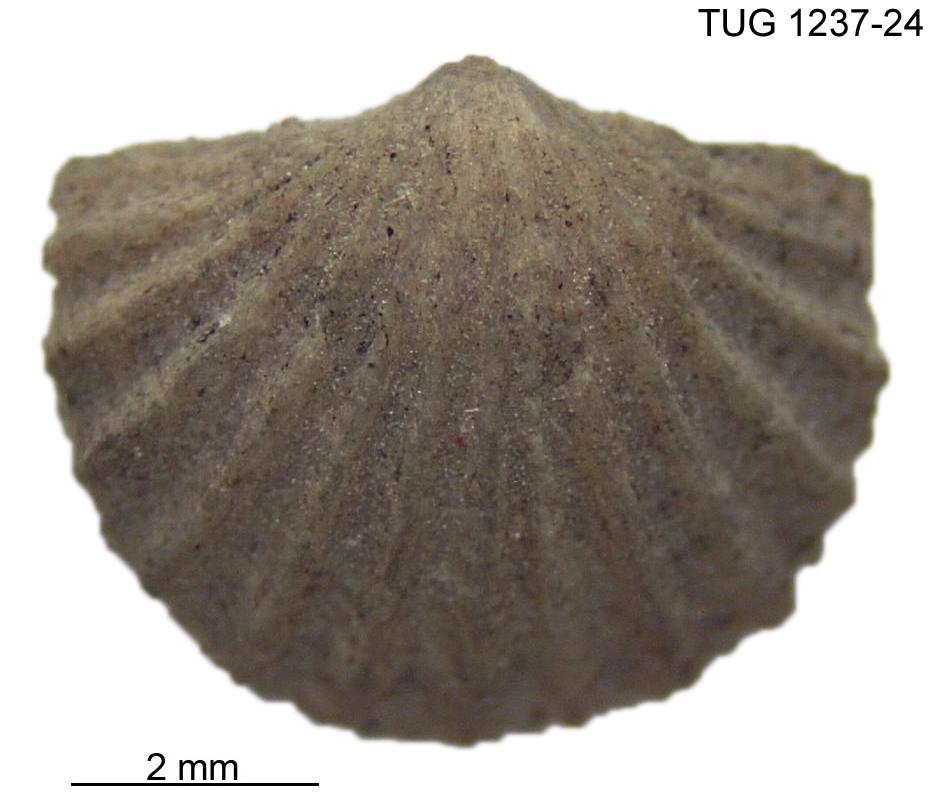
GALR · CC BY-NC 4.0 · via GBIF. May be a photograph of a specimen, or an artist’s reconstruction — an interpretation of a skeleton, since colour and soft tissue are almost never preserved.
On record
Recorded, not inferred- Sits inside
- HesperorthidaePBDB
- Diet
- suspension feederPBDB, for Orthida
- Life habit
- epifaunalPBDB, for Orthida
- Motility
- stationary, attachedPBDB, for Orthida
- Vision
- blindPBDB, for Rhynchonellata
- Environment
- marinePBDB, for Lophophorata
Time the record covers
At least 4.3 million years on record.
The record covers at least 449.5 Mya to 445.2 Mya. No occurrence read is dated outside 449.9 Mya to 443.1 Mya.
31 occurrences of Barbarorthis on record, most of them in the Ordovician. Bar height is expected occurrences, not a count: each fossil is spread across the span it is dated to, so a tall narrow bar means tight dating and a low wide one means loose.
When
31 occurrences- Ordovician100%
These are dates about fossils, not the animal: the record can only begin after it arose and end before it died out, so either end may reach further. Shares are expected occurrences: a fossil dated to a span is counted partly in each period it straddles. More on what this infers.
Found in
6 formations
- Vaureal Formation15
- Kuldiga Formation4
- Ellis Bay Formation3
- Moe Formation3
- Killey Bridge Formation1
- Kuldiga Formation1
Loading coastlines…
The named rock units Barbarorthis has been recovered from, largest first. Drawn where the rock is now, not where it formed. 4 occurrences have no formation on record, which is common for older literature.
Barbarorthis and its relatives
OrdovicianWhere Barbarorthis and its relatives were recorded in the Ordovician.
Found in the same rock
88 taxa- Onniella tricapitata15 sites
- Hebertella maria13 sites
- Mendacella uberis12 sites
- Eochonetes glabra11 sites
- Plaesiomys anticostiensis11 sites
- Coolinia gamachiana10 sites
- Leptaena quadrilatera10 sites
- Hindella umbonata9 sites
- Vinlandostrophia regularis8 sites
- Eospirigerina7 sites
- Nicolella oswaldi7 sites
- Strophomena7 sites
- Sowerbyella (Eochonetes)6 sites
- Boreadorthis crassa5 sites
- Parastrophinella reversa5 sites
- Rostricellula5 sites
- Boreadorthis sadewitzensis4 sites
- Hypsiptycha anticostiensis4 sites
- Vellamo diversa4 sites
- Platystrophia humilis3 sites
- Dinorthis (Plaesiomys) solaris2 sites
- Eostrophonella semiovalis2 sites
- Pseudolingula elegantula2 sites
- Rhynchotrema nutrix2 sites
The Paleobiology Database records 30 sites for Barbarorthis, and this reads all of them. The number is how many of those sites it was catalogued from too. The 24 sharing the most are listed.
This is not a list of everything alive at the time. It is only what has come out of the same ground as this animal and been written down.
Entered from
7 references- Late Ordovician Orthide and Billingsellide Brachiopods from Anticosti Island, Eastern Canada: Diversity Change Through Mass Extinction16
- Einige Vertreter der Superfamilie Orthacea des Oberordoviziums Estlands6
- Paleontological Characteristic of adjacent Ordovician and Silurian deposits in Latvia5
- First Major Appearance of Brachiopod-Dominated Benthic Shelly Communities in the Reef Ecosystem during the Early Silurian1
- Late Ordovician and Early Silurian strophomenid brachiopods of Anticosti Island, Quebec, Canada1
- The Ordovician Brachiopoda from Pomeroy, Co. Tyrone1
- Über Klitamboniten1
Each of the 31 occurrences read was entered from one of these publications, ordered by how many each accounts for. This is not a search for papers mentioning the name. Entries link to doi.org where the Paleobiology Database holds an identifier, and to its own record where it does not. Relayed as the Paleobiology Database holds them, not checked against what they resolve to.
Media and terms
Media content1
Picture of Barbarorthis
- Source
- GBIF
- Credit
- GALR
- Licence
- CC BY-NC 4.0
- Commercial use
- the licence does not allow it
No 3D scan of Barbarorthis was found in MorphoSource and Sketchfab.
Smithsonian Open Access was not reached for this taxon, so this list is what the others held rather than everything there is.
This is what the site found, which is not the same as what exists.
Keep going
What may have been alongside itHesperorthidae through timeFormations of the OrdovicianThe world it lived on
Occurrence data from the Paleobiology Database, CC BY 4.0. Opik 1934