Astrangia
Astrangia is a genus of stony corals in the family Rhizangiidae. Members of this genus are non-reef building corals and are found in the Atlantic and Indo-Pacific Oceans. They are solitary corals with large polyps and are found in clumps. They reproduce from stolons. The corallites are small with simple toothed septa.

Cairns S, Kitahara M (2012) · CC BY 3.0 · via Wikipedia/Commons. May be a photograph of a specimen, or an artist’s reconstruction — an interpretation of a skeleton, since colour and soft tissue are almost never preserved.
On record
Recorded, not inferred- Sits inside
- RhizangiidaePBDB
- Diet
- suspension feederPBDB, for Rhizangiidae
- Life habit
- colonial, clonalPBDB, for Rhizangiidae
- Motility
- stationary, attachedPBDB, for Rhizangiidae
- Vision
- blindPBDB, for Anthozoa
- Environment
- marinePBDB, for Rhizangiidae
Time the record covers
At least 93 million years on record.
The record covers at least 93.9 Mya to 11.7 ka. No occurrence read is dated outside 100.5 Mya to 0 Mya.
73 occurrences of Astrangia on record, most of them in the Miocene. The Paleobiology Database records this as a living group. Bar height is expected occurrences, not a count: each fossil is spread across the span it is dated to, so a tall narrow bar means tight dating and a low wide one means loose.
When
73 occurrences- Late Cretaceous8%
- Paleocene4%
- Eocene16%
- Oligocene7%
- Miocene23%
- Pliocene19%
- Pleistocene20%
- Holocene3%
These are dates about fossils, not the animal: the record can only begin after it arose and end before it died out, so either end may reach further. Shares are expected occurrences: a fossil dated to a span is counted partly in each period it straddles. More on what this infers.
Found in
31 formations
- Moodys Branch Formation · Jackson Group3
- Kirkwood Formation3
- Cook Mountain Formation · Claiborne Group3
- San Joaquin Formation3
- Agatdal Formation2
- Acredale Formation2
Loading coastlines…
The named rock units Astrangia has been recovered from, largest first. Drawn where the rock is now, not where it formed. 7 further formations hold fewer occurrences each and are not listed. 27 occurrences have no formation on record, which is common for older literature.
Astrangia and its relatives
MioceneWhere Astrangia and its relatives were recorded in the Miocene.
Found in the same rock
1,230 taxa- Nucula (Nucula) proxima6 sites
- Chama arcana5 sites
- Crassostrea virginica5 sites
- Anadara (Larkinia) transversa4 sites
- Anadara trilineata4 sites
- Anomia simplex4 sites
- Crepidula fornicata4 sites
- Culicia parasita4 sites
- Dallocardia quadragenarium4 sites
- Dendrophyllia amica4 sites
- Elphidium4 sites
- Mercenaria mercenaria4 sites
- Panopea generosa4 sites
- Polinices4 sites
- Turritella4 sites
- Ammonia3 sites
- Balanophyllia italica3 sites
- Balanophyllia varians3 sites
- Bryozoa3 sites
- Busycon carica3 sites
- Calliostoma3 sites
- Calliostoma coalingensis3 sites
- Calliostoma kerri3 sites
- Cladocora multicaulis3 sites
The Paleobiology Database records 35 sites for Astrangia, and this reads all of them. The number is how many of those sites it was catalogued from too. The 24 sharing the most are listed.
This is not a list of everything alive at the time. It is only what has come out of the same ground as this animal and been written down.
Entered from
42 references- Les faunes de coraux (Anthozoaires Scléractiniaires) de la façade atlantique française au Chattien et au Miocène8
- Invertebrate Macropaleontolgy of the Clarke County Mississippi Area6
- The Eocene and lower Oligocene coral faunas of the United States with descriptions of a few doubtfully Cretaceous species5
- Late Cenozoic corals of south Florida3
- Corals from the Chipola and Jackson Bluff Formations of Florida3
- Miocene invertebrate fauna of New Jersey3
- Diverse Macroids and Rhodoliths from the Upper Pleistocene of Baja California Sur, Mexico2
- The fauna and paleoecology of the Late Pleistocene marine sediments of southeastern Virginia2
- Scleractinian corals from the Upper Cretaceous and Lower Tertiary of Nugssuaq, West Greenland2
- Recherches sur les Madreporaires et les formations recifales Miocenes de la Mediterranee occidentale [Miocene corals and reefs from the western Mediterranean]2
- Results of the Puritan-American Museum of Natural History expedition to western Mexico. Part 7: Corals and coral reefs in the Gulf of California2
- A new coral from the Pliocene of California2
Each of the 73 occurrences read was entered from one of these publications, ordered by how many each accounts for. This is not a search for papers mentioning the name. 30 further references are not listed. Entries link to doi.org where the Paleobiology Database holds an identifier, and to its own record where it does not. Relayed as the Paleobiology Database holds them, not checked against what they resolve to.
Media and terms
Media content3
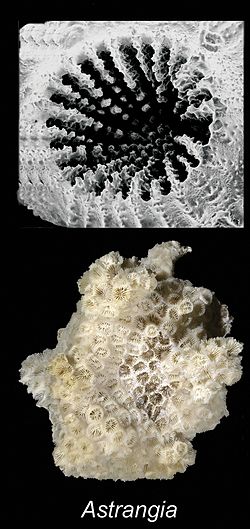
Picture of Astrangia
- Source
- Wikipedia/Commons
- Credit
- Cairns S, Kitahara M (2012)
- Licence
- CC BY 3.0
- Commercial use
- the licence allows it
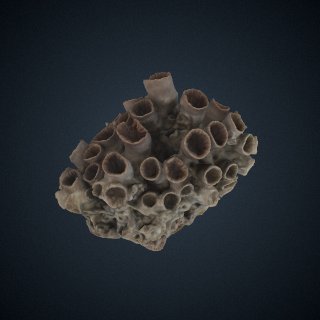
3D scan
- Source
- Smithsonian
- Licence
- CC0 — this site’s default, not the record’s
- Commercial use
- the licence allows it
- Specimen
- Astrangia rathbuni
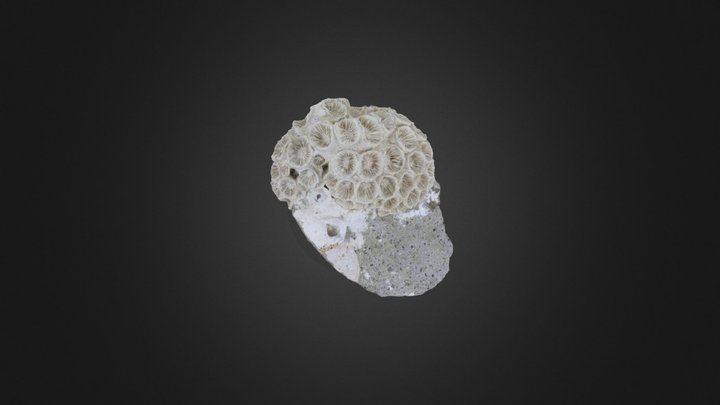
3D model
- Source
- Sketchfab
- Licence
- CC0 Public Domain
- Commercial use
- the licence allows it
The description on this site
- Source
- Wikipedia, “Astrangia”
- Licence
- CC BY-SA 4.0
This is what the site found, which is not the same as what exists.
Keep going
What may have been alongside itRhizangiidae through timeFormations of the MioceneThe world it lived on
Occurrence data from the Paleobiology Database, CC BY 4.0. Milne-Edwards and Haime 1848