Asteriacites
Asteriacites is a type of five-rayed trace fossil found in marine sedimentary rocks. It records the burrows of ophiuroid and asteroid sea stars on the sea floor. Asteriacites is found in European and American rocks, from the Ordovician period onwards, and is especially numerous in the Triassic and Jurassic systems.

Photograph taken by Mark A. Wilson (Department of Geology, The College of Wooster). [1] · Public Domain · via Wikipedia/Commons. May be a photograph of a specimen, or an artist’s reconstruction — an interpretation of a skeleton, since colour and soft tissue are almost never preserved.
On record
Recorded, not inferred- Sits inside
- AsteriacitidaePBDB
Time the record covers
At least 341 million years on record.
The record covers at least 382.31 Mya to 41.03 Mya. No occurrence read is dated outside 393.47 Mya to 37.71 Mya.
15 occurrences of Asteriacites on record, most of them in the Early Triassic. Bar height is expected occurrences, not a count: each fossil is spread across the span it is dated to, so a tall narrow bar means tight dating and a low wide one means loose.
When
15 occurrencesThese are dates about fossils, not the animal: the record can only begin after it arose and end before it died out, so either end may reach further. Shares are expected occurrences: a fossil dated to a span is counted partly in each period it straddles. More on what this infers.
Found in
6 formations
- Moenkopi Formation7
- Werfen Formation3
- Pimenteira Formation1
- Talara Formation1
- Calcaire Nankin Formation1
- Thaynes Formation1
Loading coastlines…
The named rock units Asteriacites has been recovered from, largest first. Drawn where the rock is now, not where it formed. 1 occurrence has no formation on record, which is common for older literature.
Asteriacites and its relatives
Early TriassicWhere Asteriacites and its relatives were recorded in the Early Triassic.
Found in the same rock
22 taxa- Arenicolites5 sites
- Planolites4 sites
- Lockeia2 sites
- Praeaplocoma2 sites
- Agerostrea ungulatus1 site
- Amotapus arbolensis1 site
- Amphidonte (Amphidonte) pyrenaicum1 site
- Argyrotheca1 site
- Asterodiscocyclina stewarti1 site
- Clementia (Egesta) peruviana1 site
- Cochlichnus1 site
- Dipsacaster jadeti1 site
- Discocyclina1 site
- Enchodus faujasi1 site
- Gastropoda1 site
- Gyrochorte1 site
- Harrisianella peruviana1 site
- Oxyperas deserta1 site
- Praeaplocoma hessi1 site
- Spisula (Spisula) caleta1 site
- Spisula (Spisula) hualtaca1 site
- Xancus peruvianus1 site
The Paleobiology Database records 15 sites for Asteriacites, and this reads all of them. The number is how many of those sites it was catalogued from too.
This is not a list of everything alive at the time. It is only what has come out of the same ground as this animal and been written down.
Entered from
5 references- Early Triassic Ophiuroids: their paleoecology, taphonomy and distribution11
- Dipsacaster jadeti sp. nov. Astropectinidae (Asteroidea, Echinodermata) du Maastrichtien des Petites Pyrénées (France)1
- The Malvinokaffric realm in the Devonian of Brazil1
- Zur Taphonomie, Ichnologie und Ökologie triadischer Ophiuroidea (Echinodermata)1
- Contributions to the Tertiary Paleontology of Northern Peru: Part 3, Eocene Mollusca1
Each of the 15 occurrences read was entered from one of these publications, ordered by how many each accounts for. This is not a search for papers mentioning the name. Entries link to doi.org where the Paleobiology Database holds an identifier, and to its own record where it does not. Relayed as the Paleobiology Database holds them, not checked against what they resolve to.
Media and terms
Media content2

Picture of Asteriacites
- Source
- Wikipedia/Commons
- Credit
- Photograph taken by Mark A. Wilson (Department of Geology, The College of Wooster). [1]
- Licence
- Public Domain
- Commercial use
- the licence allows it
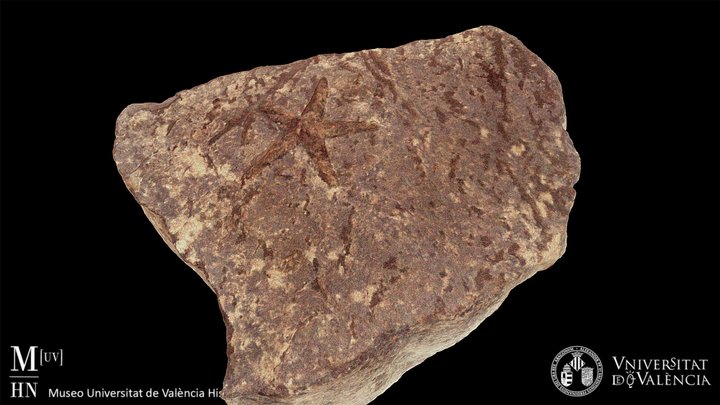
3D model
- Source
- Sketchfab
- Licence
- CC Attribution
- Commercial use
- cannot be read from the licence given — check the record
Smithsonian Open Access was not reached for this taxon, so this list is what the others held rather than everything there is.
The description on this site
- Licence
- CC BY-SA 4.0
This is what the site found, which is not the same as what exists.
Keep going
What may have been alongside itAsteriacitidae through timeFormations of the Early TriassicThe world it lived on
Occurrence data from the Paleobiology Database, CC BY 4.0. von Schlotheim 1820