Archisargoidea
Archisargoidea is an extinct superfamily of brachyceran flies known from the late Middle Jurassic (Callovian) to early Late Cretaceous (Turonian). Most flies in the superfamily have large eyes and an elongated abdomen, preserved females have a sharp, piercing oviscapt used for injecting eggs into host matter. Their relationships with other members of Brachycera is controversial, they are usually considered close relatives of either Stratiomyomorpha or Muscomorpha. Internal relationships between the families are uncertain and the topology of the only cladistic analysis of the family was weakly supported, finding that Archisargidae was paraphyletic with respect to Eremochaetidae and miniaturized Tethepomyiidae. The sharp piercing oviscaps possessed by the group had alternatively been suggested to represent evidence of being parasitoids, injecting their eggs into hosts similar to parasitic wasps, or to inject eggs into plant material like rotting wood or fruit, similar to members of Tephritoidea.

Qingqing Zhang, Junfeng Zhang · CC BY 4.0 · via Wikipedia/Commons. May be a photograph of a specimen, or an artist’s reconstruction — an interpretation of a skeleton, since colour and soft tissue are almost never preserved.
On record
Recorded, not inferred- Sits inside
- BrachyceraPBDB
- Motility
- actively mobilePBDB, for Arthropoda
- Environment
- terrestrialPBDB, for Insecta
Time the record covers
At least 60 million years on record.
The record covers at least 154.8 Mya to 93.9 Mya. No occurrence read is dated outside 165.3 Mya to 89.8 Mya.
111 occurrences of Archisargoidea on record, most of them in the Late Jurassic. Bar height is expected occurrences, not a count: each fossil is spread across the span it is dated to, so a tall narrow bar means tight dating and a low wide one means loose.
When
111 occurrencesThese are dates about fossils, not the animal: the record can only begin after it arose and end before it died out, so either end may reach further. Shares are expected occurrences: a fossil dated to a span is counted partly in each period it straddles. More on what this infers.
Found in
14 formations
- Daohugou Formation42
- Karabastau Formation26
- Yixian Formation · Jehol Group14
- Haifanggou Formation4
- Zaza Formation4
- Sharteg Formation3
Loading coastlines…
The named rock units Archisargoidea has been recovered from, largest first. Drawn where the rock is now, not where it formed. 7 occurrences have no formation on record, which is common for older literature.
Archisargoidea and its relatives
Late JurassicWhere Archisargoidea and its relatives were recorded in the Late Jurassic.
Found in the same rock
3,526 taxa- Aktassoblatta fusca7 sites
- Ampliceps furcitibia7 sites
- Ano ona7 sites
- Archirhyphus asiaticus7 sites
- Asioblatta punctata7 sites
- Asvab bavsa7 sites
- Blattula brevicaudata7 sites
- Blattula microscopica7 sites
- Decomposita triocella7 sites
- Falcatusiblatta casovec7 sites
- Liassothrips crassipes7 sites
- Memento mori7 sites
- Olzmasg zi7 sites
- Oxycorynoides (Oxycorynoides) similis7 sites
- Perlucipecta liangiae7 sites
- Procramptonomyia kovalevi7 sites
- Protoscelis jurassica7 sites
- Rhipidoblatta matriky7 sites
- Akinisia chorevei6 sites
- Blattula rectinervosa6 sites
- Falcatusiblatta storozhenkoi6 sites
- Kararhynchus occiduus6 sites
- Latiblatta lativalvata6 sites
- Liberiblattina liberiblattina6 sites
The Paleobiology Database records 38 sites for Archisargoidea, and this reads all of them. The number is how many of those sites it was catalogued from too. The 24 sharing the most are listed.
This is not a list of everything alive at the time. It is only what has come out of the same ground as this animal and been written down.
Entered from
36 references- To the knowledge of Archisargoidea (Diptera, Brachycera). Families Eremochaetidae and Archisargidae18
- Archisargoid flies (Diptera, Brachycera, Archisargidae and Kovalevisargidae) from the Jurassic Daohugou biota of China, and the related biostratigraphical correlation and geological age8
- On knowledge of fossil flies of the superfamily Archisargoidea (Diptera, Brachycera)8
- New Species of the Genus Mesosolva Hong, 1983 (Diptera, Archisargidae) from the Jurassic of Kazakhstan and Mongolia7
- New male eremochaetid flies (Diptera, Brachycera, Eremochaetidae) from the Lower Cretaceous of China6
- The oldest Calosargus Mostovski, 1997 from the Middle Jurassic of China (Diptera: Brachycera: Archisargidae)6
- An evolutional special case in the lower Orthorrhapha: some attractive fossil flies from the Middle Jurassic of China (Insecta: Diptera: Brachycera)5
- Late Jurassic Brachycera from northeastern China (Insecta: Diptera)5
- Quantitative assessments and taxonomic revision of the genus Archirhagio with a new species from Daohugou, China (Diptera: Archisargidae)4
- Distinct but rare archisargid flies from Jurassic of China (Diptera, Brachycera, Archisargidae) with discussion of the systematic position of Origoasilus pingquanensis Zhang et al, 20113
- Three distinct but rare kovalevisargid flies from the Jurassic Daohugou biota, China (Insecta, Diptera, Brachycera, Kovalevisargidae)3
- Records of bizarre Jurassic Brachycerans in the Daohugou biota, China (Diptera, Brachycera, Archisargidae and Rhagionemestriidae)3
Each of the 111 occurrences read was entered from one of these publications, ordered by how many each accounts for. This is not a search for papers mentioning the name. 24 further references are not listed. Entries link to doi.org where the Paleobiology Database holds an identifier, and to its own record where it does not. Relayed as the Paleobiology Database holds them, not checked against what they resolve to.
Media and terms
Media content1
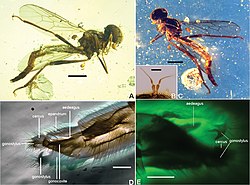
Picture of Archisargoidea
- Source
- Wikipedia/Commons
- Credit
- Qingqing Zhang, Junfeng Zhang
- Licence
- CC BY 4.0
- Commercial use
- the licence allows it
No 3D scan of Archisargoidea was found in Sketchfab.
Smithsonian Open Access and MorphoSource were not reached for this taxon, so this list is what the others held rather than everything there is.
The description on this site
- Licence
- CC BY-SA 4.0
This is what the site found, which is not the same as what exists.
Keep going
What may have been alongside itBrachycera through timeFormations of the Late JurassicThe world it lived on
Occurrence data from the Paleobiology Database, CC BY 4.0. Rohdendorf 1962