Aphaenogaster
Aphaenogaster is a genus of myrmicine ants in the tribe Stenammini. About 200 species have been described, including 18 fossil species. They occur worldwide except in South America south of Colombia, sub-Saharan Africa, and Antarctica.

Uncredited · CC BY 4.0 · via Wikipedia/Commons. May be a photograph of a specimen, or an artist’s reconstruction — an interpretation of a skeleton, since colour and soft tissue are almost never preserved.
On record
Recorded, not inferred- Sits inside
- StenamminiPBDB
- Motility
- actively mobilePBDB, for Arthropoda
- Environment
- terrestrialPBDB, for Insecta
Time the record covers
At least 41 million years on record.
The record covers at least 41.03 Mya to 11.7 ka. No occurrence read is dated outside 48.07 Mya to 0 Mya.
37 occurrences of Aphaenogaster on record, most of them in the Eocene. The Paleobiology Database records this as a living group. Bar height is expected occurrences, not a count: each fossil is spread across the span it is dated to, so a tall narrow bar means tight dating and a low wide one means loose.
When
37 occurrencesThese are dates about fossils, not the animal: the record can only begin after it arose and end before it died out, so either end may reach further. Shares are expected occurrences: a fossil dated to a span is counted partly in each period it straddles. More on what this infers.
Found in
4 formations
Loading coastlines…
The named rock units Aphaenogaster has been recovered from, largest first. Drawn where the rock is now, not where it formed. 24 occurrences have no formation on record, which is common for older literature.
Aphaenogaster and its relatives
EoceneWhere Aphaenogaster and its relatives were recorded in the Eocene.
Found in the same rock
3,123 taxa- Lasius schiefferdeckeri8 sites
- Liometopum miocenicum8 sites
- Miomyrmex impactus8 sites
- Prenolepis henschei8 sites
- Protazteca elongata8 sites
- Yantaromyrmex geinitzi8 sites
- Ctenobethylus goepperti7 sites
- Lasius peritulus7 sites
- Protazteca capitata7 sites
- Protazteca quadrata7 sites
- Dolichoderus antiquus6 sites
- Eotemnothorax gracilis6 sites
- Formica flori6 sites
- Formica robusta6 sites
- Gesomyrmex hoernesi6 sites
- Tetraponera simplex6 sites
- Eocamponotus mengei5 sites
- Iridomyrmex5 sites
- Liometopum scudderi5 sites
- Lype sericea5 sites
- Messor draxil5 sites
- Nylanderia pygmaea5 sites
- Plagiolepis klinsmanni5 sites
- Tetraponera ocellata5 sites
The Paleobiology Database records 30 sites for Aphaenogaster, and this reads all of them. The number is how many of those sites it was catalogued from too. The 24 sharing the most are listed.
This is not a list of everything alive at the time. It is only what has come out of the same ground as this animal and been written down.
Entered from
15 references- The Fossil Ants of North America10
- Ants of the genus Aphaenogaster (Hymenoptera: Formicidae) in Late Eocene European ambers7
- Die Ameisen des baltischen Bernsteins4
- The Ants of the Baltic Amber3
- Two new Aphaenogaster species (Hymenoptera, Formicidae) from Baltic amber2
- The Ant Genus Aphaenogoster in Dominican and Mexican Amber (Amber Collection Stuttgart: Hymenoptera, Formicidae. IX: Pheidolini)2
- First record of the male of the genus Aphaenogaster Mayr, 1853 (Hymenoptera, Formicidae) from late Eocene ambers1
- The mid-Miocene Zhangpu biota reveals an outstandingly rich rainforest biome in East Asia1
- New fossil ants of the subfamily Myrmicinae (Hymenoptera, Formicidae) from the Upper Oligocene of Enspel (Westerwald Mountains, Rhineland Palatinate, Germany)1
- The ant Aphaenogaster dlusskyana sp. nov. (Hymenoptera, Formicidae) from the Sakhalin amber - the earliest described species of an extant genus of Myrmicinae1
- Insects from the upper Miocene Grubstake Formation of Alaska1
- Murav'i (Hymenoptera, Formicidae) Rovenskogo yantarya1
Each of the 37 occurrences read was entered from one of these publications, ordered by how many each accounts for. This is not a search for papers mentioning the name. 3 further references are not listed. Entries link to doi.org where the Paleobiology Database holds an identifier, and to its own record where it does not. Relayed as the Paleobiology Database holds them, not checked against what they resolve to.
Media and terms
Media content2

Picture of Aphaenogaster
- Source
- Wikipedia/Commons
- Credit
- nobody named on the record
- Licence
- CC BY 4.0
- Commercial use
- the licence allows it
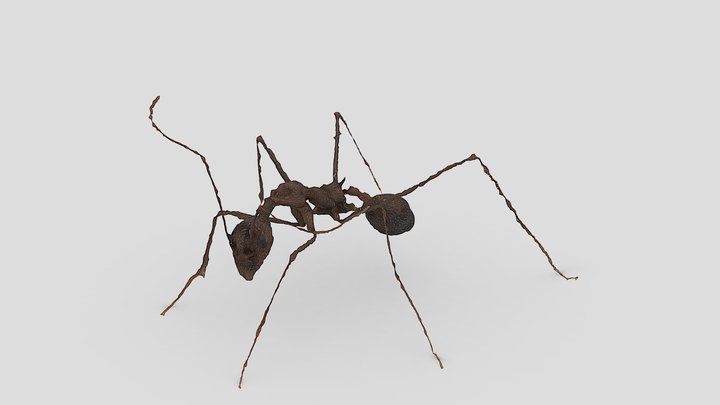
3D model
- Source
- Sketchfab
- Credit
- EvoBiomech
- Licence
- CC Attribution
- Commercial use
- cannot be read from the licence given — check the record
Smithsonian Open Access and MorphoSource were not reached for this taxon, so this list is what the others held rather than everything there is.
The description on this site
- Licence
- CC BY-SA 4.0
This is what the site found, which is not the same as what exists.
Keep going
What may have been alongside itStenammini through timeFormations of the EoceneThe world it lived on
Occurrence data from the Paleobiology Database, CC BY 4.0. Mayr 1853