Antrimpos
Antrimpos is an extinct genus of crustacean which existed during the Triassic and Jurassic periods. It contains 15 species, including Antrimpos speciosus.

LadyofHats · Public Domain · via Wikipedia/Commons. May be a photograph of a specimen, or an artist’s reconstruction — an interpretation of a skeleton, since colour and soft tissue are almost never preserved.
On record
Recorded, not inferred- Sits inside
- PenaeidaePBDB
- Diet
- carnivorePBDB, for Penaeidae
- Life habit
- semi-infaunalPBDB, for Penaeidae
- Motility
- actively mobilePBDB, for Penaeoidea
- Vision
- well-developedPBDB, for Malacostraca
Time the record covers
At least 95 million years on record.
The record covers at least 245.19 Mya to 149.2 Mya. No occurrence read is dated outside 247 Mya to 145.06 Mya.
21 occurrences of Antrimpos on record, most of them in the Middle Triassic. Bar height is expected occurrences, not a count: each fossil is spread across the span it is dated to, so a tall narrow bar means tight dating and a low wide one means loose.
When
21 occurrencesThese are dates about fossils, not the animal: the record can only begin after it arose and end before it died out, so either end may reach further. Shares are expected occurrences: a fossil dated to a span is counted partly in each period it straddles. More on what this infers.
Found in
8 formations
- Grès à Voltzia Formation6
- Dolomia di Forni Formation4
- Liegende Bankkalk Formation3
- Solnhofen Formation2
- Sundance Formation1
- Grès à Meules Formation1
Loading coastlines…
The named rock units Antrimpos has been recovered from, largest first. Drawn where the rock is now, not where it formed. 2 occurrences have no formation on record, which is common for older literature.
Antrimpos and its relatives
Middle TriassicWhere Antrimpos and its relatives were recorded in the Middle Triassic.
Found in the same rock
166 taxa- Euestheria minuta6 sites
- Lingularia tenuissima6 sites
- Eoscorpiidae5 sites
- Palaeoxyris regularis5 sites
- Chondrostei4 sites
- Euthycarcinus kessleri4 sites
- Halicyne ornata4 sites
- Homomya impressa4 sites
- Myophoria vulgaris4 sites
- Acanthochirana norica3 sites
- Clytiopsis argentoratense3 sites
- Dusa longipes3 sites
- Isaura3 sites
- Limulitella bronnii3 sites
- Palaeolimnadia alsatica3 sites
- Pericentrophorus minimus3 sites
- Progonionemus vogesiacus3 sites
- Schimperella beneckei3 sites
- Acanthochirana cordata2 sites
- Acanthochirana triassica2 sites
- Aeger spinipes2 sites
- Aeger tipularius2 sites
- Araneida2 sites
- Archaeopalinurus levis2 sites
The Paleobiology Database records 18 sites for Antrimpos, and this reads all of them. The number is how many of those sites it was catalogued from too. The 24 sharing the most are listed.
This is not a list of everything alive at the time. It is only what has come out of the same ground as this animal and been written down.
Entered from
9 references- Faunes et paysages du Grès à Voltzia du Nord des Vosges: Essai paléoécologique sur le Buntsandstein supérieur7
- Acanthochirana triassica n. sp. and Antrimpos colettoi n. sp. (Decapoda: Aegeridae, Penaeidae) from the Upper Triassic (Norian) of northern Carnic Pre-Alps (Udine, northeastern Italy)4
- Im Reich der Meerengel. Der Nusplinger Plattenkalk und seine Fossilien3
- On unreported historical specimens of marine arthropods from the Solnhofen and Nusplingen Lithographic Limestones (Late Jurassic, Germany) housed at the Muséum national d’Histoire naturelle, Paris2
- Zwei neue natante Dekapoden aus dem Oberen Muschelkalk (Mittel-Trias, Ladin) des Germanischen Beckens - Antrimpos germanicus n. sp. und Parapalaemonetes thuringiacus n. gen. n. sp.1
- Remarkable Invertebrates from the Lower Callovian of La Voulte-sur-Rhône (Ardèche, France)1
- A new penaeid shrimp (Antrimpos mirigiolensis n. sp., Crustacea, Decapoda) from the Middle Triassic of the Monte San Giorgio (Ticino, Switzerland)1
- Malacostracan crustacean fauna from the Sundance Formation (Jurassic) of Wyoming1
- Contribution a l'étude des crustacés décapodes de la période Jurassique1
Each of the 21 occurrences read was entered from one of these publications, ordered by how many each accounts for. This is not a search for papers mentioning the name. Entries link to doi.org where the Paleobiology Database holds an identifier, and to its own record where it does not. Relayed as the Paleobiology Database holds them, not checked against what they resolve to.
Media and terms
Media content2

Picture of Antrimpos
- Source
- Wikipedia/Commons
- Credit
- LadyofHats
- Licence
- Public Domain
- Commercial use
- the licence allows it
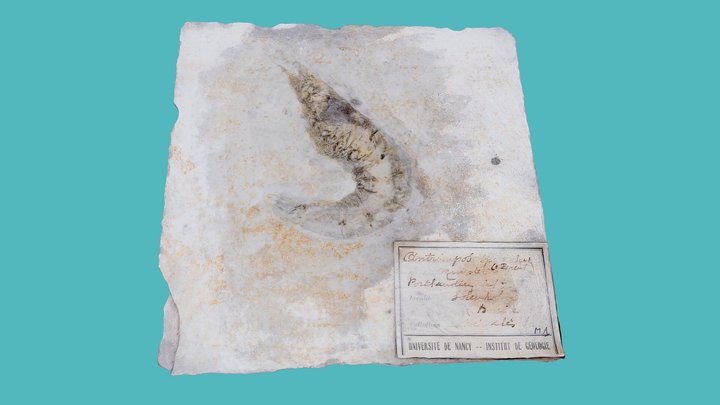
3D model
- Source
- Sketchfab
- Licence
- CC Attribution-NonCommercial-ShareAlike
- Commercial use
- the licence does not allow it
Smithsonian Open Access and MorphoSource were not reached for this taxon, so this list is what the others held rather than everything there is.
The description on this site
- Source
- Wikipedia, “Antrimpos”
- Licence
- CC BY-SA 4.0
This is what the site found, which is not the same as what exists.
Keep going
What may have been alongside itPenaeidae through timeFormations of the Middle TriassicThe world it lived on
Occurrence data from the Paleobiology Database, CC BY 4.0. Munster 1839