Anagalidae
Anagalidae is an extinct family of mammals closely related to rodents and lagomorphs. Members of the family are known from Paleocene to Oligocene deposits in China and Mongolia.

Uncredited · via Wikipedia/Commons. May be a photograph of a specimen, or an artist’s reconstruction — an interpretation of a skeleton, since colour and soft tissue are almost never preserved.
On record
Recorded, not inferred- Sits inside
- AnagalidaPBDB
- Diet
- insectivorePBDB, for Theria
- Life habit
- scansorialPBDB, for Eutheria
- Motility
- actively mobilePBDB, for Osteichthyes
- Environment
- terrestrialPBDB, for Eutheria
Time the record covers
At least 27 million years on record.
The record covers at least 61.66 Mya to 33.9 Mya. No occurrence read is dated outside 66 Mya to 27.3 Mya.
37 occurrences of Anagalidae on record, most of them in the Paleocene. Bar height is expected occurrences, not a count: each fossil is spread across the span it is dated to, so a tall narrow bar means tight dating and a low wide one means loose.
When
37 occurrencesThese are dates about fossils, not the animal: the record can only begin after it arose and end before it died out, so either end may reach further. Shares are expected occurrences: a fossil dated to a span is counted partly in each period it straddles. More on what this infers.
Found in
16 formations
- Wanghudun Formation11
- Nomogen Formation3
- Shanghu Formation3
- Nongshan Formation3
- Doumu Formation3
- Chijiang Formation2
Loading coastlines…
The named rock units Anagalidae has been recovered from, largest first. Drawn where the rock is now, not where it formed. 1 occurrence has no formation on record, which is common for older literature.
Anagalidae and its relatives
PaleoceneWhere Anagalidae and its relatives were recorded in the Paleocene.
Found in the same rock
207 taxa- Palaeostylops iturus5 sites
- Anictops tabiepedis4 sites
- Hyracolestes ermineus4 sites
- Prodinoceras4 sites
- Pseudictops lophiodon4 sites
- Archaeolambda3 sites
- Bemalambda3 sites
- Bothriostylops progressus3 sites
- Hsiuannania maguensis3 sites
- Pachyaena3 sites
- Pseudictops3 sites
- Anhuichelys doumuensis2 sites
- Anhuichelys tsienshanensis2 sites
- Archaeolambdidae2 sites
- Bemalambda crassa2 sites
- Bemalambda nanhsiungensis2 sites
- Bemalambda pachyoesteus2 sites
- Dissacus magushanensis2 sites
- Dissacus serratus2 sites
- Dissacus shanghoensis2 sites
- Dysnoetodon minuta2 sites
- Eomylus bayanulanensis2 sites
- Haplolambda planicanina2 sites
- Harpyodus progressus2 sites
The Paleobiology Database records 30 sites for Anagalidae, and this reads all of them. The number is how many of those sites it was catalogued from too. The 24 sharing the most are listed.
This is not a list of everything alive at the time. It is only what has come out of the same ground as this animal and been written down.
Entered from
22 references- The Paleogene mammals of China6
- New Materials of Anagalidae from the Palaeocene of Anhui (A)6
- New Materials of Anagalidae from the Palaeocene of Anhui (B)5
- Two new genera of Anagalidae (Anagalida, Mammalia) from the Paleocene of Qianshan, Anhui and the phylogeny of anagalids2
- A new Eocene anagalid (Mammalia: Euarchontoglires) from Mongolia and its implications for the group’s phylogeny and dispersal1
- Small mammal fauna from Wulanhuxiu (Nei Mongol, China) implies the Irdinmanhan–Sharamurunian (Eocene) faunal turnover1
- The Gashatan (late Paleocene) mammal fauna from Subeng, Inner Mongolia1
- A new anagalid (Anagalida, Mammalia) from the Paleocene of Nanxiong basin, Guangdong province1
- Glires (Mammalia) from the Late Paleocene Bayan Ulan Locality of Inner Mongolia1
- Mammalian remains from the late Paleocene of Jiashan, Anhui1
- Early Tertiary mammals of Xuancheng Basin, Anhui Province and its implication for the age of Shuangtasi Formation1
- Palaeocene and Eocene Mixodontia (Mammalia, Glires) of Mongolia and China1
Each of the 37 occurrences read was entered from one of these publications, ordered by how many each accounts for. This is not a search for papers mentioning the name. 10 further references are not listed. Entries link to doi.org where the Paleobiology Database holds an identifier, and to its own record where it does not. Relayed as the Paleobiology Database holds them, not checked against what they resolve to.
Media and terms
Media content1
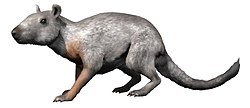
Picture of Anagalidae
- Source
- Wikipedia/Commons
- Credit
- nobody named on the record
- Licence
- not stated by the source
- Commercial use
- cannot be read from the licence given — check the record
No 3D scan was found. Smithsonian Open Access, MorphoSource and Sketchfab were all searched.
The description on this site
- Source
- Wikipedia, “Anagalidae”
- Licence
- CC BY-SA 4.0
This is what the site found, which is not the same as what exists.
Keep going
What may have been alongside itAnagalida through timeFormations of the PaleoceneThe world it lived on
Occurrence data from the Paleobiology Database, CC BY 4.0. Simpson 1931