Adeonellopsis
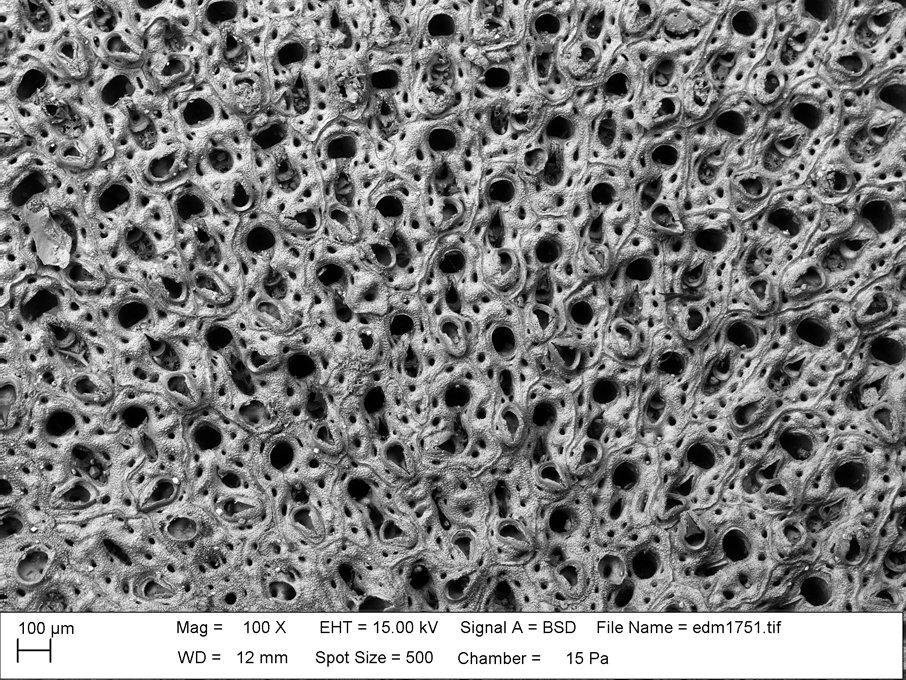
via iDigBio · CC BY · via iDigBio. May be a photograph of a specimen, or an artist’s reconstruction — an interpretation of a skeleton, since colour and soft tissue are almost never preserved.
On record
Recorded, not inferred- Sits inside
- AdeonidaePBDB
- Diet
- suspension feederPBDB, for Cheilostomata
- Life habit
- epifaunalPBDB, for Cheilostomata
- Motility
- stationary, attachedPBDB, for Cheilostomata
- Vision
- blindPBDB, for Gymnolaemata
- Environment
- marinePBDB, for Lophophorata
Time the record covers
At least 46 million years on record.
The record covers at least 48.07 Mya to 1.8 Mya. No occurrence read is dated outside 66 Mya to 0 Mya.
69 occurrences of Adeonellopsis on record, most of them in the Miocene. The Paleobiology Database records this as a living group. Bar height is expected occurrences, not a count: each fossil is spread across the span it is dated to, so a tall narrow bar means tight dating and a low wide one means loose.
When
69 occurrencesThese are dates about fossils, not the animal: the record can only begin after it arose and end before it died out, so either end may reach further. Shares are expected occurrences: a fossil dated to a span is counted partly in each period it straddles. More on what this infers.
Found in
14 formations
- Myaring Beds Formation · Glenelg Group6
- Red Bluff Formation5
- Dry Creek Sands Formation5
- Moodys Branch Formation · Jackson Group4
- Wataepoolan limestone Formation · Glenelg Group3
- Glenaulin clay Formation · Glenelg Group3
Loading coastlines…
The named rock units Adeonellopsis has been recovered from, largest first. Drawn where the rock is now, not where it formed. 32 occurrences have no formation on record, which is common for older literature.
Adeonellopsis and its relatives
MioceneWhere Adeonellopsis and its relatives were recorded in the Miocene.
Found in the same rock
875 taxa- Cellaria contigua15 sites
- Porina gracilis14 sites
- Smittina13 sites
- Smittinella tatei12 sites
- Cellaria australis11 sites
- Escharella11 sites
- Margaretta11 sites
- Mecynoecia10 sites
- Oncousoecia10 sites
- Reteporella10 sites
- Metrarabdotos9 sites
- Antropora8 sites
- Enoplostomella8 sites
- Filisparsa8 sites
- Hornera8 sites
- Melicerita angustiloba8 sites
- Ogiva concamerata8 sites
- Selenaria cupola8 sites
- Arachnopusia liversidgei7 sites
- Caleschara denticulata7 sites
- Cellaria bicornis7 sites
- Cellaria rigida7 sites
- Crisia7 sites
- Cucullipora tetrasticha7 sites
The Paleobiology Database records 47 sites for Adeonellopsis, and this reads all of them. The number is how many of those sites it was catalogued from too. The 24 sharing the most are listed.
This is not a list of everything alive at the time. It is only what has come out of the same ground as this animal and been written down.
Entered from
18 references- Fossil cheilostomatous polyzoa from south-west Victoria28
- North American early Tertiary Bryozoa13
- Some Pliocene Polyzoa from South Australia5
- Miocene Bryozoa from East Kalimantan, Indonesia. Part II: ‘Ascophoran’ Cheilostomata.3
- A bryozoan and foraminifera association from the Miocene of Podbrezice, south Moravia (Czech Republic): an environmental history3
- Late Eocene Zoogeography of the Eastern Gulf Coast Region3
- South Australian Cainozoic Bryozoa. Part 13
- Bryozoa of the Early Eocene Tumaio Limestone, Chatham Island, New Zealand1
- New Middle Miocene Bryozoa from Gârbova de Sus (Romania) and their relationship to the sedimentary environment1
- Les bryozoaires cheilostomes du Néogène bétique (SE Espagne)1
- A paleobiotic survey of Caribbean faunas from the Neogene of the Isthmus of Panama1
- The Molluscan Macrofauna of the Reklaw Formation, Marquez Member (Eocene: Lower Claibornian), in Texas1
Each of the 69 occurrences read was entered from one of these publications, ordered by how many each accounts for. This is not a search for papers mentioning the name. 6 further references are not listed. Entries link to doi.org where the Paleobiology Database holds an identifier, and to its own record where it does not. Relayed as the Paleobiology Database holds them, not checked against what they resolve to.
Media and terms
Media content1
Picture of Adeonellopsis
- Source
- iDigBio
- Credit
- via iDigBio
- Licence
- CC BY
- Commercial use
- the licence allows it
No 3D scan was found. Smithsonian Open Access, MorphoSource and Sketchfab were all searched.
This is what the site found, which is not the same as what exists.
Keep going
What may have been alongside itAdeonidae through timeFormations of the MioceneThe world it lived on
Occurrence data from the Paleobiology Database, CC BY 4.0. MacGillivray 1886